CNN was highly criticized on Monday for interviewing Richard Spencer, an avowed white supremacist who took part in the fatal "Unite the Right" rally in Charlottesville, Virginia.
"CNN interviewed white supremacist Richard Spencer during a Tuesday segment on President Donald Trump’s racist tweets, in another example of a news outlet inadvertently giving a large platform to white supremacists," The Daily Beastreported.
The appearance occurred the day after a federal magistrate judge ordered Andrew Anglin to pay $14 million for unleashing a "troll storm" on a small town in Montana that rejected Spencer's white nationalism.
"The segment on Jake Tapper’s The Lead covered neo-Nazis’ support for Trump’s racist attacks on four progressive congresswomen of color. The spot included an interview with Spencer who said Trump is playing a 'con game' and that his attacks were not racist enough," The Beast reported.
"Spencer is an open white nationalist who advocates for “peaceful ethnic cleansing.” Spencer was a key player and featured speaker at Unite the Right, the 2017 white supremacist rally in Charlottesville, Virginia, where a neo-Nazi murdered an anti-racist protester," The Beast reminded. "He has repeatedly invoked Nazi slogans and imagery, including calling media the “lügenpresse” ("lying press") and leading a Hitler-type salute of Trump."
All across the country the nation's local newspapers are blasting President Donald Trump's latest round of "anti-American" racism. In Bangor, Maine and Los Angeles, California, in Syracuse, New York, Charlotte, North Carolina, and in Minneapolis, Minnesota, editorial boards are denouncing what is now day three of the President's blatant racism, nativism, white nationalism, and white supremacist attacks against four duly-elected Democratic progressive U.S. Congresswomen.
" Trump taps the tool kit of racism once again," decries the Editorial Board of the Minneapolis Star-Tribune. "The 'go back where you came from' message is especially ignorant, hurtful."
They classified the President's remarks as "an unapologetically racist, xenophobic spew," and said that just like "a true bully, he then demanded an apology from those whom he attacked."
Calling his attacks "nakedly racist," and "vile and incendiary," the Editorial Board at Syracuse.com asked simply, "When will GOP stand up to Trump’s racism?"
"By now, we all understand that our president is a bigot. He no longer tries to hide it much, and neither do many of those who champion his cause," they write. "White nationalist messages are broadcast from the White House. Racist memes bleed onto the pages of national websites. White supremacist laments get shouted from cable news, where people like Laura Ingraham wonder how 'massive demographic changes have been foisted upon the American people…changes that none of us ever voted for, and most of us don’t like.'"
“Go back where you came from” is among the worst of racist tropes. It divides us by ethnicity and skin color. It says that even if someone is a citizen or legal immigrant, they are not part of the rest of us.
Calling Trump's remarks "xenophobic," the California paper accused the President of "fanning the flames of disunity, chaos, prejudice and polarization," saying his words are "all cleverly hidden behind a veneer of rote and thuggish patriotism. He is playing to the lowest, most degraded emotions of his supporters while reveling in the fury of his opponents. This is the definition of demagoguery."
CBS Evening News host Norah O'Donnell on Monday began referring to President Donald Trump's tweets as "racist" after four progressive Democratic women lashed out at the president in a press conference.
While speaking to reporters on Monday, Democratic congresswomen Ilhan Omar (MN), Alexandria Ocasio-Cortez (NY), Ayanna Pressley (MA) and Rashida Tlaib (MI) fired back at the president because he suggested that they should "go back" to their country of origin.
Following the press conference, O'Donnell's report on the CBS Evening News referred to the tweets as "racist."
A TV Eyes search of CBS did not find the word "racist" in the previous night's report on the president's tweets.
Trump over the weekend caused an uproar in the media by tweeting the following:
Trump’s defenders are zeroing in on the one clause where the president suggests the “‘Progressive’ Democrat Congresswomen” can “come back and show us how it is done,” and ignoring the other 85 percent of Trump’s tweet — particularly where he says the congresswomen are “telling the people of the United States … how our government is to be run” (emphasis added), which seems particularly vile.
Writing for the Times, Baker summed up those defenders thusly (emphasis also added):
Republican lawmakers, by and large, did not rush to the president’s side on Sunday either, but neither did they jump forward to denounce him. Deeply uncomfortable as many Republicans are with Mr. Trump’s racially infused politics, they worry about offending the base voters who cheer on the president as a truth-teller taking on the tyranny of political correctness.
Ah yes, “racially infused politics,” now with a dash of nativism. Here’s what Twitter had to say:
During a panel discussion on MSNBC's "AM Joy," Donald Trump biographer Tim O'Brien attempted to explain where exactly accused child trafficker Jeffrey Epstein came by his wealth since he has left little financial trails for investigators.
Speaking with host Joy Reid, O'Brien smirked and made air quotes when describing Epstein "providing financial services " to his clients.
"Of course it's suspicious," O'Brien suggested. "And I suspect at the end of the day the way Jeffrey Epstein stayed in business year after year was providing a variety of financial services to clients."
"Now some of that could have been to mask park trades, some of it possibly could have been classic money laundering, some of it could have been involved with perhaps bribes related to the other things he was doing," he explained. "And I think, you know, some of this is so speculative still, but there is a possibility that he blackmailed other men who visited his homes and had sexual relationships with either girls or women by consent, but he had cameras in all of his houses."
"There's a real possibility as the story unwinds that one of the reasons he was protected over the years was because he had blackmail on them and were there payments associated with that," he added. "The federal filing that came in yesterday said he was making about $10 million a year and he had assets worth about $500 million."
Political journalists will be paying very close attention when former special counsel Robert Mueller publicly testifies before two Democrat-led committees in the House of Representatives on Wednesday, July 17. But veteran journalist/author Carl Bernstein, now 75, believes that many of his colleagues in the media could be doing a better job covering Mueller’s final report for the Russiainvestigation, and he voiced his complaints during a July 7 appearance on CNN’s “Reliable Sources.”
The media, Bernstein complained, need to spend more time analyzing the contents of Mueller’s report and less time discussing the conflicts between Republican and Democrats in Congress over it.
“I think we’ve made a big mistake in the press about how we’ve covered the Mueller report,” Bernstein told CNN’s Brian Stelter. “We’ve gotten totally wrapped up in the warfare in the Congress between Republicans and Democrats, and is there obstruction of justice or is there not obstruction of justice.”
Bernstein added, “In fact, there are dozens and dozens of leads in there about (President Donald) Trump’s business dealings, things having to do with women as well that we know about from elsewhere — and trying to keep women silent.”
Mueller’s report, Bernstein continues, offers important information “about (Trump’s) business dealings, about oligarchs, about money laundering, about Ponzi schemes.”
Bernstein stressed, “Our job in the press is to look at these candidates, and that includes Donald Trump’s 30-, 35-year public record in life — in business life, and it is a record of astonishing, disarming conduct as a so-called businessman when in fact, there is a tremendous amount of illegitimate business activity that’s been demonstrated. We need to be looking at every aspect of it.”
The veteran journalist/author went on to say, “We’re in a cold civil war in this country.” Polls, Bernstein asserted, are a “reflection of” that “cold civil war” and “how appealing (Trump’s) message has been to almost half the people in this country. And we’re not making, in the press, the connections between what’s going on in the country and Donald Trump the president.”
Bernstein is no stranger to reporting on political conflicts in the United States: back in the early 1970s, Bernstein and fellow investigative journalist/author Bob Woodward famously teamed up to cover the Watergate scandal and President Richard Nixon’s final months in office. In June 1974, only two months before Nixon’s resignation, Bernstein and Woodward’s bestselling book, “All the President’s Men” was released — and that book became the basis for a Hollywood film adaptation released in 1976. Robert Redford played Woodward, while Dustin Hoffman played Bernstein.
In the Trump era, Woodward and Bernstein have often appeared on cable news to discuss Mueller’s Russia investigation.
Trump, Bernstein told Stelter, realizes that the U.S. is in a “cold civil war” and has taken advantage of the country’s bitter divisions.
“This cold civil war pre-dates Donald Trump,” Bernstein asserted. “And Donald Trump understood that we’re in a cold civil war in this country, and he has exploited it and brought this cold civil war almost to the point of ignition through his actions and his words — which are unprecedented in terms of presidential conduct. No president in the history of the United States in 247 years has expressed the kinds of ideas and thoughts and undemocratic notions and authoritarian notions that he has. We need to start connecting these dots.”
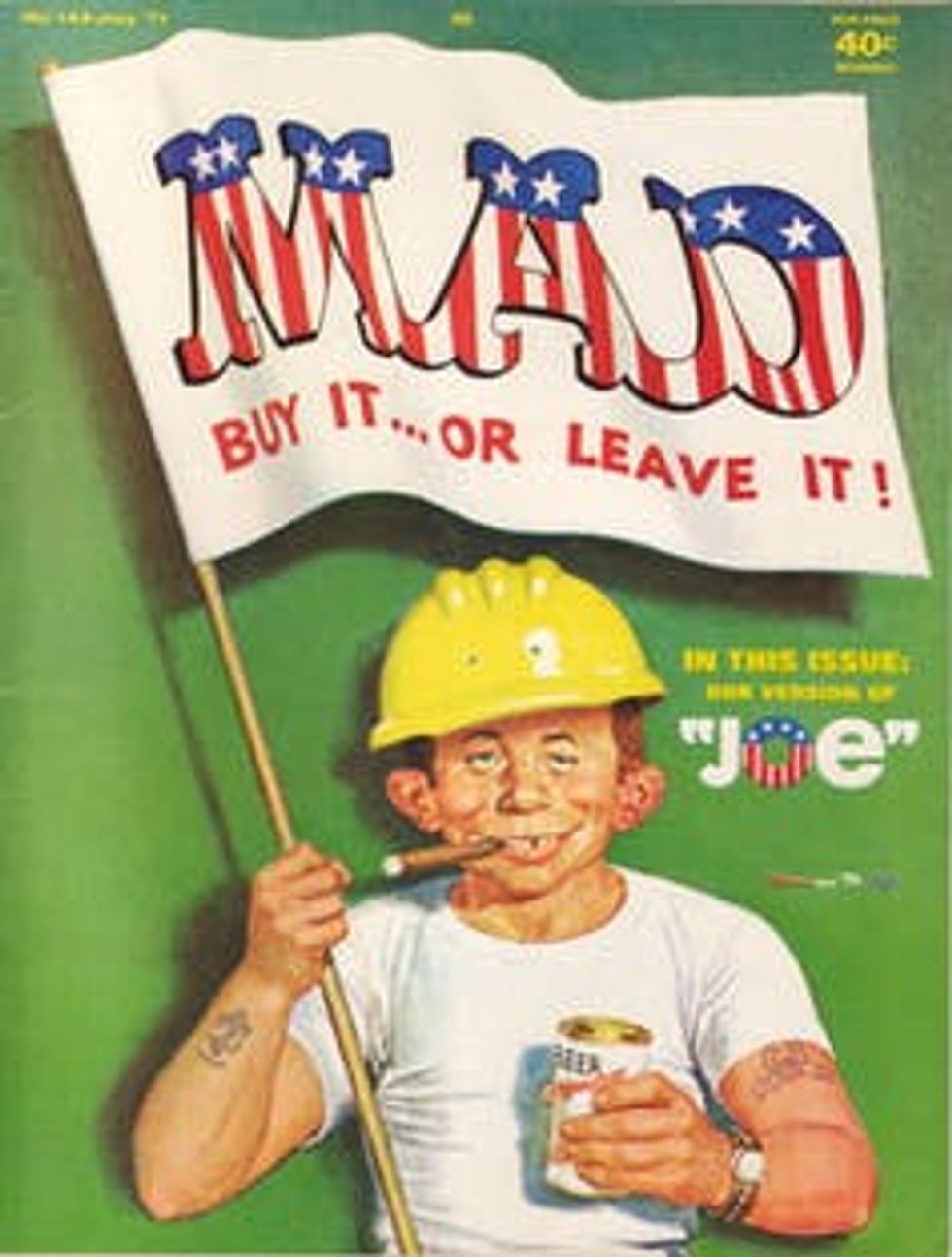
Mad Magazine is on life support. In April 2018, it launched a reboot, jokingly calling it its “first issue.” Now the magazine announced it will stop publishing new content, aside from year-end special issues.
But in terms of cultural resonance and mass popularity, its clout has been fading for years.
At its apex in the early 1970s, Mad’s circulation surpassed 2 million. As of 2017, it was 140,000.
As strange as it sounds, I believe the “usual gang of idiots” that produced Mad was performing a vital public service, teaching American adolescents that they shouldn’t believe everything they read in their textbooks or saw on TV.
Mad preached subversion and unadulterated truth-telling when so-called objective journalism remained deferential to authority. While newscasters regularly parroted questionable government claims, Mad was calling politicians liars when they lied. Long before responsible organs of public opinion like The New York Times and the CBS Evening News discovered it, Mad told its readers all about the credibility gap. The periodical’s skeptical approach to advertisers and authority figures helped raise a less credulous and more critical generation in the 1960s and 1970s.
Today’s media environment differs considerably from the era in which Mad flourished. But it could be argued that consumers are dealing with many of the same issues, from devious advertising to mendacious propaganda.
While Mad’s satiric legacy endures, the question of whether its educational ethos – its implicit media literacy efforts – remains part of our youth culture is less clear.
A merry-go-round of media panics
In my research on media, broadcasting and advertising history, I’ve noted the cyclical nature of media panics and media reform movements throughout American history.
The pattern goes something like this: A new medium gains popularity. Chagrined politicians and outraged citizens demand new restraints, claiming that opportunists are too easily able to exploit its persuasive power and dupe consumers, rendering their critical faculties useless. But the outrage is overblown. Eventually, audience members become more savvy and educated, rendering such criticism quaint and anachronistic.
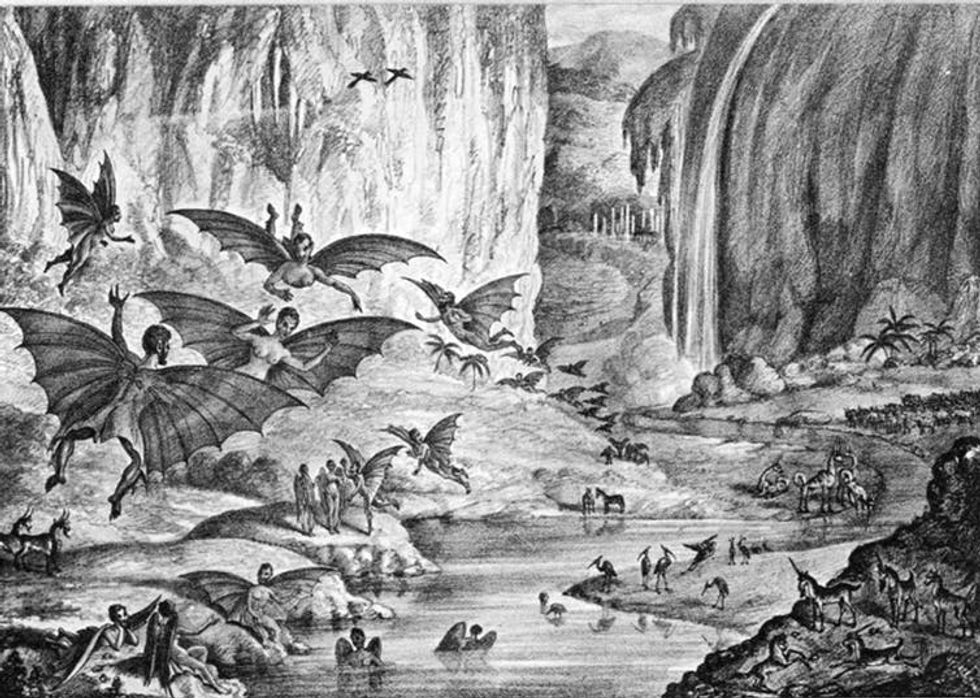
During the penny press era of the 1830s, periodicals often fabricated sensational stories like the “Great Moon Hoax” to sell more copies. For a while, it worked, until accurate reporting became more valuable to readers.
During the ‘Great Moon Hoax,’ the New York Sun claimed to have discovered a colony of creatures on the moon.
When radios became more prevalent in the 1930s, Orson Welles perpetrated a similar extraterrestrial hoax with his infamous “War of the Worlds” program. This broadcast didn’t actually cause widespread fear of an alien invasion among listeners, as some have claimed. But it did spark a national conversation about radio’s power and audience gullibility.
Aside from the penny newspapers and radio, we’ve witnessed moral panics about dime novels, muckraking magazines, telephones, comic books, television, the VCR, and now the internet. Just as Congress went after Orson Welles, we see Mark Zuckerberg testifying about Facebook’s facilitation of Russian bots.
Holding up a mirror to our gullibility
But there’s another theme in the country’s media history that’s often overlooked. In response to each new medium’s persuasive power, a healthy popular response ridiculing the rubes falling for the spectacle has arisen.
For example, in “The Adventures of Huckleberry Finn,” Mark Twain gave us the duke and the dauphin, two con artists traveling from town to town exploiting ignorance with ridiculous theatrical performances and fabricated tall tales.
They were proto-purveyors of fake news, and Twain, the former journalist, knew all about selling buncombe. His classic short story “Journalism in Tennessee” excoriates crackpot editors and the ridiculous fiction often published as fact in American newspapers.
Then there’s the great P.T. Barnum, who ripped people off in marvelously inventive ways.
“This way to the egress,” read a series of signs inside his famous museum. Ignorant customers, assuming the egress was some sort of exotic animal, soon found themselves passing through the exit door and locked out.
They might have felt ripped off, but, in fact, Barnum had done them a great – and intended – service. His museum made its customers more wary of hyperbole. It employed humor and irony to teach skepticism. Like Twain, Barnum held up a funhouse mirror to America’s emerging mass culture in order to make people reflect on the excesses of commercial communication.
‘Think for yourself. Question authority’
Mad Magazine embodies this same spirit. Begun originally as a horror comic, the periodical evolved into a satirical humor outlet that skewered Madison Avenue, hypocritical politicians and mindless consumption.
Teaching its adolescent readers that governments lie – and only suckers fall for hucksters – Mad implicitly and explicitly subverted the sunny optimism of the Eisenhower and Kennedy years. Its writers and artists poked fun at everyone and everything that claimed a monopoly on truth and virtue.
“The editorial mission statement has always been the same: ‘Everyone is lying to you, including magazines. Think for yourself. Question authority,’” according to longtime editor John Ficarra.
That was a subversive message, especially in an era when the profusion of advertising and Cold War propaganda infected everything in American culture. At a time when American television only relayed three networks and consolidation limited alternative media options, Mad’s message stood out.
Just as intellectuals Daniel Boorstin, Marshall McLuhan and Guy Debord were starting to level critiques against this media environment, Mad was doing the same – but in a way that was widely accessible, proudly idiotic and surprisingly sophisticated.
For example, the implicit existentialism hidden beneath the chaos in every “Spy v. Spy” panel spoke directly to the insanity of Cold War brinksmanship. Conceived and drawn by Cuban exile Antonio Prohías, “Spy v. Spy” featured two spies who, like the United States and the Soviet Union, both observed the doctrine of Mutually Assured Destruction. Each spy was pledged to no one ideology, but rather the complete obliteration of the other – and every plan ultimately backfired in their arms race to nowhere.
Mad skewered those who mindlessly supported the people who controlled the levers of power.
The cartoon highlighted the irrationality of mindless hatred and senseless violence. In an essay on the plight of the Vietnam War soldier, literary critic Paul Fussell once wrote that U.S. soldiers were “condemned to sadistic lunacy” by the monotony of violence without end. So too the “Spy v. Spy” guys.
As the credibility gap widened from the Johnson to Nixon administrations, the logic of Mad‘s Cold War critique became more relevant. Circulation soared. Sociologist Todd Gitlin – who had been a leader of the Students for a Democratic Society in the 1960s – credited Mad with serving an important educational function for his generation.
“In junior high and high school,” he wrote, “I devoured it.”
A step backward?
And yet that healthy skepticism seems to have evaporated in the ensuing decades. Both the run-up to the Iraq War and the acquiescence to the carnival-like coverage of our first reality TV star president seem to be evidence of a widespread failure of media literacy.
We’re still grappling with how to deal with the internet and the way it facilitates information overload, filter bubbles, propaganda and, yes, fake news.
But history has shown that while we can be stupid and credulous, we can also learn to identify irony, recognize hypocrisy and laugh at ourselves. And we’ll learn far more about employing our critical faculties when we’re disarmed by humor than when we’re lectured at by pedants. A direct thread skewering the gullibility of media consumers can be traced from Barnum to Twain to Mad to “South Park” to The Onion.
While Mad’s legacy lives on, today’s media environment is more polarized and diffuse. It also tends to be far more cynical and nihilistic. Mad humorously taught kids that adults hid truths from them, not that in a world of fake news, the very notion of truth was meaningless. Paradox informed the Mad ethos; at its best, Mad could be biting and gentle, humorous and tragic, and ruthless and endearing – all at the same time.
That’s the sensibility we’ve lost. And it’s why we need outlets like Mad more than ever.
This is an updated version of an article originally published on May 11, 2018.
Two news anchors in Los Angeles reacted in barely controlled panic as a 7.1 earthquake located outside of LA rattled their studio , driving one of the to take shelter under the desk.
While anchoring KCAL's Friday night broadcast, Sara Donchey and Juan Fernandez reacted as the earthquake struck as Donchety reported “We are experiencing quite a bit of shaking if you bear with us a moment.”
As the studio continued to shake she grabbed her partner's arm as they both looked up, before she added, “This is a very strong earthquake. 8:21 here and we’re experiencing very strong shaking. I think we need to get under the desk Juan,” at which point she disappeared from view.
Amazon founder Jeff Bezos and MacKenzie Bezos finalized their divorce Friday to the tune of a $38-billion settlement, Bloomberg News reported.
Under the agreement, MacKenzie Bezos, 49, will receive approximately 19.7 million Amazon.com shares, giving her a four percent stake in the company valued at $38.3 billion, and landing her at 22nd on the Bloomberg Billionaires Index, the news service said.
A judge in Washington state's King County finalized the divorce. Jeff Bezos, 55, will retain a 12 percent stake and remain the world's richest man.
MacKenzie Bezos, a novelist, has said she would give all of her stake in The Washington Post and the space exploration firm Blue Origin to her husband as well as voting control of her remaining Amazon stock.
She has also promised to donate half her fortune to charity, joining the ranks of the world's ultra-wealthy philanthropists as a signatory of the Giving Pledge.
The personal life of Jeff Bezos was thrust into the spotlight with the announcement in January that he and his wife were divorcing after 25 years of marriage and the revelation by the National Enquirer that he had been having an affair with a former news anchor, Lauren Sanchez.
Jeff and MacKenzie Bezos married in 1993 and have four children. Jeff Bezos founded Amazon in their Seattle garage in 1994 and turned it into a colossus that dominates online retail.
"Criminally investigating journalist Glenn Greenwald for reporting on corruption within the Bolsonaro government is a shocking violation of his rights as a reporter."
The Brazilian government is targeting one of its biggest critics, journalist Glenn Greenwald, in a move that has been decried by observers as an intimidation tactic designed to stifle opposition to right-wing President Jair Bolsonaro.
The government's finance ministry's money laundering unit was asked by federal police to investigate Greenwald's finances, O Antagonistareported Tuesday. The right-wing Brazilian news site said that the investigation would focus on whether Greenwald paid for access to leaked records he used in reporting on the Bolsonaro government's "Operation Car Wash" sting.
"If there is an investigation for doing journalism it is illegal and it is an attempt at intimidation," University of Sao Paolo law professor Pierpaolo Bottini toldThe Guardian.
Attacks on Greenwald and his family, including husband David Miranda, a member of Brazil's Congress, were criticized by U.N. and Organization of American States (OAS) Edison Lanza and David Kaye. In a joint press release, Lanza and Kaye called on Brazil "to conduct an exhaustive, effective, and impartial investigation on the threats against the journalist and his family."
"The Special Rapporteurs remind the Brazilian State that it has an obligation to prevent, protect, investigate, and punish violence against journalists, particularly those who have been subjected to harassment and threats or other acts of violence," the rapporteurs' statement said.
Greenwald, co-founder of independent news organization The Intercept, published in the online magazine's Brazilian edition a number of investigations that use leaked documents to prove that the prosecution of former President Lula da Silva for corruption was steered by now Justice Minister Sergio Moro. The reporting has impacted Brazil's politics and thrown the Bolsonaro presidency into crisis.
Given the impact of the reporting, said José Guimarães, a congressman who is a member of da Silva's Workers' Party, the investigation appears to be "a brutal violation of press freedom."
That point was echoed by Trevor Timm of the Freedom of the Press Foundation. In a statement, Timm said that an investigation into Greenwald would be "not only an outrageous attack on press freedom, but a gross abuse of power."
"Criminally investigating journalist Glenn Greenwald for reporting on corruption within the Bolsonaro government is a shocking violation of his rights as a reporter," Timm said. "Worse, the same person who is the primary subject of The Intercept's reporting—Minister of Justice Sergio Moro—would also have ultimate authority over any Federal Police investigation."
The fallout from Greenwald's reporting is having a major affect on Brazilian politics. On Tuesday, Moro appeared in front of the Brazilian Congress to answer questions on "Operation Car Wash" in a hearing that devolved at one point into near-violence.
Greenwald, who spoke to the lower house of Brazil's Congress about his reporting in June, was invited this week to testify in front of the Brazilian Senate. A date for that testimony has yet to be set.
Our work is licensed under a Creative Commons Attribution-Share Alike 3.0 License. Feel free to republish and share widely.
North Korea's state-controlled media has praised the weekend meeting between dictator Kim Jong-un and President Donald Trump as a "historic" event.
But North Korea's propaganda outlets are not the only ones offering effusive praise for the meeting. Many of Trump's conservative allies in the media have hailed the meeting as well.
Comedy Central's The Daily Show on Monday tweeted out a video in which they mashed up clips from Fox News and Fox Business with clips from North Korea.
"This is something that many analysts and pundits thought was totally impossible," Fox News pundit Jeanine Pirro says in the video, followed by a North Korean broadcaster using eerily similar language.
According to Russia media analyst Julia Davis, Donald Trump spoke with reporters from Russian state TV where he expressed his admiration for President Vladimir Putin before taking shots at the late Senator John McCain (R-AZ).
In a series of tweets, Davis wrote, "Trump engages with Russia's state TV, gives a brief interview to the same television station that routinely mocks him (Rossiya 24), repeatedly says that Putin 'is a terrific person' and insists that Russia and the U.S. should do more trading."
According to the Daily Beast writer, Trump also took time to disparage the GOP senator, with Davis tweeting: "Trump: 'I was never a fan of John McCain and I never will be... I never liked him much.'"
On Wednesday, at the first Democratic debate, the candidates were asked a key question: how do they plan to prevent Senate Majority Leader Mitch McConnell (R-KY) from blocking their agenda?
It was an important and practical question. But on Thursday, Vox's David Roberts pointed out that, from a big picture view, it is actually an incredibly strange thing to ask the candidates — and indicative of a dangerous double standard in how Democrats and Republicans are both covered and questioned by the mainstream press: