On Wednesday, at the first Democratic debate, the candidates were asked a key question: how do they plan to prevent Senate Majority Leader Mitch McConnell (R-KY) from blocking their agenda?
It was an important and practical question. But on Thursday, Vox's David Roberts pointed out that, from a big picture view, it is actually an incredibly strange thing to ask the candidates — and indicative of a dangerous double standard in how Democrats and Republicans are both covered and questioned by the mainstream press:
Reddit said Wednesday it had "quarantined" a popular forum of supporters of President Donald Trump, claiming users repeatedly violated platform rules by promoting violence.
The online bulletin board said it took the action against the forum or subreddit known as "The Donald" in response to "repeated rule-breaking behavior" that required its moderators to remove posts that seek to encourage or incite violence.
"Most recently, we have observed this behavior in the form of encouragement of violence towards police officers and public officials in Oregon," according to a statement posted on the forum.
The quarantine does not block or delete the forum but requires visitors to see a warning message and to explicitly opt-in to view it.
According to the media watchdog group Media Matters for America, users on "The Donald" called for violence to prevent Oregon's governor from tracking down Republican state lawmakers who went into hiding to deny a quorum for a vote on climate change.
One user wrote, "None of this gets fixed without people picking up rifles," according to the left-leaning watchdog group.
A report in the Daily Beast said members of Oregon's self-styled militia posted comments indicating they would mobilize to protect the renegade senators.
The announcement comes amid repeated criticism from Trump that social networks are biased against conservatives.
In an interview earlier Wednesday, Trump accused Twitter of censoring him, alleging the social media platform was making it hard for him to get his message out.
Social media firms have been facing pressure to curb hate speech and extremist propaganda, blocking accounts of many conspiracy theorists in recent months.
But Trump and his allies contend that the purge has also silenced conservative voices.
The pro-Trump forum, with some 750,000 subscribers, has been reportedly targeted by Russian-based propaganda to circulate talking points and conspiracy theories.
Hundreds of people descended on the headquarters of the New York Times on Saturday to demand the "paper of record" drastically improve its coverage of the global climate crisis and specifically demanded its reporters refer to the situation as a "climate emergency" in alignment with what the world's scientific community is warning.
Coordinated by Extinction Rebellion NYC, 70 people were reported arrested after the group staged a sit-in on Eight Avenue in midtown Manhattan in order to bring attention to the failure of the paper—and that of the journalism industry overall—to adequately report on the global urgency of skyrocketing greenhouse gas concentrations in the atmosphere, rapidly warming oceans, and all the associated perils that result. The group hung banners in front of the Times building as well as from the Port Authority Bus Terminal on the other side of the street.
Standing on the street corner, scores of people repeated the chant: "Report the urgency, this is a climate emergency!'
Others, as shown in this footage captured by News2Share, shouted "Tell the truth! Tell the truth!" as they sat down in the street and refused to leave:
Detailing their demands, the group has put forth a "Climate Media Standards" document which offers guidance to outlets, editors, and reporters for how to best provide coverage. For example, the standards call for use of "climate emergency language" in all reporting:
Stop calling it "climate change."Name the threat: "climate crisis," "climate breakdown," "climate destruction," or "climate emergency."
Use language that states the risks of the crisis more clearly. For example, "global warming" becomes "global heating," and "biodiversity" becomes "wildlife."
Do not publish statements that cast doubt on the scientific consensus that a catastrophic climate crisis is under way and driven by human activity.
Do not print the opinion of writers who cast doubt on the scientific consensus and the effects of the climate emergency.
Ironically, however, it appeared the Times did not read the memo because their own coverage of Saturday's protest—which was actually just an Associated Press wire version of the events—did not take the advice.
Demonstrator Donna Nicolino told the Guardian she was willing to risk arrest because "we want the New York Times as well as all the other media to treat climate change as the crisis it is."
As one demonstrators was brought down from the side of a building in handcuffs by police, she shouted to the crowd: "This is the biggest crisis in human history. What are we going to tell our children when they ask us: why didn't we do anything to stop it while we still had time?"
As Greta Thunberg, the sixteen-year-old Swedish climate campaigner and driving force behind the global student strike movement, has said, "If there really was a crisis this big, then we would rarely talk about anything else. As soon as you turn on the TV, almost everything would be about that: headlines, radio, newspapers. You would almost never hear or read about anything else."
Just like lawmakers, say Thunberg and her allies, too many major media outlets pay lipservice to the scale of the crisis but then fail to back up that rhetoric with meaningful action or commitments.
"The lack of coverage of the climate crisis is completely unacceptable," Becca Trabin, a member of Extinction Rebellion organizing team, explained to the Guardian on Saturday. "It's a public safety crisis on a global scale."
Our work is licensed under a Creative Commons Attribution-Share Alike 3.0 License. Feel free to republish and share widely.
While NBC might be happy with the ratings it got from a highly-touted interview with Donald Trump conducted by Meet The Press host Chuck Todd, the reviews of the NBC political director's performance were bad. Really bad.
Focusing on Todd's inability, or lack of desire, to push-back on any of the president's claims -- including particularly egregious claims Trump made about detaining immigrant children at the border that the president blamed on Barack Obama -- one Twitter commenter called what Todd does for a living the "opposite" of journalism.
Particularly brutal was an assessment by NYU journalism professor Jay Rosen who tweeted: "Just watched @chucktodd 'interview' the president about kids and the border. I don't what that was. But it was not public discourse. Nothing to do with eliciting information, or accountability, or where do you stand? It was like feeding English sentences into a wood chipper."
Hollywood director Rob Reiner said that because it happened behind closed doors, it was as if Hope Hicks never even testified before Congress.
Hicks, the former White House communications director, testified for seven hours. The interview was not broadcast, with the House Judicial Committee instead releasing a 273-page transcript of her testimony.
The director was interviewed on MSNBC by Chris Hayes on Thursday.
"Hope Hicks did not testify. Nobody knows about Hope Hicks," Reiner argued. "It didn’t happen."
"Because it didn’t happen in front of the cameras," Hayes said.
"And that means it didn’t happen," Reiner explained. "In terms of the public. They need to see people on television telling the story."
"If Hope Hicks, for instance, did what she did in closed session on camera, it would be shocking! And people would be talking about that for days," he continued.
"I one hundred percent agree with that," Hayes replied. "Very good point about what we’re seeing and what we’re not seeing. The book version and the movie version, which is sort of the key part of this whole thing."
Rob Braun, a fixture on local Cincinnati television for over 35 years, is retiring after stating it was "time to move on" because "I don't fit well with the Sinclair News model," reports WVXU.
The reports states that Braun -- the dean of Cincinnati's WKRC news broadcasting -- made the comments on his Facebook page and assured loyal fans that he was not fired by the conservative news organization.
In a Facebook post, he wrote: "I want you to know that I am not retiring. Ch 12 is NOT forcing me out. In fact, they offered me a generous contract. I am choosing to leave. There is no 'real story but .... Sometimes in life, you just know, it's time to move on. I don't feel I fit well with the Sinclair News model."
He added, "It has been an unbelievable run. More than any Newsman can ask for and That is all do to you. Our viewers! and I thank you."
According to WVXU, Braun had a run-in with owners Sinclair Broadcasting months ago over a script they forced him to read on the air.
"Braun clashed with his bosses last year when Sinclair ordered news anchors to read a commentary complaining about media companies pushing 'their own personal bias and agenda to control exactly what people think," WVXU reported, adding, "Two Channel 12 staffers said Braun tried to rewrite Sinclair's script in his own words, but it was rejected."
The Stonewall riots were a six-night series of protests that began in the early morning of June 28, 1969, and centered around the Stonewall Inn, a gay bar in New York City.
Four days earlier, on June 24, 1969, the police, led by Deputy Inspector Seymour Pine, raided the Stonewall Inn and began arresting bar employees and confiscating liquor. But when Pine led a second raid on the 28th, patrons fought back. Approximately 150 people fled, regrouped on the street and stormed the bar, trapping the police inside. The protesters began throwing bricks, bottles and garbage, and attempted to set the bar on fire.
For six nights, protesters clashed off and on with police, while chanting and marching in and around Christopher Street.
Today, many credit the protests with sparking the LGBTQ rights movement. But at the time, if you were a New Yorker reading the local, mainstream papers, you wouldn’t know that a new civil rights movement was unfolding in the city.
In the days after the Stonewall riots, depending on which paper you read, you would have been exposed to a vastly different version of events. The major dailies gave a megaphone to the police, while alternative outlets embedded themselves among the protesters.
When the press inadvertently outed people
To understand the differences in media coverage, it’s important to recall the relationship between gay people, the press and the police prior to Stonewall.
If arrested, a person’s name, age, address and crime would be published as part of the police blotter in most local newspapers across the U.S. For example, if a man was arrested for committing a “homosexual” act in Dayton, Ohio, his information would be published in the Dayton Daily News. Such publication often had disastrous consequences for the person “outed” in print.
Gay men, therefore, were forced underground. Christopher Street in Manhattan’s Greenwich Village became a fairly safe locale with bars and coffee shops that surreptitiously catered to a LGBTQ clientele. These bars often were run by the Mafia, which owned the cigarette machines and jukeboxes, and sold watered-down liquor.
Unlike many clubs, the Stonewall Inn, which opened in March 1967, was on a main thoroughfare instead of a side street. The clientele was mostly men, though even marginalized segments of the LGBTQ community frequented the bar because of its two dance floors.
On average, police raided bars once a month, though they typically would warn the bar that a raid was coming and time the raid to minimize disrupting the bar’s business. Police raids usually were accepted by bar employees and clientele.
However, this time was different. Stonewall’s patrons already were upset about the June 24 raid, so when one person resisted arrest, others joined in. The situation quickly escalated.
The big dailies give the police a platform
The scene was tense and chaotic.
Inside Stonewall, Pine gave his officers the order not to shoot, fearing that any additional escalation could lead to a full-scale massacre. Outside, hundreds of protesters were throwing almost anything they could get their hands on, while others were trying to find a way to set Stonewall on fire with the cops inside.
Yet the mainstream media largely failed to adequately cover the protests.
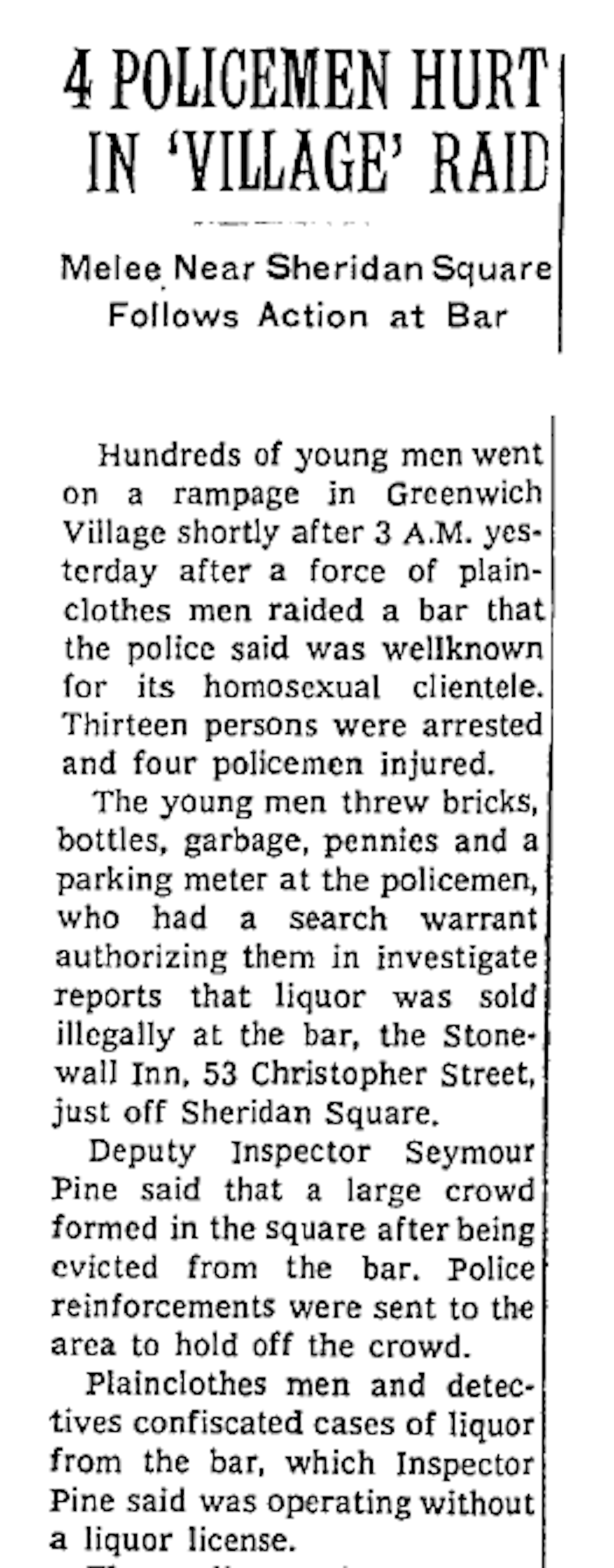
The first article on Stonewall to appear in The New York Times relied solely on interviews with the police.
The three city dailies – The New York Times, The New York Daily News and New York Post – wrote a smattering of stories in which they quoted exclusively police sources and offered little context. The story was framed as an instance of lawless youth run amok – an almost unprovoked riot.
For example, the Times’ first Stonewall article, “4 policemen hurt in ‘Village’ raid” began “Hundreds of young men went on a rampage in Greenwich Village shortly after 3 a.m. yesterday after a force of plainclothes men raided a bar that the police said was wellknown for its homosexual clientele.”
The mainstream papers at least covered Stonewall. Local TV stations failed to even report on the riots happening in the heart of Manhattan.
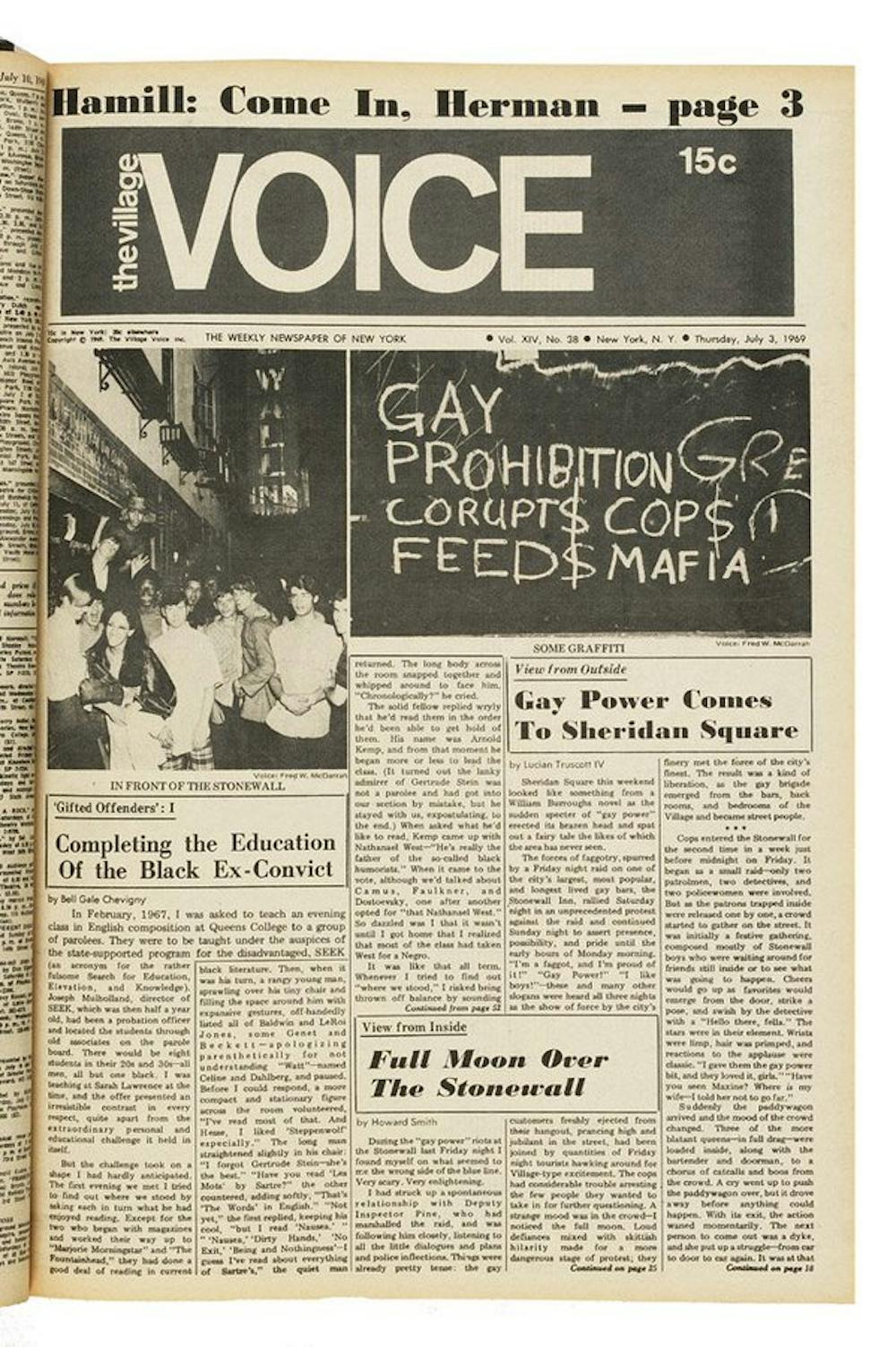
In contrast, the most popular local alternative paper, The Village Voice, gave the riots front-page coverage. It included interviews and quotes from the protesters, as well as two first-person accounts by Voice reporters Howard Smith, who was trapped inside the bar with police officers, and Lucian Truscott IV, who was outside with protesters.
Both reporters initially witnessed the riot from the Voice offices, which were a few doors down Christopher Street from Stonewall.
The alternative press rises to the occasion
The Voice’s coverage featured many hallmarks of alternative publications.
By incorporating the views of both protesters and police, they created a more complex, nuanced story. And the paper framed the Stonewall riots as an expression of liberation instead of rebellion, with Smith writing that the protesters were simply “objecting to how they were being treated.”
‘Gay Power Comes to Sheridan Square’ – The Village Voice gave the riots front-page treatment.
However, the Voice coverage was far from perfect. The anti-gay tone in Truscott’s piece angered protesters, as did some of the paper’s long-held editorial policies against same-sex personal ads.
While the Voice often was left-of-center politically, it wasn’t as radical as some of its more underground counterparts – the Rat, the East Village Other and the Berkeley Barb, all of which also covered the Stonewall riots.
Still, the Voice served as an important platform for the otherwise voiceless left out of the mainstream discussion during both Stonewall and the paper’s 60-year run. The Voice closed in 2018, following the shuttering of similar publications in Boston, Baltimore, Philadelphia and San Francisco.
An alternative press has existed alongside the mainstream since the earliest days of the nation. These papers play an important role in the U.S. media landscape by covering stories and topics that go unreported by their mainstream counterparts. They often forego the pretense of objectivity for activism; rather than quote government officials and business leaders, they’ll quote people on the ground.
Fifty years after Stonewall, it’s important to reflect on the gains of the LGBTQ movement. But it’s equally important to think about what’s lost when alternative newspapers stop publishing – and thus stop covering unreported, underreported or misreported stories.
NBC News' Pete Williams has won three national news Emmy awards. He has a reputation for offering very factual reports with little to no personal opinion. Williams for decades has primarily covered the U.S. Supreme Court and Justice Department.
Monday morning on MSNBC Williams gave his report on the Supreme Court's order in the "Sweetcakes" case, involving an Oregon Christian couple who refused to bake a wedding cake for a same-sex couple. The case is exceptionally more complicated than that – including alleged doxxing of the same-sex couple and the subsequent death threats they say they received.
The U.S. Supreme Court set aside the $135,000 the anti-gay bakers, Melissa and Aaron Klein of Sweetcakes by Melissa, were ordered to pay to the same-sex couples they refused, and told the lower court to re-examine the case in light of the SCOTUS ruling in favor of Colorado anti-gay Christian baker Jack Phillips – which the court had originally made clear applied only to the Phillips case. The Court ruled Phillips was the victim of anti-religious animus by the state.
Now, Pete Williams appears to be wondering about the Supreme Court's order, sending the case back to a lower court for review.
Asked what today's decision means, Williams responds, "I'm not sure," then delivered his report.
"So today the Supreme Court sent this Oregon case back with instructions to reconsider in light of the Colorado case, but none of the infirmities that existed in the Colorado case are present in the Oregon case, so I'm not exactly sure what the Oregon courts are going to conclude from this," Williams told viewers.
"My guess is that if the state sues again, and it probably will, the Oregon courts will rule the same way and the case will come back here," meaning to the Supreme Court.
"I don't know what the [Supreme] Court gains here other than perhaps time, and letting other cases like this percolate up," Williams said.
Exactly.
It would appear the Supreme Court is attempting to lay the groundwork for special religious rights that would supersede the rights of LGBTQ people to not be discriminated against.
Discussing the departure of Donald Trump's spokesperson Sarah Sanders from the White House, an MSNBC panel surveyed her possible replacements with one ridiculed for his appearances on TV defending the president.
Speaking with "AM Joy" fill-in host Jonathan Capehart, The Beat DC editor Tiffany Cross shot former Trump associate Stever Cortes -- a regular on CNN -- down as a possible candidate.
"There are names that are out there," Capehart suggested. "[Meliania Trump spokesperson] Stephanie Grisham and Hogan Gidley and Steve Cortes."
Pointing out that Grisham is the most likely contender, and the Trump would probably prefer a woman, Cross called out Cortes for his TV appearances.
"Steve Cortes is a nut, " she remarked. "I don't know if you have seen him on television."
"He literally invents things," she added, as the panel laughed.
CNN host Jake Tapper on Sunday disagreed with the notion that President Donald Trump and Russians tried to "suppress" Democratic votes by engaging in what he called large-scale voter "discouragement."
During a panel discussion on CNN, Democratic analyst Jennifer Granholm slammed Trump's campaign for "voter suppression."
"The thing that concerns me about the launch, Jake, of this new — of his re-election [campaign], he has already raised $100 million," Granholm said of Trump. "His campaign manager, Brad Parscale, who ran the digital campaign last time around, said that this time this campaign is going to be bigger, better and badder."
"The badder part really worries me because last time the efforts that the Trump campaign combined with the Russians to do voter suppression," she added before being interrupted by the CNN host.
"Voter discouragement," Tapper said, correcting Granholm. "They were discouraging people from voting."
"They were discouraging people from voting and it had an impact," Granholm insisted. "And that effort is going to be done again in spades this time. When he says he wants to move to Oregon as he expands the map, he either expands his map or he suppresses the vote. He's going to do the second."
On Friday morning, some affiliates in ABC News’ digital division posted an article promoting an online “birthday card” for President Donald Trump — who turned 73. The “card” turned out to be linked to a petition website created by Trump’s 2020 reelection campaign and the Republican National Committee (RNC). And those ABC affiliates, according to the Daily Beast, helped Trump and the RNC add to their e-mail lists.
“Happy Birthday, Mr. President!,” the content read. “To help him celebrate, the GOP has made him a digital birthday card.”
The article promoting the “birthday card” has since been removed from the websites of those ABC affiliates. A spokesperson for ABC affiliate stations told the Daily Beast that the article was initially posted “by an overnight producer at one of our local stations, and they did not follow the station’s editorial standards.”
That spokesperson confirmed to the Beast, “The story has since been taken down.”
ABC-affiliated websites are free to use content posted by fellow ABC affiliates. And after the initial post of the article promoting Trump’s digital “birthday card,” other stations used their own versions, the Beast reported.
The use of digital “birthday cards” to harvest e-mail addresses is hardly limited to Trump or the RNC; the Democratic National Committee (DNC) has had plenty of them as well. But major media outlets often have a policy against promoting content that can be used to help politicians increase the size of their e-mail lists.
Before the article promoting the “birthday card” was removed, at least five ABC affiliates ran it — including affiliates in New York City, Philadelphia and Houston.
Reporting on one of Donald Trump's Saturday tweets -- where the president darkly warned that the stock market would collapse if he is not re-elected -- a financial reporter for Bloomberg slyly pointed out that Trump financial successes since he became president are "middling" -- and that his predecessor was more successful.
According to Bloomberg's Roz Krasny, "President Donald Trump, gearing up for the official start of his 2020 campaign, warned that the U.S. would face an epic stock market crash if he’s not re-elected," noting his tweet stated, "The Trump Economy is setting records, and has a long way up to go....However, if anyone but me takes over in 2020 (I know the competition very well), there will be a Market Crash the likes of which has not been seen before! KEEP AMERICA GREAT."
Pointing out that Trump has tried to scapegoat the Fed over interest rates for keeping the market from booming, Krasny noted how the markets are doing under the Republican president who has roiled markets with his trade wars.
Doing so, she noted that former President Barack Obama -- and Bill Clinton for that matter -- had a better track record.
"Research by Macrotrends shows the Dow Jones Industrial Average’s performance so far in Trump’s term has been middling compared with his predecessors, and trails the gains made under Democrats Barack Obama and Bill Clinton," she wrote before adding. "It’s a touch above the gains logged under Republicans Ronald Reagan and George H. W. Bush; George W. Bush had presided over a losing market at this point in his first term."
US journalist Glenn Greenwald said Thursday he has received "grotesque" threats also targeting his husband and children after publishing leaked chats showing Brazil's justice minister conspired to keep leftist icon Luiz Inacio Lula da Silva out of the 2018 presidential race.
Greenwald told AFP "political violence is a reality" in Brazil and he would not leave the country after The Intercept investigative website he co-founded released explosive material that has cast doubt on Sergio Moro's impartiality when he was an anti-corruption judge.
The Telegram chats -- provided to The Intercept by an anonymous source -- have triggered calls for the resignation of Moro, who spearheaded a massive graft investigation known as Car Wash before he joined far-right President Jair Bolsonaro's cabinet in January.
No one has been untouchable in the probe, which began in 2014 and upended Brazil's politics by uncovering large-scale looting of state oil company Petrobras.
Scores of top players across the political spectrum as well as business figures have been taken down.
But critics say Moro -- who handed Lula his first conviction for taking bribes and money laundering in 2017, effectively ending both his election hopes and decades of center-left rule in Brazil -- targeted the former president and his popular Workers' Party (PT) most of all.
"We knew that when we were going to report on very powerful figures who are part of the Bolsonaro government that was going to generate a lot of hatred, animosity and threats," Greenwald said a day after The Intercept released more conversations between Moro and Car Wash chief prosecutor Deltan Dallagnol.
"We have received some really disgusting and detailed and grotesque, graphic threats that are pretty disturbing and we do take seriously," he said.
The menacing messages -- sent via email and social media -- have also targeted his husband, Brazilian lawmaker David Miranda, and their two adopted children.
Greenwald, who was part of the team that first interviewed fugitive US whistleblower Edward Snowden in 2013, acknowledged the risks were greater this time given his physical proximity to the people he is accusing, but said he "would absolutely not ever leave Brazil."
"It's the country that belongs to my children and my husband," Greenwald said.
"We have taken all the measures that we feel like we should take for our legal and physical security. After that you have to go about and do your work.
"Journalism is about confronting powerful people."
- Corrupted justice -
Moro, a hero to many Brazilians fed up with corruption, has remained defiant since The Intercept published the first tranche of what it said was an "enormous trove" of documents on Sunday.
In the leaked group chats, Car Wash prosecutors expressed "serious doubts" over the evidence against Lula and spoke openly of wanting to prevent the PT from winning the 2018 presidential election that Lula was widely expected to win.
Moro repeatedly "overstepped the ethical lines that define the role of a judge" by offering prosecutors advice and tips for "new avenues of investigation," The Intercept said.
Moro has denied any wrongdoing and claims the leaked messages were illegally hacked. Car Wash investigators have questioned the authenticity of the chats, saying they could have been fabricated.
Greenwald refused to discuss how The Intercept's source obtained the incendiary material, which he said showed "Moro was integrated fully into the prosecutorial work" of the Car Wash investigation.
"They had an ongoing collaborative relationship which violates the constitution and the code of judicial ethics in a way that calls into question every verdict that Moro issued as part of the Lava Jato (Car Wash) case."
Lula, who led Brazil through a historic boom from 2003 to 2010, is serving a reduced jail term of eight years and 10 months after being convicted of accepting a seaside apartment as a bribe for helping the OAS construction company get lucrative deals with Petrobras.
A second conviction was handed down in February for which he was sentenced to almost 13 years.
Lula has denied all the corruption charges against him, arguing they were politically motivated to prevent him from competing in the 2018 election, which Bolsonaro won.
While the leaks have been a blow to Moro's reputation, some analysts have downplayed the potential fall-out from the scandal given the popularity of Moro, who is seen by many as an anti-corruption crusader.
Bolsonaro, who has been uncharacteristically silent on Twitter over the leak, attended a football game with Moro on Wednesday in a sign of his support.
Greenwald said he had not expected Moro to resign after the initial reports, but questioned whether the minister could hang on to his job or be effective as The Intercept publishes more material.
"The main victims of what we are revealing is Brazilian society... and the people who were punished and imprisoned by a process that was clearly run by people who had no regard for the rules that they are required to abide by," said Greenwald.
"When those rules are violated the entire system of justice is corrupted."