During a press briefing held by the White House coronavirus task force, a reporter directly challenged Vice President Mike Pence over the actions of his administration as opposed to the guidelines they're issuing to combat the coronavirus.
"It really does sound though like you're saying, 'Do as we say, not as we do,'" the reporter said. "You're telling people to listen to local officials, but in Tulsa you defied local health officials -- to have an event that even though you say didn't result in a spike, dozens of Secret Service agents, dozens of campaign staffers are now quarantined after positive tests. And then in Arizona, one of the hardest-hit states, you packed a church with young people who weren't wearing masks. So how can you say the [Trump campaign] is not part of the problem that Dr. Fauci laid out."
"Well, I want to remind you again that freedom of speech and the right to peaceably assemble is enshrined in the Constitution of the United States," Pence replied.
The number of infections could be 10 times the 2.4 million confirmed cases, says the head of the Centers for Disease Control and Prevention.
Some U.S. cities and states have slowed or halted plans to ease restrictions enacted in response to the ongoing coronavirus pandemic as the country continues to shatter records in terms of confirmed Covid-19 cases and public health experts warn of what the future could hold.
"People need to know that wearing masks can reduce transmission of the virus by as much as 50%, and those who refuse are putting their lives, their families, their friends, and their communities at risk."
—Dr. Christopher Murray, IHME
Texas Republican Gov. Greg Abbott announced a temporary pause in the state's reopening process on Thursday amid rising infections, a move that critics called "too little, too late." Austin, Dallas, Houston, and San Antonio are all seeing rising case numbers.
"The big metro areas seem to be rising very quickly and some of the models are on the verge of being apocalyptic," Dr. Peter Hotez, dean of the National School of Tropical Medicine at the Baylor College of Medicine, toldCNN this week, citing models that show Houston could see a four-fold spike in daily cases by July 4.
"That is really worrisome and as those numbers rise, we're seeing commensurate increases in the number of hospitalizations and ICU admissions," added Hotez, who is also working on a potential vaccine for Covid-19. "You get to the point where you overwhelm ICUs and that's when the mortality goes up."
On a national level, there was a record number of about 40,000 new Covid-19 cases on Thursday, according to the Johns Hopkins University global tracker. The last record was set on April 24 at 36,400, though the U.S. saw new infections nearly at that level on Tuesday and Wednesday of this week.
The rise in U.S. cases, as Common Dreamsreported Thursday, comes as countries with socialized healthcare systems are seeing their infection numbers decline.
As of Friday morning, the U.S. death toll had topped 124,500 and the number of total confirmed cases nationwide was over 2.4 million—more than any other country in the world—though public health experts warn the infection rate could be much higher.
"Our best estimate right now is that for every case that's reported, there actually are 10 other infections," Robert Redfield, director of the Centers for Disease Control and Prevention (CDC), said in a call with reporters Thursday—meaning that over 24 million Americans could actually be infected with the virus.
That estimate is based on blood samples tested for the presence of antibodies to the virus, Redfield explained. NBC Newsreported that the samples are from people who have specifically sought antibody testing as well as those who have donated blood or had laboratory testing of blood for other reasons.
"This virus causes so much asymptomatic infection," added Redfield, who reiterated the importance of social distancing, wearing a face mask in public, and hand-washing. "The traditional approach of looking for symptomatic illness and diagnosing it obviously underestimates the total amount of infections."
The New York Times tracking system put the number of new Covid-19 cases in the United States on Thursday above 41,000:
The Times also reported Thursday on the rising number of adults in their 20s, 30s, and 40s with confirmed infections in some places of the country where the case numbers are surging, pointing to Arizona, Florida, and Texas as examples.
"What is clear is that the proportion of people who are younger appears to have dramatically changed," Joseph McCormick, a professor of epidemiology at UTHealth School of Public Health in Brownsville, told the Times. "It's really quite disturbing."
According to the newspaper:
The pattern is drawing notice from mayors, governors, and public health officials, and comes as a worrisome sign for cities and institutions as they look to the fall. The rise in cases among younger people could complicate the plans of leaders who are eager to open schools and universities, resume athletic events, and return to normal life and a fully functioning economy.
The increases could reflect a simple reality: Since many states have reopened bars, restaurants and offices, the coronavirus has been allowed to spread more widely across communities, including to more young people. But people in their 20s and 30s are also more likely to go out socializing, experts say, raising concerns that asymptomatic young people are helping to spread the virus to more vulnerable Americans at a time when cases are surging dangerously in the South and the West.
The University of Washington's Institute for Health Metrics and Evaluation (IHME) on Wednesday released a model showing that nearly 180,000 people in the United States will die because of Covid-19 by October 1. The researchers also projected the U.S. death toll would drop to about 146,000 if at least 95% of people wore masks in public.
"There is no doubt that even as states open up, the United States is still grappling with a large epidemic on a course to increase beginning in late August and intensifying in September," IHME director Dr. Christopher Murray said in a statement. "People need to know that wearing masks can reduce transmission of the virus by as much as 50%, and those who refuse are putting their lives, their families, their friends, and their communities at risk."
New ABC News/Ipsos polling released Friday shows that 87% of Americans have worn a face mask or covering when leaving home in the past week, up from 61% in April. The poll also found that 56% of Americans believe the economy is reopening too quickly and 76% of Americans are now concerned about contracting the virus, which is up from 69% in early June and reverses a two-month declining trend since April.
The survey, which also showed that Americans' willingness to go out in public for various activities has fallen in the past two weeks as cases across the country have surged, was conducted Wednesday and Thursday and its margin of sampling error is plus or minus 4.7 percentage points.
The White House Coronavirus Task Force on Friday afternoon is set to hold its first public briefing in nearly two months. The live-streamed event will be held at the Department of Health and Human Services rather than the White House and reportedly led by Vice President Mike Pence, who heads the task force.
The NBA and its players union announced they have struck a deal on a restart plan for the 2019-20 season starting July 30, including health and safety protocols.
The deal between the league and the National Basketball Players Association will feature all games played at the Walt Disney World Resort campus in Orlando, Florida, where players will reside in a "bubble" quarantine environment to safeguard them from COVID-19.
"It's very exciting to officially announce the restart of the 2019-2020 season," NBPA executive director Michele Roberts said.
The coronavirus pandemic forced the NBA to shut down the campaign March 11 after Rudy Gobert tested positive for the deadly virus.
In all, 22 teams will compete in Orlando, each with a chance to capture the NBA title in October.
The league and players also agreed to take united action to combat systemic racism and promote social justice, easing some player fears the restart might distract from the rising social movement in the wake of the death of unarmed black man George Floyd while in police custody last month.
"We have worked together with the players association to establish a restart plan that prioritizes health and safety, preserves competitive fairness and provides a platform to address social justice issues," NBA commissioner Adam Silver said.
Health and safety protocols were created in consultation with public health experts, infectious disease specialists and government officials.
The announcement came on the same day the Florida Department of Health said a one-day record 8,942 people tested positive Thursday for coronavirus, smashing the two-day-old mark of 5,508 as the deadly virus spikes in the same area where NBA players are planning to complete the campaign.
"It has taken true collaboration between the league and the union... along with the continued support and assistance from medical experts, public health officials and many others," Roberts said.
The top eight teams in the Eastern and Western conferences and the six teams within six games of the eighth spot in either conference were chosen to compete in Orlando.
Each club starts with eight "seeding" games to complete a regular season, with a schedule set to be announced later Friday.
The seven teams with the top overall season win percentages after the seeding games will take the top seven seeds in each conference for the NBA playoffs.
If the eighth-placed team in either conference leads the number nine club by more than four games in the overall standings, it will become the eighth seed in that conference.
If the gap is four games or fewer, there, those two clubs would meet in a one-game play-in matchup to decide the eighth spot.
The ninth place team would be eliminated with one loss while two defeats would be needed for the number eight squad to be ousted.
That would set the field for a typical playoff run of four best-of-seven rounds, concluding the NBA Finals ending no later than October 13.
After a nearly two month absence from the public eye, the heads of the White House Coronavirus Task Force, relegated to the offices of the Dept. of Health and Human Services and kicked off the White House live video feed page, held a press conference.
It did not go well.
Vice President Mike Pence, while acknowledging the very basic of facts, including that over 126,000 Americans have died from the coronavirus and the U.S. having about 2.5 million cases.
The rest of his facts were the very best of spin and lies, as many on social media charged, like the Vice President saying, "we have made truly remarkable progress in moving our nation forward."
Or, that 34 states across the country are seeing "a measure of stability," which is false since cases are on the rise in more than half the states. Remember, too, that in other countries, the number of cases have dropped tremendously, while in the US they are increasing to numbers higher than ever before.
CNN fact checker Daniel Dale did an excellent job in real-time. A sampling:
In a statement released by American Airlines Group Inc., flights will be booked to capacity going forward, abandoning previous social distancing guidelines for operation, according to a report from Bloomberg.
"Customers will still be notified when they’re booked on crowded flights and can move their reservations at no cost, the airline said in a statement Friday," Bloomberg reports. "As of June 30, American also will ask customers to certify that they have been free of Covid-19 symptoms for the previous 14 days."
The move comes as cases of coronavirus spike to record levels all across the country. The spikes are taking place in states where American Airlines has major operations, such as Texas, Arizona and North Carolina.
Despite the disparities, countries are reopening without a plan to redress these unequal harms and protect the broader community going forward. Our ethics research examines the potential for using virtues as a guide for a more moral coronavirus response.
Virtues are applied morals – actions that promote individual and collective well-being. Examples include generosity, compassion, honesty, solidarity, fortitude, justice and patience. While often embedded in religion, virtues are ultimately a secular concept. Because of their broad, longstanding relevance to human societies, these values tend to be held across cultures.
Compassion is a core virtue of all the world’s major religions and a bedrock moral principle in professions like health care and social work. The distinguishing characteristic of compassion is “shared suffering:” Compassionate people and policies recognize suffering and take actions to alleviate it.
As the French philosopher André Comte-Sponville said, compassion “means that one refuses to regard any suffering as a matter of indifference or any living being as a thing.”
Individual acts of compassion abound in the coronavirus crisis, like frontline health care professionals and neighbors who deliver food, among other examples.
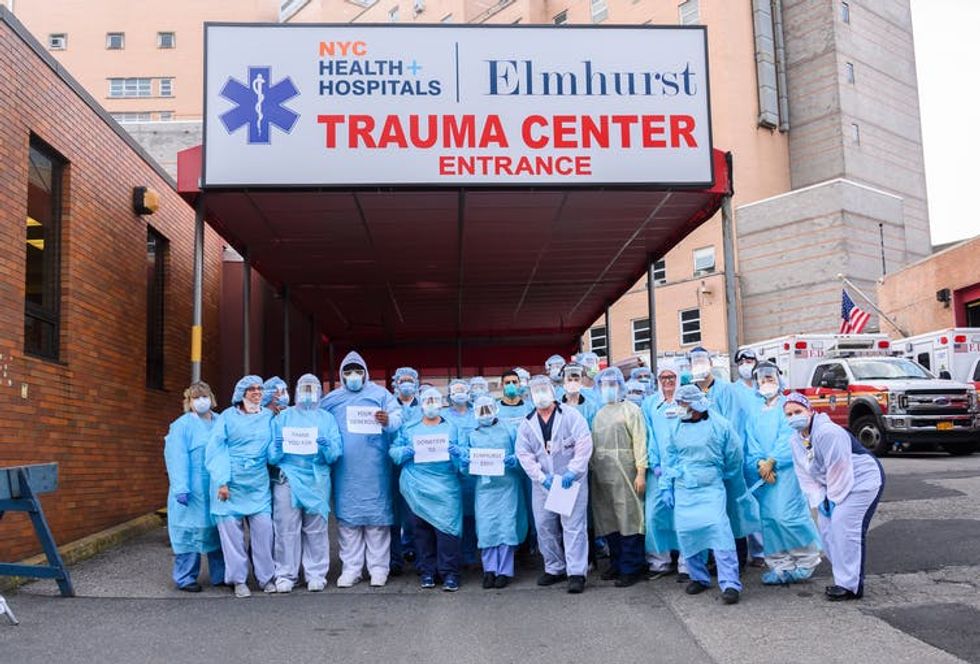
Compassion and solidarity on display at New York’s Elmhurst Hospital, during the April peak of the city’s coronavirus outbreak.
A compassion-guided reopening aimed at preventing or reducing human suffering would require governments to continually monitor and alleviate the pain of their people. That includes addressing new forms of suffering that arise as circumstances change.
Public health measures like stay-at-home orders, social distancing and wearing masks reflect solidarity. While compliance in the United States has not been universal, data indicate broad approval for these measures. A new study found that 80% of Americans nationwide support staying home and social distancing and 74% support using face coverings in public.
To achieve these acts of solidarity, the leaders most praised in their countries and abroad – from U.S. National Institutes of Health director Dr. Anthony Fauci to New Zealand prime minister Jacinda Ardern – have relied primarily on moral persuasion, not threats of punishment.
By delivering clear information, giving simple and repeated behavioral guidance, and setting a good example, they’ve helped convince millions to take personal responsibility for protecting their community.
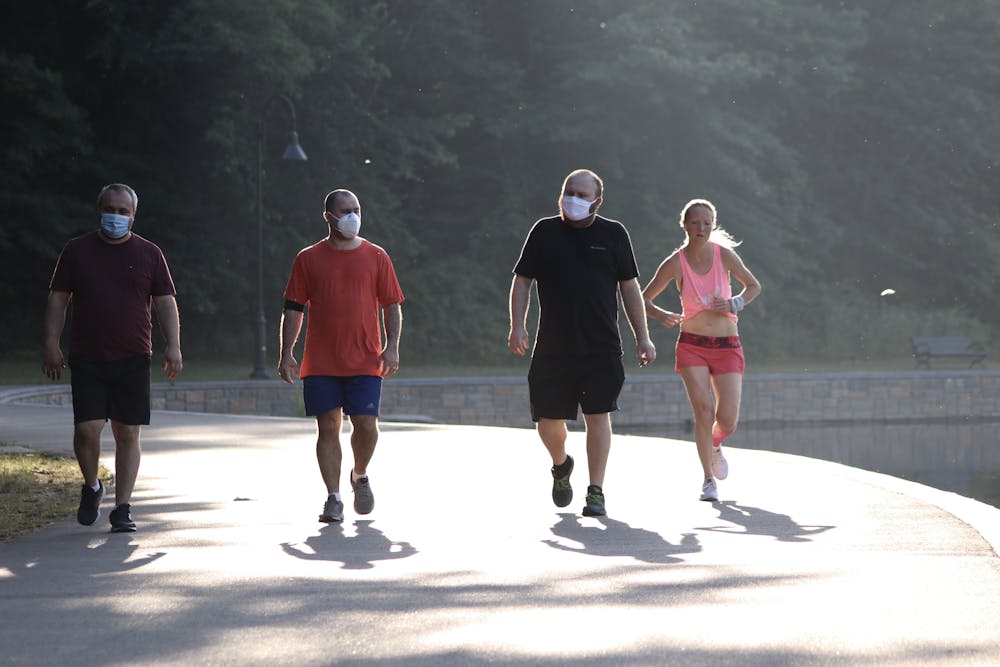
Face masks signal that wearers care about protecting others around them.
Justice focuses on the fair distribution of resources and the social structures that enable what the Dutch philosopher Patrick Loobuyck has called a “condition of equality.”
Justice-oriented policies are necessary for a moral reopening because of the pandemic’s disproportionate health and economic impacts. The evidence clearly shows that communities of color, low-income populations, people in nursing homes and those on the margins of society, such as homeless people and undocumented immigrants, are hardest hit.
Justice-oriented policies would aim for equitable balancing of necessary pandemic resources. That means directing testing and health equipment toward vulnerable communities – as identified by COVID-19 tracking data and risk factors like housing density and poverty – and ensuring free, widespread vaccine distribution when it becomes available.
In the U.S., economic justice will also require aggressively investing in minority-run businesses and poorer areas to guard against further harm to owners, employees and neighborhoods.
Similarly, all American school children have lost critical classroom hours, but lower-income children have been disproportionately damaged by remote learning in part due to the digital divide and loss of free lunch programs. Justice would demand channeling additional resources to the students and schools that need them most.
Note that it isn’t enough to apply just one virtue in a crisis of this magnitude. Policies built on compassion, solidarity and justice should be deployed in combination.
A compassionate post-pandemic response that does not address underlying inequalities, for example, ignores certain communities’ specific needs. Meanwhile, tackling specific injustices without engaging everyone in efforts like mask-wearing endangers the public health.
Bolstered by scientific evidence, virtue ethics can help nations reopen not just economically but morally, too.
"The View" host Whoopi Goldberg said people who won't wear masks don't deserve medical care for the coronavirus.
The panelists discussed lurid public comments by Florida residents against a mask mandate in Palm Beach County, and none of them could understand why a vocal minority of Americans were so opposed to basic health safety.
"It's not just about protecting myself, which it is, but it's also, like, you know, protecting people who are immune-compromised," said co-host Meghan McCain, "protecting people who are fighting cancer and protecting old people. It's not just about you, it's about our fellow mankind."
McCain wondered how those people had been brought up, and Goldberg said they should face consequences for putting themselves and others at risk.
"Here's the deal," Goldberg said. "You don't want to wear a mask? We just need to have your name and phone number so that when you get sick and you go rushing to the hospital for help, you know, people can actually say, 'Oh, you're the one who said don't wear a mask, and here you are -- you're ill.'"
"See, I want to rub it in your face," Goldberg added, "I want to rub it in your face because that means that you, because of your insanity, have taken time away from a doctor who could be working on someone who did do the right thing who got it anyway, see? But I'm a bad person because I'm saying, you know what? You don't want to do it, fine, but don't come looking for help when you need it, because you will need it."
President Donald Trump's planned trip to his golf course in Bedminster, New Jersey has been canceled.
Per CNN's Kaitlan Collins, the White House has announced that the president will not be traveling to Bedminster this weekend because New Jersey has placed new quarantine restrictions on Americans coming into the state who have visited COVID-19 hot spots such as Florida, California, Texas, and Arizona.
"He was supposed to leave this afternoon, but wasn’t going to follow a required quarantine for those who have been in states with rising cases," Collins reports.
Trump earlier this week visited Arizona, which has seen COVID-19 cases and hospitalizations surge in recent weeks. During the president's visit, he held an indoor rally at a megachurch in which very few attendees wore face masks or practiced social distancing.
The move to restrict alcohol consumption at bars comes on the same day that Florida revealed that it recorded nearly 9,000 new COVID-19 infections on Thursday, which has shattered its previous record for daily recorded new cases.
Florida Gov. Ron DeSantis has so far been reluctant to reimpose restrictions even as COVID-19 cases have exploded throughout the state, although the situation now appears to have reached a point where the state's government has little option to avoid overwhelming local hospitals.
Texas on Friday went a step further and ordered all bars to be shut down, while also ordering restaurants to restrict their services to 50 percent occupancy.
The vaccine will inject you with an electronic chip, poison you, make you sick, they say.
There's no vaccine yet for treating the novel coronavirus, and scientists are multiplying efforts to find one.
But already anti-vaxxers -- a small but vocal group of people who don't believe in vaccinations -- have taken advantage of the pandemic to multiply disinformation on social media.
The video "Plandemic," which claims the COVID-19 crisis was a government setup, has already been viewed millions of times on YouTube and other streaming platforms.
A list of substances with scary-sounding names -- phenoxyethanol, potassium chloride -- said to be found in toxic quantities in vaccines (which is not true) has been shared thousands of times on Facebook since the end of April.
The anti-vax rhetoric is not new, but has gained huge visibility during the pandemic, according to experts who spoke with AFP.
- Echo chamber -
The anti-vax movement predates both the internet and the COVID-19 crisis, but social media has created a highly-efficient "echo chamber" for anti-vaxxers, according to Sylvain Delouvee, a researcher in social psychology at the University of Rennes, in France.
Despite these platforms' claims that they will limit viral anti-vax content, the false headlines have nonetheless proliferated, he said.
Anti-vax rhetoric, he added, is "continuously-evolving, without a clear definition," meaning it can reach people across the political divide.
Some misleading claims -- like one article claiming that vaccines contain the same toxic chemicals as the substances used for lethal injections -- have seemed to reappear online without direct reference to COVID-19.
The extent to which the pandemic has altered the misinformation landscape is not yet clear, according to David Broniatowski, from George Washington University in DC.
"We are still investigating the question of whether vaccine opponents are more active because of the pandemic, or whether they are just more visible because of the increased attention given to the pandemic," he said.
The attention given to COVID-19 has allowed anti-vaxxers to fold the news into their existing narrative, according to Amelia Jamison, at the University of Maryland.
"There's this kind of small but very vocal group online," she said. "This has just re-energised them."
She noted that in the US in particular, the anti-vax, anti-mask and anti-quarantine movements have come together ostensibly in the name of preserving individual liberties.
- Conspiracy 'groundswell' -
Anti-vaxxers are "taking up more and more space online," Delouvee noted, comparing the current wave of anti-vax activity to a "groundswell".
But Jamison cautioned that things online aren't always what they seem.
"If you look at polarised content on vaccines, it tends to break out like 50-50 [online]," she said.
"We know in real life it's not at all close to 50-50."
The vast majority of people worldwide -- about 80 percent -- somewhat or strongly agree that vaccines are safe, according to the 2018 Wellcome Global Monitor, an annual survey on science and health. Seven percent of people said that they "somewhat or strongly disagree," while 11 percent did not have an opinion.
Still, the anti-vax movement "could amplify outbreaks" of COVID-19, as was the case for the 2019 measles outbreak, according to researchers who published a study in the scientific journal Nature.
The World Health Organization, for its part, classified "vaccine hesitancy" as one of its 10 threats to global health in 2019.
Florida Gov. Ron DeSantis snapped at reporters when he was asked whether his administration was “cooking the books” on coronavirus deaths.
Rebekah Jones, who says she was fired after creating the state's COVID-19 database after refusing to manipulated statistics, claimed on Twitter that her former colleagues had been instructed to start "slowly deleting deaths and cases" to make it look like Florida had "made it over the hump," reported The Guardian.
The state has been setting records for new cases every day, logging nearly 9,000 new cases and 13 percent positive cases on a day of record testing.
“They’re only reporting all these cases now so they can restrict reporting next week to make everyone think it’s over,” Jones said Tuesday.
She pointed out to WPEC-TV that the state does not count non-resident deaths when it reports coronavirus fatalities, while her database did.
"I do not separate those," Jones said. "I feel like communities don't really care what your state legal address is. If you were sick here, you died here, you died in a Florida hospital, you were going to the Florida grocery stores. That's what they care about."
DeSantis snapped at reporters when asked Thursday about Jones' allegations.
“You guys have been on the conspiracy bandwagon for months,” DeSantis said. “You need to move on. You really do. It's embarrassing at this point."
DeSantis has faced months of criticism for not issuing statewide shutdown orders or mandating mask usage, and Florida's outbreak is now spiraling out of control -- and Jones claims the administration is concealing important health data like the number of intensive care unit beds were being used.
"If we don't have any actual real grounding in how many ICU beds we have available in any given place," Jones said, "we have no idea what our capacity is in our health care system to absorb an influx of very sick people."
Jones said the Department of Health is planning to slow down the reporting of new cases next week to create a "bottleneck" and make it look like Florida is improving, so tourists will visit over the holiday weekend.
"The context that was added by an employee is that they are letting the number of real cases flow this week so that next week they can start to reduce the number of cases and make it look like Florida is over the hump, that we have hit the worst of it, it's all downhill from here," Jones told WPEC. "Come to Florida, celebrate July 4th weekend at whatever event or beach you want to vacation at and come one, come all. That is a very serious allegation, though for me at this point, not very shocking."
Writing in The Week this Friday, Windsor Mann points to new polling that shows President Trump trailing Joe Biden nationally by 14 points. According to Mann, Trump's handling of the coronavirus and unrest in the wake of George Floyd's death plays a large role in the numbers.
Republicans are criticizing Biden for "hiding in his basement," but according to Mann, this is a "compliment masquerading as a criticism."
"That Biden is staying at home during a pandemic is a testament to his deference to public health and his political savvy," Mann writes. "Biden knows that no one makes a stronger case against Trump than Trump himself."
"In Trump we have a president in which incompetence, stupidity, derangement, bigotry, corruption, and dishonesty are each struggling to take the upper hand," he adds.
In 2016, the prospect of an "outsider" shaking up the political system was appealing to many.
"As a political neophyte, Trump could make sweeping promises without having to defend or explain anything," Mann writes. "His inexperience was a boon. Having never been tested in politics, he had never failed. He talked like a regular guy, which is to say, like someone who had no idea what he was talking about. He still talks that way."
In an announcement made Friday morning, Abbott said he is ordering the closure of bars and is asking restaurants to reduce their capacities back to 50 percent occupancy until the rate of transmission of the disease slows down.
Abbott is also closing down rafting and tubing businesses in the state that have been identified as major sources of infection, and is also placing new restrictions on social gatherings of 100 or more people.
Abbott's order comes as hospitals in Houston, Austin and other major cities in Texas have warned that they are running out of room in their intensive care units to handle the influx of COVID-19 patients.
Despite this, many conservatives voiced angry displeasure at the Texas governor, whom they accused of "caving" to the left by trying to save lives.