The Atlanta Journal-Constitution reported that early on the morning of January 2, a Roswell, Georgia police officer identified as C. Dickerson stopped a 13-year-old boy who was driving a golf cart. According to the police report obtained by the AJC, the boy only had on a hoodie and sweatpants, and the sleeves of his sweatshirt were soaked and frozen.
The boy gave conflicting answers to their questions about what he was doing and where they could get in contact with his mother, so Dickerson handcuffed him and put him into the patrol car.
"I don’t want to go to jail,” the boy can be heard saying. The report noted that he also said “I can’t feel my wrists,” and “I just want to go home," and in the portion of the video the AJC published on its YouTube page, he also sounds like he is crying.
Eventually, Roswell PD Sgt. Daniel Elzey arrived, rolled the back windows down to let in the cold winter air and told Dickerson he did so to get the boy to talk.
"Give him a few minutes to think about it," the sergeant said. "Let him get a little chilly. Maybe that’ll help.”
The boy was searched again, the Journal-Constitution noted, and told the officers he felt "violated." In response, one of the officers said they didn't care and that he felt violated because the boy "lied."
Chairwoman of the Spokane County Republican Party, Cecily Wright, accused the political left of “label lynching,” according to a report from Spokesman News.
While defending James Allsup, 22, during a Northwest Grassroots meeting, Wright said that the media has hurt his reputation because of labels placed on him.
Allsup is affiliated with the Identity Evropa group, an organization that has been classified by the Anti-Defamation League as a white supremacist group.
“How many of you have heard the term label lynching? Sorta crazy, isn’t it?” Wright says in a video. “And yet, when you look at a website such as the SPLC, the Southern Poverty Law Center, or listen to your news commentators, they hang labels on people.”
Wright continues: “If I started saying something about you, that you were a white supremacist (sic), and you could say because so-and-so and such-and-such happened, and other people pick it up, and then if the news media picks it up, you’re dead meat, and it’s pretty darn sad. And people’s lives are destroyed by these labels that are being hung on them because we don’t take time to really figure out, is it true or is it not true? What is the purpose behind labeling a person a certain way or not?”
However, prior to this Wright condemned Allsup's views. When asked about Allsup’s past she claimed not be connected to him.
“I have not looked over them all,” she said. “I did not investigate James Allsup. I know how he is portrayed, and he is not someone that I affiliate with.”
People of color have had the cops called on them at an increasing rate over the past months. Most recently, a black woman in Brooklyn, New York was waiting on her Uber when she experienced discrimination at the hands of a white woman.
According to Ebony, Darsell Obregon was waiting for an Uber on July 25, when Arabella Juniper called 911.
Obregon recorded the incident and uploaded the video to Facebook. Obregon said she was waiting inside an apartment doorway to stay safe from the rain when she had the cops called on her.
"On Sunday afternoon, I was in Brooklyn walking to the train when a sudden rainstorm began and I hid in the doorway outside of a random apartment in Park Slope to shield myself from the rain and called an Uber," Obregon wrote on Facebook.
She was only standing in the outside doorway for less than five minutes when Juniper decided to call the police.
"No more than 3 minutes later a young woman who lives in the building opened the front door and told me that I can not stand there and had to leave. I told her I was not going to move (unbeknownst to her I was just waiting for my ride and would be leaving in a couple of minutes) so then she called the police," she wrote on Facebook.
The video shows Juniper talking to police. Juniper also contradicted herself while talking to police.
"You're standing on public property, ma'am, you know that right?" Juniper said in the video. "This is not public property."
Once the Uber arrived, Juniper continued to harass her. The Uber driver tried to drive away slowly, but Juniper followed the car.
"If you go anywhere, you'll be committing a crime, as well, you know that right?" Juniper said to the Uber driver.
This situation is a part of the countless incidents of people of color having the police called on them for doing ordinary tasks. According to an NPR report, 92 percent of black people said they experienced discrimination within their lifetime.
Fox News host Shepard Smith on Tuesday scoffed at President Donald Trumpfor suggesting that a government shutdown might be necessary to protect the American people.
“President Trump sending mixed signals about whether he’ll shutdown the government if he doesn't get funding for the border wall,” Smith said.
“I don’t care what the political ramifications are, our immigration laws and border security have been a complete and total disaster for decades, and there is no way that the Democrats will allow it to be fixed without a Government Shutdown," Trump tweeted Tuesday morning.
"A Government Shutdown is a very small price to pay for a safe and Prosperous America!" he added.
“As if shutting down the government is going to make America safe and prosperous,” Smith said. “Laughable.”
"Well, depends on what time you're talking about, Shep," he replied.
"There's a lot of concern from Republicans in Congress, most of whom are up for re-election that shutting down the government over broader immigration reform and wall funding could have a backlash against Republican candidates just before the mid-term elections," Roberts said.
In a video uploaded to YouTube, a young woman on a Toronto subway car can be seen chasing the victim of her racist rant to steal her phone after she realizes that she was recorded.
According to CTV, Toronto Transit passenger Margaret Anthony recorded the chase -- and subsequent theft of the cell phone -- after the younger woman accosted her victim and told her to "Go back to China."
“I noticed there was a bit of a kerfuffle and I could hear a young girl essentially screaming ‘Go back to China!’” Anthony said in an interview after the video went viral. “My blood was boiling, so I did what I thought was right and I pressed the emergency alarm.”
In the footage, you can see the attacker -- in a black Toronto Blue Jays t-shirt -- chasing her victim through the nearly empty subway car before grabbing her and attempting to wrestle the phone from her hand.
When confronted by Anthony, the assailant continues to pull at the phone before yelling, "I just want her to delete the video of me."
As Anthony calls her out for her racist comments, the younger woman suddenly gains control of the phone and bolts out the open doors of the subway with another passenger in pursuit.
According to the report, Toronto police are treating the incident as a robbery.
Former White House adviser Steve Bannon this week cautioned President Donald Trump that he is wasting his time by campaigning to Republican women because "they're gone."
“It’s like my white board’s there and Trump is checking shit off,” Bannon crowed. “Trump is on the full MAGA agenda."
Bannon argued that the 2018 midterm election is like 2016's contest, except Trump is running against House Minority Leader Nancy Pelosi (D-CA) instead of Hillary Clinton.
“She’s the Hillary,” he said. “She’s got some of the same tendencies!”
The former Trump adviser said that the threat of impeachment would drive Trump voters to the polls.
“When you focus on impeachment, it’s a game changer," he explained. "It’s an emotional issue that raises the stakes.”
But Bannon's also had some bad news for Trump concerning Republican women voters.
“This is a ‘deplorable-plus electorate.’ What I mean is, it’s deplorables plus Reagan Democrats and guys who voted for Trump who vote never. You bring them out in an off year.” he said.
“The Republican college-educated woman is done,” Bannon added. “They’re gone. They were going anyway at some point in time. Trump triggers them. This is now the Trump movement.”
Speaking for a great many people, The View's Whoopi Goldberg went off on a furious rant on Tuesday morning at airlines that continue to overbook flights in search of higher profits and at the expense of travelers.
Discussing a recent incident where a gay couple was asked by Alaskan Airlines employees to move so that a heterosexual, couple could have their seats, Goldberg hammered that particular airline over discriminating against the couple before taking on the industry at large.
"Alaska Airlines is apologizing to a gay couple after one of them was asked to move out of his premium seat so a heterosexual couple could sit together." Goldberg relayed. "Even after they explained that they too were a couple, they were asked to move or leave the plane."
"Looking into the discrimination?" co-host Sunny Hostin sarcastically interrupted to laughter from the studio audience.
"Well, I don't know if they're looking into the discrimination," Goldberg admitted, before addressing the airline industry with some advice.
"How about this? If the people who bought the tickets are in their seat, leave them alone," she lectured. "That's because they were on time. they were on time, they spent the money."
"You know, this policy of maybe airlines need to start looking at this policy of overbooking stuff because you want to make money. And then kicking people out which leads to people getting that man who got dragged off," she continued, referencing a horrifying video of an Asian man who was forcibly removed by airline security in April of last year.
"Maybe y'all want to stop doing that," she repeated before turning to the Alaska Airlines incident. "You know, people get there on time, they were in their seats. You had no business saying we need this couple to sit together."
Fox News host Jessica Tarlov on Tuesday mocked Donald Trump's claim that he hires "the best people" as a panel on Outnumbered was discussing the trial of former Trump campaign chairman Paul Manafort.
"There is no doubt that Paul Manafort is shady," said guest Lawrence Jones, the editor-in-chief of Campus Reform. "A lot of us know that when you've been involved in politics, you've heard of him around Washington."
Jones added that he was concerned that special counsel Robert Mueller was trying to put pressure on Manafort to get evidence against Trump. "If he wasn't the president's campaign manager, in likelihood, he wouldn't be facing these charges."
"Lawrence is absolutely correct," said Tarlov. "It goes beyond even if you're in the Washington scene, where you know that Paul Manafort has had unsavory dealings for many decades. Certainly flies in the face of the president's claim that he only hires the best people -- even for only a few days or a couple of months here in this case."
"How would you know that if it's beyond Washington?" host Melissa Francis asked.
"You can Google it," Tarlov replied. "If you're doing any normal background check and you Google Paul Manafort, a lot of things come up about his dealings in that part of the world. This is something -- I would say the most obvious mistake that they made."
On Tuesday, Secretary of Homeland Security Kirstjen Nielsen joined a long list of government officials to confirm Russian interference in the 2016 election and denounce the Kremlin's meddling.
"Let me be clear: our intelligence community has it right. It was the Russians. We know that. They know that. It was directed from the highest levels. And we cannot and will not allow that to happen again," Nielsen said at a cybersecurity summit in New York.
President Donald Trump has yet to admit that Russia tried to sway the election in favor of a Trump presidency—even after Russian President Vladimir Putinadmitted he had hoped Trump would beat Hillary Clinton.
"The View's" Meghan McCain on Tuesday got into a heated dispute with co-host Joy Behar over the difference between former President Barack Obama's diplomacy with Iran and President Donald Trump's diplomacy with North Korea.
McCain acknowledged that Trump had dropped the ball when it comes to North Korea, especially in light of reports that Pyongyang may be continuing to produce intercontinental ballistic missiles.
However, she said that the Trump debacle with North Korea should be viewed as the same as Obama's deal with Iran that Trump unceremoniously scrapped earlier this year.
"That's the No. 1 thing I was petrified of by the Obama administration," she said. "The idea we could ever trust a country, with the people that scream, 'Death to America!' on the streets!"
Behar objected and argued that Obama, unlike Trump, had secured a multinational agreement with Iran that had viable enforcement mechanisms, whereas Trump had simply secured an informal joint statement in which North Korea made no specific commitments to any kind of time table for disarming or even a full declaration of its current nuclear capabilities.
"No one is trusting," Behar said. "They were constantly monitoring it."
McCain then pointed out that she seemed unnerved when Trump indicated he might talk to Iran -- and Behar shot back that Trump was conducting in "name calling, not diplomacy."
McCain kept insisting, however, that she is "against having any conversation with Iran, in any capacity whatsoever, while they're screaming, 'Death to America!'"
In a surprise announcement that was posted late Monday night on Facebook, the entire police department of a small Massachusetts town resigned en masse over what they called unsafe working conditions.
According to WWLP, all four members of the Blandford Police Department stepped down according to the warning posted to the department's social media page by the interim police chief.
Speaking with WWLP, Police Chief Roberta Sarnacki said officers Chris Anciello, Gage Terlik, Krysten Scapin and herself resigned after complaints to city officials about work conditions were ignored.
On Facebook, Sarnacki wrote: "Attention Blandford residents: If you have a police, fire or medical emergency, please continue to call 911 as you normally would. Until further notice, please call the Russell State Police Barracks at 413-862-3312 if you need any other police services. The entire Blandford Police Department resigned this evening, effective immediately."
Speaking with the local news station she explained that officers have been attempting to patrol in cruisers that don't work, forced to wear bulletproof vests that are not fitted properly and might be expired, lack adequate radio communications equipment, and are paid poorly.
Faced with no police force, the city has turned to Hampden County Sheriff Nick Cocchi who has assigned six deputy sheriffs to patrol night and morning commute, with Cocchi saying the city needs to get their own police department up and running again.
According to the report: "Blandford police officers make $14 and $15 an hour. The department's best car, a 2010 Crown Victoria, that was purchased from the Otis Police Department overheats at times, has no air conditioning and the electric seat is stuck in the reclined positions."
Additionally, Sarnacki complained that police radios don't work in all parts of the small town, meaning officers can't contact each other to provide back-up when needed.
In a statement from city officials, Sarnacki was criticised for leading the walkout, with Blandford Selectboard Chair Cara Letendre complaining, "It is unfortunate that she led this officer walk out as she would have been considered as one of our candidates for Acting Chief position as we pursue the future opportunities with our police force."
Altruism can now be added to the list of benign activities black people apparently can't engage in without being treated like criminals.
Sunnyvale, California resident Erika Martin says she and her family liked to give food and other supplies to the homeless, KPIX reports.
"It makes me feel good, you know," Martin told the station.
On a Sunday in July, she was sitting in her car, waiting to give a homeless man who spends his time in a Safeway parking lot some dog food for his pet.
All of the sudden, multiple officers approached her car. Safeway employees had called the police because they thought she'd been shoplifting.
Part of the misunderstanding seemed to arise because her son had approached the deli earlier to see if they were offering cookie samples.
After the police confronted the family her son thought he was in trouble and got upset. “He was like crying because he thought they were there to arrest him,” said Martin.
Her sister, who recorded the incident and posted it to Facebook, described the encounter with disbelief.
"Right here at Safeway in Mountain View someone called the police on Erika. She was in her car the whole time. Crazy. You've got four cops here for one black person. Absolutely nuts," she said.
Reached by KPIX, officers said the family had been fully co-operative.
"This is the type of world we live in you guys," Martin wrote on Facebook. "We need to pray because this right here is crazy."
Mountain View, home to Google, saw homelessness increase by 51 percent between 2015 and 2017.
In 1932, the musicologist Wilfrid Perrett reported to an audience at the Royal Musical Association in London the words of an unnamed professor of Greek with musical leanings: “Nobody has ever made head or tail of ancient Greek music, and nobody ever will. That way madness lies.”
Despite this wealth of information, the sense and sound of ancient Greek music has proved incredibly elusive. This is because the terms and notions found in ancient sources – mode, enharmonic, diesis, and so on – are complicated and unfamiliar. And while notated music exists and can be reliably interpreted, it is scarce and fragmentary. What could be reconstructed in practice has often sounded quite strange and unappealing – so ancient Greek music had by many been deemed a lost art.Indeed, ancient Greek music has long posed a maddening enigma. Yet music was ubiquitous in classical Greece, with most of the poetry from around 750BC to 350BC – the songs of Homer, Sappho, and others – composed and performed as sung music, sometimes accompanied by dance. Literary texts provide abundant and highly specific details about the notes, scales, effects, and instruments used. The lyre was a common feature, along with the popular aulos, two double-reed pipes played simultaneously by a single performer so as to sound like two powerful oboes played in concert.
An older reconstruction of ancient Greek music.
But recent developments have excitingly overturned this gloomy assessment. A project to investigate ancient Greek music that I have been working on since 2013 has generated stunning insights into how ancient Greeks made music. My research has even led to its performance – and hopefully, in the future, we’ll see many more such reconstructions.
New approaches
The situation has changed largely because over the past few years some very well preserved auloi have been reconstructed by expert technicians such as Robin Howell and researchers associated with the European Music Archaeology Project. Played by highly skilled pipers such as Barnaby Brown and Callum Armstrong, they provide a faithful guide to the pitch range of ancient music, as well as to the instruments’ own pitches, timbres, and tunings.
Central to ancient song was its rhythms, and the rhythms of ancient Greek music can be derived from the metres of the poetry. These were based strictly on the durations of syllables of words, which create patterns of long and short elements. While there are no tempo indications for ancient songs, it is often clear whether a metre should be sung fast or slow (until the invention of mechanical chronometers, tempo was in any case not fixed, and was bound to vary between performances). Setting an appropriate tempo is essential if music is to sound right.
What about the tunes – the melody and harmony? This is what most people mean when they claim that ancient Greek “music” is lost. Thousands of words about the theory of melody and harmony survive in the writings of ancient authors such as Plato, Aristotle, Aristoxenus, Ptolemy, and Aristides Quintilianus; and a few fragmentary scores with ancient musical notation first came to light in Florence in the late 16th century. But this evidence for actual music gave no real sense of the melodic and harmonic riches that we learn of from literary sources.
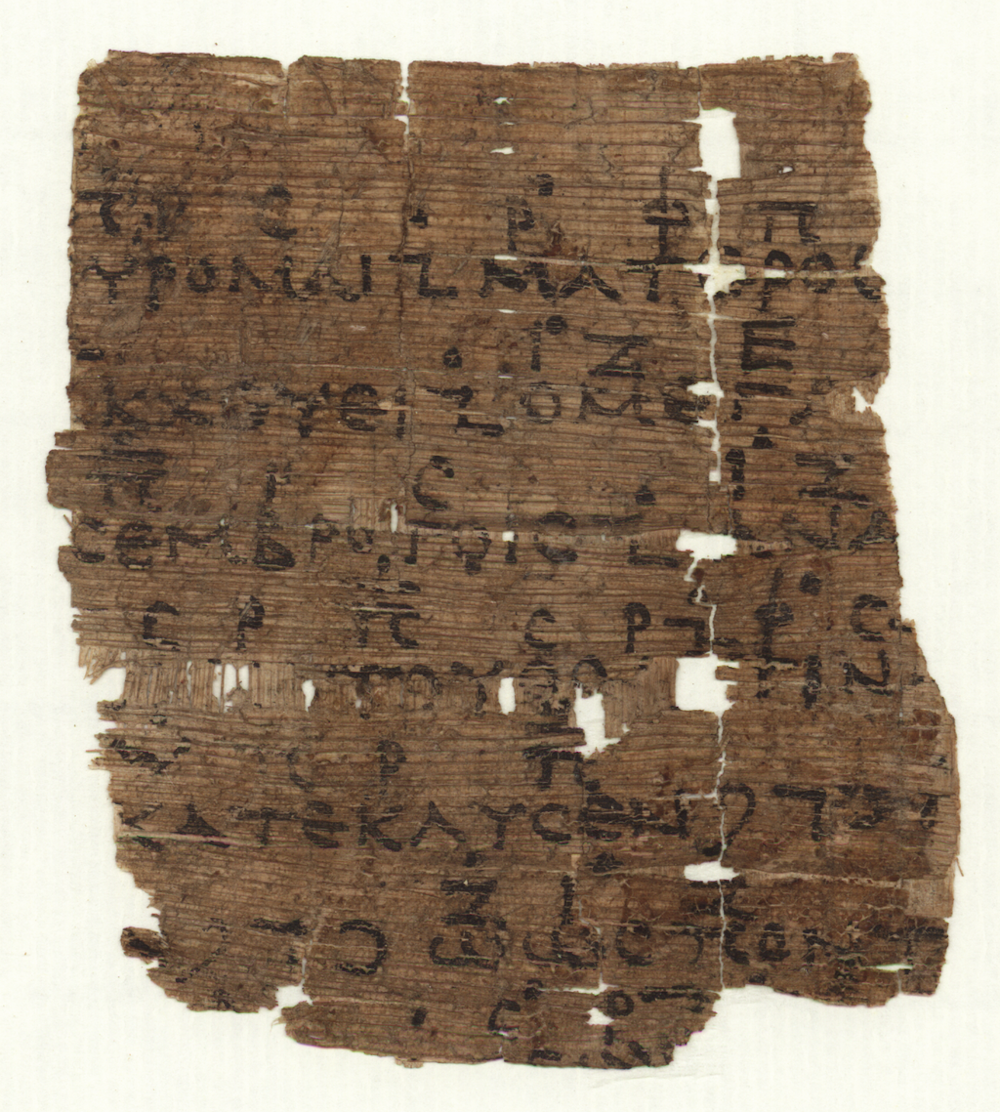
More documents with ancient notation on papyrus or stone have intermittently come to light since 1581, and now around 60 fragments exist. Carefully compiled, transcribed, and interpreted by scholars such as Martin West and Egert Pöhlmann, they give us a better chance of understanding how the music sounded.
Ancient Greek music performed
The earliest substantial musical document, found in 1892, preserves part of a chorus from the Athenian tragedian Euripides’ Orestes of 408BC. It has long posed problems for interpretation, mainly owing to its use of quarter-tone intervals, which have seemed to suggest an alien melodic sensibility. Western music operates with whole tones and semitones; any smaller interval sounds to our ears as if a note is being played or sung out of tune.
But my analyses of the Orestes fragment, published earlier this year, led to striking insights. First, I demonstrated that elements of the score clearly indicate word-painting – the imitation of the meaning of words by the shape of the melodic line. We find a falling cadence set to the word “lament”, and a large upward interval leap accompanying the word “leaps up”.
Second, I showed that if the quarter-tones functioned as “passing-notes”, the composition was in fact tonal (focused on a pitch to which the tune regularly reverts). This should not be very surprising, as such tonality exists in all the documents of ancient music from later centuries, including the large-scale Delphic Paeans preserved on stone.
With these premises in view, in 2016 I reconstructed the music of the Orestes papyrus for choral realisation with aulos accompaniment, setting a brisk tempo as indicated by the metre and the content of the chorus’s words. This Orestes chorus was performed by choir and aulos-player at the Ashmolean Museum, Oxford, in July 2017, together with other reconstructed ancient scores.
It remains for me to realise, in the next few years, the remaining few dozen ancient scores, many extremely fragmentary, and to stage a complete ancient drama with historically informed music in an ancient theatre such as that of Epidaurus.
Meanwhile, an exciting conclusion may be drawn. The Western tradition of classical music is often said to begin with the Gregorian plainsong of the 9th century AD. But the reconstruction and performance of Greek music has demonstrated that ancient Greek music should be recognised as the root of the European musical tradition.




 Meanwhile, an exciting conclusion may be drawn. The Western tradition of classical music is often said to begin with the Gregorian plainsong of the 9th century AD. But the reconstruction and performance of Greek music has demonstrated that ancient Greek music should be recognised as the root of