Tomi Lahren is aligning herself very closely with the NRA in the wake of two mass shootings that stole the lives of 31 people in El Paso and Dayton over the weekend. The anti-LGBT hyper-partisan Fox Nation host who has been called “white power Barbie” told “Fox and Friends” viewers Wednesday morning that gun rights are gay rights, after airing a clip from her interview with the NRA’s social media manager.
“You know, when I interviewed Billy McLaughlin it was actually during Pride month. He wrote an excellent article in The Washington Post talking about how gun rights are also LGBT rights and he also happens to be gay and the social media director of the NRA in his 20’s, so the NRA really does represent everybody,” Lahren claimed, falsely, while also plugging her Fox Nation show.
“Gun rights really are human rights and he attests that perfectly,” she concluded. Her remarks were toward the end of her segment in this Fox News video:
Earlier in the segment Lahren attacked liberals for what she called “liberal privilege,” which she literally defined as liberals having the belief they can criticize anyone they want, then pivoting to the false claim that “gun rights are human rights.”
She lamented, “Sadly, at least in Boston, straight people aren’t allowed to parade their heterosexuality for all to see,” while claiming it is “open-season on straight white men in this country.”
"We all know it's an important issue. The question is, will they take action right now before more kids die in their schools, before more people die at the mall, before more people die in their places of worship?"
Sen. Susan Collins fled Tuesday when asked directly by a college student whether she would take concrete action to push for gun control legislation that could prevent the deaths of more children in mass shootings.
Bowdoin College student Livia Kunins-Berkowitz approached Collins and her staffers Tuesday afternoon in Portland, Maine to ask if the Republican senator would join her colleagues on both sides of the aisle to demand that Senate Majority Leader Mitch McConnell (R-Ky.) reconvene the Senate for a vote on the universal background checks legislation passed by the House earlier this year.
"Sen. Collins, are you going to call for an emergency vote on gun control now?" Kunins-Berkowitz asked as Collins exited a building and walked to her car with two aides. "We need the Senate to meet right now to talk about gun control. Yes or no, Senator?"
The senator briefly rolled down her window after entering the car to tell Kunins-Berkowitz that she believes gun control is "important" but didn't answer her question even after the student said unequivocally that "more kids are going to die" if universal background checks legislation and other reforms are not passed now.
"I'm scared to go to school, I'm scared to go to my synagogue," Kunins-Berkowitz said. "We need a session right now or more kids are going to die."
The confrontation came just days after 31 people were killed in two mass shootings in El Paso, Texas and Dayton, Ohio over the weekend. Shortly after the massacres, Sens. Bernie Sanders (I-Vt.) and Sherrod Brown (D-Ohio) were among the lawmakers who demanded that McConnell call the Senate back from its August recess to vote on universal background checks legislation.
"She kept saying, 'It's an important issue,' but didn't answer yes or no on an emergency Senate meeting," Kunins-Berkowitz said after the encounter. "She kind of avoided the question even when I said kids are dying in our schools."
"We all know it's an important issue," she added. "The question is, will they take action right now before more kids die in their schools, before more people die at the mall, before more people die in their places of worship?"
The corruption scandal at the National Rifle Association expanded on Tuesday night when The Washington Post published a bombshell report about the right-wing organization seeking to buy a "luxury mansion" for its chief executive officer.
"Documents indicate that National Rifle Association planned to purchase a luxury mansion in the Dallas area last year for the use of chief executive Wayne LaPierre, according to two people familiar with the records," the newspaper reported. "The discussions about the roughly $6 million purchase, which was not completed, are now under scrutiny by New York investigators."
The newspaper reported "The New York attorney general’s office is now examining the plan for a NRA-financed mansion as part of its ongoing investigation into the gun lobby’s tax-exempt status, in which it has subpoenaed the group’s financial records, the people said."
The newspaper revealed details about the mansion.
"One property that was considered, according to an individual familiar with the plans, was a 10,000 square foot French country estate with lakefront and golf course views," The Post reported. "The four-bedroom, nine-bath home in a gated golf course community, northwest of Dallas, resembles a French chateau, with a stately boxwood-lined drive, a formal courtyard, vaulted ceilings and an antique marble fireplace, according to its online real estate listing."
The timing couldn't be worse for the embattled organization.
"The revelations that the NRA was involved in discussions about the Texas mansion come as the nonprofit is contending with the fallout from allegations of lavish spending by top executives," the newspaper reported. "Leaked documents show that the NRA paid $542,000 for private jet trips for LaPierre, including a trip to the Bahamas with his wife after the Sandy Hook shooting and an array of Italian designer suits as well as the rent for a summer intern’s apartment."
In response to the week of mass shootings, people have taken to the streets, begging leaders to "do something" to keep Americans safe from the terror they face of these shooters.
One person asking for action is a 9-year-old girl, who joined a group demanding action. Holding a sign reading: "DO SOMETHING," the girl held vigil in Carroll, Iowa. She was met by a man in a truck, who shouted "f*ck you!" at her.
She's hardly the first to demand that something be done to protect Americans. Singer/songwriter Kacey Musgraves led her audience crowd in a chant of "somebody f*cking do something."
She said that she can't believe the country is being forced to process the death and carnage that happened over the course of just one week in the United States.
When Ohio Republican Gov. Mike DeWine addressed a vigil in Dayton, he too was met with a crowd shouting over him. "Do something!" they demanded.
House Speaker Nancy Pelosi (D-CA) and members of the Congress are willing to cut their August recess short to come back to pass stricter background checks and an assault weapons ban. Senate Majority Leader Mitch McConnell (R-KY), however, is unwilling to do that.
On Tuesday, Dayton Mayor Nan Whaley held a press conference in the aftermath of a deadly mass shooting -- the second one in one weekend.
Whaley once again criticized the president, saying that she was disappointed in Trump's remarks about the shooting. She said that he’d failed to offer any significant proposals to regulate guns. She also voiced her displeasure that the President had initially mistaken Dayton for Toledo.
"May God bless the memory of those who perished in Toledo, may God protect them. May God protect all of those from Texas to Ohio. May God bless the victims and their families," Trump said from the White House on Monday.
"Look, I'm disappointed with his remarks," Whaley said. "I think they fell really short. He mentioned gun issues one time," Whaley said.
"I think, you know, watching the president over the past few years on the issue of guns he's been -- I don't know if he knows what he believes, frankly," she said.
A reporter prodded her about the president confusing Dayton and Toledo.
"My immediate reaction is that people from the coast never understand Ohio and they think all Ohio cities are the same. It's an exhausting issue that we have all the time," she added.
"You know, if we had people from power centers really invest and pay attention to our communities, we'd all be better off."
The facts on the US children and teens killed by firearms
Injury is the leading cause of death for U.S. children and adolescents, accounting for over 60% of all deaths in this group.
Many of these deaths occur during fun, everyday activities, like swimming in the backyard pool or during a family car ride. But a disproportionate and disturbing number of these deaths in the U.S. occur as a result of firearms.
Firearms are the second leading cause of death among U.S. children and adolescents, after car crashes. Firearm deaths occur at a rate over three times higher than drownings.
Wehavededicated our careers to understanding violence and injury prevention, including how firearm injury and deaths happen and how they can be prevented.
Causes of injury and death due to motor vehicle crashes have steadily declined over the last 20 years, but death and injury due to firearms has remained about the same over the same period.
Rates of death from firearms among ages 14 to 17 are now 22.5% higher than motor vehicle-related death rates. In the U.S., middle and high school age children are now more likely to die as the result of a firearm injury than from any other single cause of death.
For Americans between the ages of 1 and 19, a little over half of 2017 firearm-related deaths are homicides.
Another 38% of firearm-related deaths in this age group are suicides, while the rest result from unintentional injuries or undetermined causes.
What’s more, the U.S. has had 1,316 school shootings since 1970. The numbers of these tragic events have been increasing, with 18% of the total occurring in the past seven years since the Newtown school shooting at Sandy Hook Elementary School.
School shootings are a focus of media attention and raise awareness about the problem of firearm deaths among children and teens. But they remain the smallest proportion of deaths, accounting for 1.2% of all homicides among 5 to 18-year-olds.
Death disparities
African American children and teens are over eight times more likely to die from firearm homicide than their white counterparts. Firearms have been the leading cause of death for African American youth for well over a decade.
Firearm suicide rates are highest among American Indian/Alaskan Native and white children and teens, compared to other racial/ethnic groups.
Although firearm-related rates of death for children and teens living in urban, suburban and rural communities are similar, rural rates of firearm suicide are twice as high and unintentional firearm injuries are four times higher than in urban communities. Meanwhile, firearm homicide rates are twice as high in urban than in rural communities.
A uniquely American epidemic
The U.S. stands out among high-income countries: Over 90% of all the firearm deaths among children and adolescents that occur in industrialized nations occur in this country.
Two-thirds of households have more than one firearm and almost one-third have five or more firearms. Firearms may have different purposes – deer hunting, shooting competition, target practice and so on – which may explain why so many households own more than one gun.
Pew’s data indicates that 54% of firearm owners with children under 18 living in the home have their firearms locked away. This suggests to us that young children and teens may have relatively easy access to unsecured firearms.
Government sponsorship of research focused on firearm has been virtually eliminated by an annual appropriations amendment, first added by Arkansas Congressman Jay Dickey in 1996.
Recently, academics, the National Institutes of Health, state governments and private foundations have begun to renew the focus on research to prevent firearm injuries and fatalities. This is due largely to changes in public opinion about firearms as mass shootings keep occurring.
Established in 2017 with NIH funding, the Firearm Safety Among Children and Teens (FACTS) Consortium is one of these efforts, with a focus on conducting critical firearm injury prevention research while respecting legal and safe firearm ownership. We lead FACTS, in which academics from 14 universities from around the country are involved.
Members of this consortium have begun to investigate key research questions, such as the best methods for health care providers to counsel families about safe firearm storage, interventions to decrease firearm suicide risks among rural teen households, and the effect of state firearm laws on school shootings.
Just as other public health problems have turned to scientific evidence to prevent injuries, we feel that the U.S. should use evidence to inform policies that protect children and teens. Much more can be done to address this vital public health problem.
Sen. Pat Toomey (R-PA) said on Tuesday that he would not support a ban on assault-style rifles because they are "very popular."
Toomey made the remarks after Fox News host Sandra Smith asked him if Republicans would do anything to prevent mass shooters from getting magazines that hold up to 100 rounds of ammunition.
"My focus is on keeping guns out of the hands of people who should not have guns, people who have no legal right to a firearm," Toomey insisted. "Guns that are described as assault weapons are almost invariably no more powerful than regular hunting rifles."
"They are no more lethal," he continued. "They are extremely popular, so to ban an extremely popular firearm, I’m not going to support that, that would be an infringement on the rights of law-abiding citizens."
Fox News host Rick Leventhal agreed: "You will never get rid of all of them."
"Nor should we because the vast overwhelming majority of Americans are not a threat to anyone," Toomey replied. "I own firearms. I’m a big believer in the Second Amendment. I’m not a threat to anyone."
The Constitution does not explicitly mention a right to own assault-style rifles and the U.S. Supreme Court has ruled that certain types of weapons can be outlawed.
"If you confiscated my guns, no one would be any safer, and we should bear that in mind," Toomey said. "What we have to focus on is keeping them out of the hands of the violent criminals, those who are mentally ill. Those are the people that are committing these massacres."
In fact, it is a myth that most mass shootings are carried out by mentally ill people.
Former FBI director of counterintelligence Frank Figliuzzi explained how President Donald Trump fooled the nation into thinking he renounced racism and white supremacy.
In an interview with BBC Newsnight, Figliuzzi said white nationalists will continue to believe Trump is on their side even after his speech on the mass shootings in El Paso and Dayton.
"Who is it that seems to be empowering and giving these people license?" Figliuzzi said. "It happens to be the president of the United States."
"At his press conference, we did not hear what we needed to hear," he continued, "him personalize this and say, 'I condemn racism, I condemn white hate and bigotry.' Instead, [he] instructed the nation to condemn it."
According to Figliuzzi, white nationalists will see that as a sign that Trump is "still with them."
"That's going to be interpreted by many extremists as lip service that he has to say because of his office," the former FBI official pointed out. "And they're going to feel like he's still with them."
The recent shooting attack in which a young white man is accused of killing 22 people in a Walmart in El Paso fits a new trend among perpetrators of far-right violence: They want the world to know why they did it.
So they provide a comprehensive ideological manifesto that aims to explain the reasoning behind their actions as well as to encourage others to follow in their steps.
In the past decade, the language of white supremacists has transformed in important ways. It crossed national borders, broadened its focus and has been influenced by current mainstream political discourse.
I study political violence and extremism. In my recent research, I have identified these changes and believe that they can provide important insights into the current landscape of the American and European violent far-right.
The changes also allow us to understand how the violent far-right mobilizes support, shapes political perceptions and eventually advances their objectives.
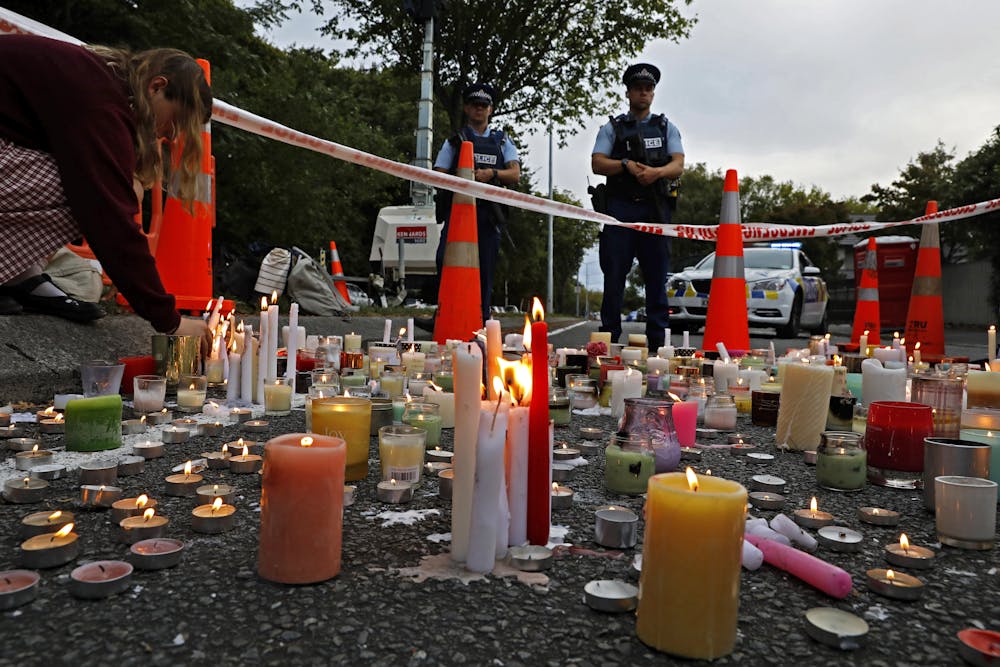
A vigil to commemorate the 50 victims of a March 15 shooting in Christchurch, New Zealand, in which the accused shooter issued a 74-page manifesto prior to the massacre.
For example, in the 1980s, a Ku Klux Klan affiliate published a map allocating specific parts of the U.S. to specific ethnic communities. The map makers imagined Jews limited to the New York area, while Hispanics were to live in Florida.
But recently, a growing number of far-right activists have preferred to focus on cultural and social differences between communities, rather than on attributes such as race and ethnic origin.
They justify their violence as a way to preserve certain cultural-religious practices, rather than relying on their old justification – maintaining the genetic purity of the white race. In these activists’ view, the battle has moved from genes to culture.
For example, a member of the National Socialist Movement, an American neo-Nazi organization, wrote in a 2018 online post that white American is an identity like African American or Jewish American. In a statement that probably wouldn’t have been made by previous generations of neo-Nazis, the member wrote that all whites should come together, using their knowledge and weapons, to stop non-Europeans from pushing their secular agenda via government and media power.
Countering liberal left’s cultural influence
Another traditional theme of the far-right discourse – preserving the patriarchal order from attacks from the left – has grown in prominence.
Andres Breivik, who killed 77 people and injured more than 300 in July 2011 in Europe’s most lethal act of white supremacism, issued a manifesto shortly before his rampage.
In it, he stated that the politically correct terminology which is becoming more prevalent in the West intends to “deny the intrinsic worth of native Christian European heterosexual males” who were reduced to an “emasculate[d] … touchy-feely subspecies.”
Such sentiments are becoming more prevalent in the white supremacist forums, and reflect another component of what they perceived as an ongoing cultural war to preserve the white Christian way of life.
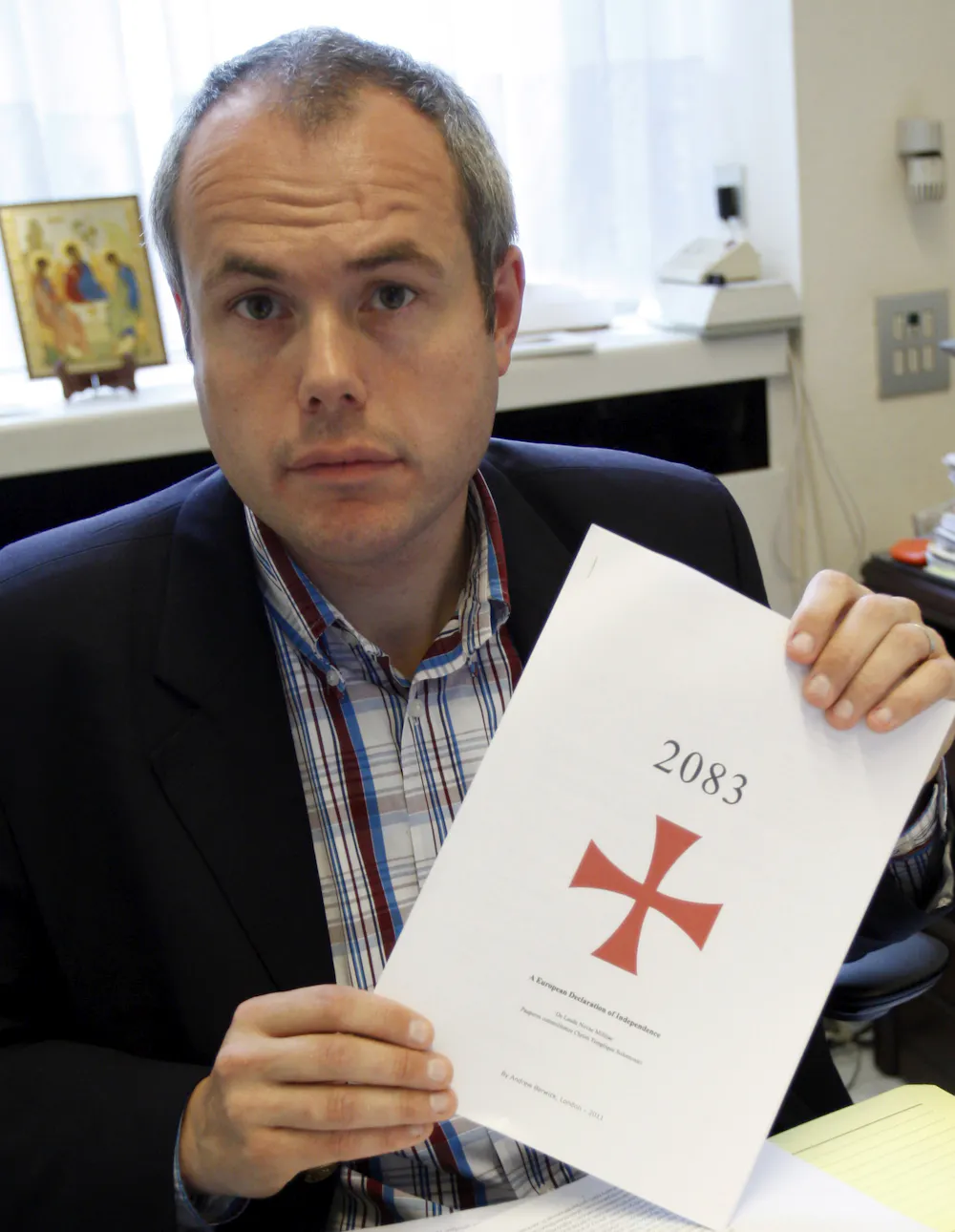
Belgian Flemish right-wing party member Tanguy Veys holds a copy of a manifesto sent to him and written by Anders Behring Breivik, who killed 76 people in twin attacks in Norway in 2011.
Racial identity was always a prime component in the identity of far-right activists, but it was usually framed by local politics. In the past, racist British skinheads focused mainly on what they perceived as the interests of the British white working class. Today the rhetoric of most skinheads focuses on international geopolitics, although local issues haven’t been abandoned.
In the U.S., what’s different about the current rhetoric of the far-right is that they are now using terminology that can also be found in some mainstream political parties and movements, aiding their efforts to gain popular legitimacy.
For example, the United Northern and Southern Knights of the Ku Klux Klan released a new set of organizational goals a couple of years ago. Beyond their longstanding, bedrock belief – the protection of the white race – they also declare support for restricting immigration and free trade and ending or limiting foreign aid. They want government to provide protection to small businesses, agricultural workers and gun owners.
This broad ideological shift also spilled over to some far-right skinhead organizations. Volksfront, for example, declares in its online mission statement that beyond white nationalism, the organization will fight for economic issues, states’ rights, crime repression and labor rights.
U.S. President Donald Trump’s language about the need to restore order to the streets of America, as expressed in his inaugural address, is also evident in the language of American white supremacists. In a poster produced by the skinhead group Keystone United, they call for harsher punishments for drug dealers.
The demand for stricter punishment of criminals is echoed in many racist group platforms. These include support of death penalty expansion, an important point of discussion mainly in skinhead message boards, and levying harsher punishments for sexual offenses.
Since minorities are overrepresented among American incarcerated population, far-right activists see these criminal justice policies as a more “legitimate” way to “punish” members of minority groups.
Two future trends
These changes in the discourse of the far-right suggest two important trends.
Second, the growing overlap between the language of the far-right and the rhetoric of elected officials illustrates how the current polarization in the political system, and delegitimization of minorities by political leaders, can provide legitimacy for radical practices and violence and broader acceptance of ideas, concepts and statements that in the past were the domain of the far-right.
President Donald Trumpcalled for reform of mental health laws on the heels of two deadly shootings that claimed the lives of at least 31 people and left a grief-stricken country in disbelief.
These sentiments are similar to comments that Trump and a number of other politicians have made previously. For example, after the Parkland shooting, which claimed the lives of 17 – 14 of whom were students – Trump said he thought due process for mentally ill people was not as important as making sure that they do not have guns.
“I don’t want mentally ill people to be having guns. Take the guns first, go through due process second,” Trump said.
In the past, mental illness has been scapegoated to deflect public outrage about access to assault rifles that can kill tens of people in a matter of minutes. During these heated debates, words such as “crazy,” “nuts” and “maniac” are used to describe the person who committed the act of violence, even before a medical diagnosis is released.
In this debate, many questions arise that those discussing mental illness and gun violence may not even think about: What do we mean by mental illness? Which mental illness? What would be the policies to keep guns away from the potentially dangerous mentally ill? Most of these questions remain unanswered during these discussions.
Specifically, no one suggests who will decide whether a patient with mental illness should not have access to firearms – would it be a psychiatrist, an independent forensic psychiatrist, a committee of psychiatrists or a judge? How about those who do not seek psychiatric evaluation and treatment? Should a psychiatric examination be integrated into the background check process for each person who wants to purchase a gun? As severe mental illness can start at any point in life, will gun owners need periodic psychiatric assessment (like a vision exam for renewing a driver’s license)? Who will pay for the visits?
As an academic psychiatrist, here’s my perspective on the complexities of this issue.
What is mental illness?
The term “mental illness” covers a wide range of psychiatric conditions that are addressed and treated by mental health professionals.
You may be surprised to know there are more than 200 diagnoses listed in the most recent version of Diagnostic Statistical Manual of Mental Disorders, which is released by the American Psychiatric Association. This includes conditions such as anxiety disorders like spider phobia, social phobia, social anxiety disorder, post-traumatic stress disorder, hair-picking, pathological gambling, schizophrenia, dementia, different forms of depression and personality disorders, such as antisocial personality disorder commonly known as psychopathy.
Now, when one suggests that gun access should be restricted for people with mental illness, do they mean all of these conditions? Or just some, or some in defined circumstances? For example, should we remove guns from all veterans with PTSD, or all people with social anxiety, or those who habitually pick their skin?
Needless to say that diagnosing these conditions mostly relies on the person’s report and the physician’s observation, and the ability to rely on their report is important.
When can a person be potentially dangerous to others?
Not all mental illness may be a risk of harm to others. In the majority of cases when a patient is involuntarily admitted to a psychiatric inpatient unit, it is not because the person is a risk to others. Rather, it is more often the case that the person is at risk of harming himself, as in the case of a depressed, suicidal patient.
In psychiatric disorders, concerns about harm to others typically arise in acutely psychotic patients with paranoid delusions that convince them to harm others. This may happen in, but is not limited to schizophrenia, dementia, severe psychotic depression or psychotic bipolar illness.
Substance use, which can increase the risk of crime or psychosis, can also lead to intentions to harm others. Other situations, when a person could be a risk of harm to others, are personality disorders with a high level of impulsivity or lack of remorse, such as antisocial personality disorder.
But the reality is that most people with personality disorders do not seek treatment and are not known to mental health providers.
It’s important to note that those with diagnosed serious mental illness, who are determined by a psychiatrist to be a serious risk of harm to themselves or others, already get admitted to acute or long-term inpatient care and are kept there until they are deemed not dangerous. Of course this happens only if they are brought in for psychiatric evaluation by others or law enforcement.
What are the facts?
Even among the 1% of the U.S. population with a diagnosis of schizophrenia, it is rare to find people who are a risk of harm to others or at risk of acting violently. Despite the widespread belief that a person with serious mental illness like bipolar disorder or schizophrenia can be dangerous, only 3% to 4% of all the violent acts committed in a given year in the U.S. are committed by people who have been diagnosed with commonly cited mental illness of schizophrenia, bipolar disorder or depression.
Also, these conditions are rather strongly associated with increased risk of suicide, not homicide. Furthermore, risk of violence among severely mentally ill declines in the absence of substance use. In other words, prevention and treatment of substance use can decrease the risk of violence in this population.
Another fact to consider is that the prevalence of severe mental illnesses, is relatively similar across different countries, including those with much lower rates of mass murder than the U.S.
Finally, one has to keep in mind that the presence of a psychiatric diagnosis in a murderer, does not necessarily justify causality, as much as the weapon the person carries. In other words, because mental illness is so prevalent, a percentage of crimes are, statistically, going to be committed by people with a mental illness.
When “mental illness” is so vaguely addressed in gun debates, those with a mental illness without an increased risk of violence or impairment in judgment (such as anxiety or phobia) may avoid seeking treatment. I have often had patients who were worried that their diagnosis of depression or anxiety, although well-treated, might be used against them in court regarding child custody. I have repeatedly had to explain to them that their disorder does not provide grounds for justification of impaired judgment.
I personally believe it is common sense to limit everyone’s access to weapons with the potential of killing tens of people in a matter of minutes. Choosing who may or may not have access to them based on mental illness is, as I’ve outlined, very hard indeed.
This is an updated version of an article that originally appeared March 1, 2018.
In a manifesto posted online shortly before he went on to massacre 22 people at an El Paso Walmart, Patrick Crusius cited the “invasion” of Texas by Hispanics. In doing so, he echoed President Trump’s rhetoric of an illegal immigrant “invasion.”
Think about what this word choice communicates: It signals an enemy that must be beaten back, repelled and vanquished.
Yet this sort of language – what I call “warspeak” – has relentlessly crept into most aspects of American life and public discourse.
After the Columbine shooting, I started writing about how “gunspeak” – the way everyday turns of phrase, from “bite the bullet” and “sweating bullets,” to “trigger warnings” and “pulling the trigger” – reflected a society obsessed with guns.
But warspeak’s tentacles extend much further. Words and phrases derived from war imagery crop up in advertisements, headlines and sports coverage. They’ve inspired an entire lexicon deployed on social media and in politics.
The intent might be as benign as the creative use of language. But I wonder if it communicates larger truths about American violence and polarization.
The political battlefield
For decades, America has been fighting metaphorical wars – wars on heart disease, drugs, smoking, cancer, poverty, advertising and illiteracy.
Then there are the culture wars, which have intensified recently to include wars on Christmas, abortion, bathrooms, cops and women. These are different: They involve people on two sides of a polarizing issue.
War targets an enemy – someone or something to be defeated, using whatever means necessary. It’s one thing when you’re at war with a disease. It’s quite another when you’re at war with a group of people on the other side of a political issue.
The political arena seems to have become especially fertile ground for warspeak.
Otherwise boring legislative machinations have been energized with the drama of a life or death struggle. The Republican-controlled Senate uses a “nuclear option” to confirm judges by a simple majority of 51 votes rather than the older standard of 60 votes. Senate Majority Leader Mitch McConnell’s ability to speed along the appointment of conservative judges constitutes the latest volley in a “judicial arms race.”
Elections deploy the language of military campaigns. Republican donors and lawmakers warned Trumpof a potential bloodbath before the 2018 midterm elections. Meanwhile, Democrats running for president strategize in their campaign “war rooms” for ways to build up “war chests” that will leave them with enough funds to compete in the “battleground states.”
The political media reinforces it all. In its coverage of the July primary debates, The New York Times wrote that the moderates were “throwing firebombs” at the progressives. Cory Booker, the “happy warrior,” sparred with former Vice President Joe Biden who “took incoming fire” all night, but “shot back” and survived, even as moderator Don Lemon “threw a generational warfare bomb.”
Our semantic arsenals
Then there are the less obvious ways warspeak has become part of everyday speech.
Baseball players mash bombs while basketball players drain three-point bombs. Social media is replete with photobombs and tweet bombs, and there are so many bombshells on cable news, it’s a miracle your TV hasn’t exploded.
Everything has been “weaponized.” According to Google’s Ngram Viewer, the use of the word in print has increased by more than a factor of 10 between 1980 and 2008.
Then there are the warriors in our midst – the weekend warriors, gridiron warriors, keyboard warriors and spiritual warriors – while the country’s future software engineers sign up for coding boot camps to learn their trade.
We’re all in the trenches, and most of us don’t even know it.
Why warspeak matters
Semantic wars, like all wars, are costly. But the role of warspeak in today’s society isn’t as easily quantified as a military budget or body count.
Nonetheless, I believe warspeak matters for three reasons.
First, it degrades our ability to engage with one another about important issues. Law professors Oren Gross and Fionnuala Aolain have written about how the framing of issues as a “war” can “significantly shape choices.” There is an urgency that’s communicated. Instantaneous action is required. Thought and reflection fall by the wayside.
Second, in the context of politics, warspeak seems to be connected to violent political attitudes. In 2011, researchers at the University of Michigan found that young adults exposed to political rhetoric charged with warspeak were more likely to endorse political violence.
Finally, if everything from weather to sports is charged with violent imagery, perceptions and emotions become needlessly distorted. Political carnage and carnage in the classroom, weaponized songs and weapons of war, snipers on the hockey rink and mass shooters – all blur together across our cognitive maps.
There’s a reason why writers, talking heads and politicians deploy warspeak: It commands people’s attention in an increasingly frenzied and fractured media environment.
I wonder, however, if it contributes to political polarization – what Pew Research describes as the “defining feature of American politics today.” And I wonder if it’s one reason why, according to Gallup, Americans’ stress, worry and anger increased in 2018, to the highest point in a dozen years.
One thing is clear: Americans no longer need to be enlisted in the Army to suffer from battle fatigue or be shell-shocked by the latest mass shooting.
The anchors were joined by Rep. Veronica Escobar (D-TX), who represents El Paso in Congress.
"The president has used the words in the clips that you've shown that have caused a tremendous amount of pain and that have fueled violence. Those words are still hanging out there. He needs to recognize his role. He needs to recognize that those words have power. He needs to apologize, and he needs to take them back," Escobar demanded.
"You know, we were told by law enforcement earlier that we have to be concerned about copycat acts of violence. It would go a long way for the president to say, 'I used racist language, I used words that dehumanized people and I was wrong and I take them back.' Only after he does that should he be welcomed into our community," she explained.
The anchors were astonished Trump is unwanted in El Paso.
"Can I just say it's such a weird thing, though, to be at a place in our country where after a national tragedy, the president isn't welcome," Wallace said. "It is such -- you just have to stop sometimes in these jobs and point out when it is not normal."
"Clearly there are meaningful differences of opinion here, but to see the emotion with which the congresswoman was conveying that -- not only for herself but for her constituents -- that they feel he is the cause of so much pain, that is profound when you talk about national leadership," Maddow said.
"I'd like to see the perimeter of every school in America surrounded, secured by retired police ... military and I want guys to donate fifteen hours," Hannity explained.
"I think we could cover every school, every hour -- add a metal detector and I think we're going to have better schools,"
"Have one armed guard on every floor of every school, all over every mall, the perimeter and inside every hall of every mall."