An employee of a Hampton Inn in South Carolina has been fired after calling the police on a Black woman who tried to use the hotel's swimming pool with her children, USA Today reports.
The incident was captured on video and shared across social media. In the video, a white hotel employee and two police officers approach Anita Williams-Wright and ask her to prove she's staying at the hotel.
"I feel it's discrimination. I have a room here," Williams-Wright said in the video, while holding up her room key. "This lady here is discriminating [against] me. I have a key to get in and I can show you that it works… I have a room here. I don’t have to give my name. I didn’t break the law."
According to Williams-Wright, the hotel employee didn't ask anyone else at the pool to prove they were staying at the hotel.
"It was two white people sitting over there and she said nothing to them," Williams-Wright said in the video. "She said to me, 'Oh, because it’s always people like you using the pool unauthorized.' Who is people like me?"
Williams-Wright refused to provide identification, saying she wasn't required to because she "didn't commit a crime." Officers then ran her license plate.
Hampton by Hilton's Gandhi Buckley gave a statement to USA Today, saying the company has "apologized directly to the guest and her family for their experience, and will work with them and the hotel to make this right."
"We remain in contact with the hotel’s ownership about follow up actions, and to ensure that in the future, their employees reflect the best values of our brand and are welcoming of all," Gandhi Buckley added.
"Hampton by Hilton has zero tolerance for racism or discrimination of any kind. On Saturday, we were alerted to an online video of a guest incident at one of our franchise properties," Gandhi Buckley continued. "The team member is no longer employed at the hotel."
The TrumpWhite House is continuing its stall and denial program, with its latest entrant, National Security Advisor Robert O'Brien releasing a statement in Tuesday's early morning hours. In it, O'Brien claims President Donald Trump was never briefed on the Russian program of paying the Taliban to kill U.S. troops, and puts the blame for him not being briefed – a claim debunked by multiple press reports – on the press.
"Over the past several days, the New York Times and other news outlets have reported on allegations regarding our troops in Afghanistan," O'Brien says in his statement, never mentioning Russia.
"While we do not normally discuss such matters, we constantly evaluate intelligence reports and brief the President as necessary. Because the allegations in recent press articles have not been verified or substantiated by the Intelligence Community, President Trump had not been briefed on the items."
O'Brien says Trump hasn't been briefed "on the items," while not saying what "the items" are. More importantly, a report from the Associated Press says former Trump National Security Advisor John Bolton has said he briefed Trump in March of 2019 on the intelligence showing Russia was offering bounties to the Taliban to kill American soldiers. And The New York Times reports Trump was briefed in writing back in April.
O'Brien goes on to say, "should the situation warrant action," Trump will be briefed.
So far, top Republicans have been briefed. NATO has been briefed. The UK has been briefed. Top Democrats today will be briefed. But the president, allegedly, has not been briefed, nor are there plans to do so, according to the National Security Advisor.
O'Brien then threatens administration officials about leaking.
"To those government officials who betray the trust of the people of the United States by leaking classified information, your actions endanger our national security. No matter the motivation, there is never a justification for such conduct," he says.
Russia paying terrorists to kill American soldiers is never mentioned.
O'Brien then offers praise for the Commander-in-Chief.
“Let me be clear that there is nothing more important to President Trump than America’s security and the safety of our men and women in uniform. He has demonstrated this commitment time and again.”
The resurgence of COVID-19 in the United States is putting President Donald Trump's reelection chances in even greater peril, and Axios's Jonathan Swan reports that many Trump advisers are feeling "widespread panic" about what's to come.
According to Swan, new COVID-19 outbreaks in states such as Florida, Texas, and Arizona have dampened "early optimism about a booming economic comeback" that would push Trump back into contention with former Vice President Joe Biden.
Aides have also been taken aback by the sparse attendance at his infamously botched rally in Tulsa, Oklahoma, as it seems "advisers have recognized that Trump's elderly base is more fearful of the virus than previously realized."
Most significantly, writes Swan, Trump keeps shooting himself in the foot.
"Trump, relentlessly, keeps committing egregious self-defeating acts -- the latest being tweeting a video in which an elderly supporter chants 'white power,'" he writes.
A key reason Republicans have stuck with President Donald Trump through scandal after scandal is that he has appointed dozens of right-wing judges to the federal bench.
The president has appointed more judges in a single term than any president since Jimmy Carter, and completely filled all vacancies on appellate courts for the first time in decades. Many of these judges hold extreme political views, and most of them are very young, so they can stay on the bench for decades. Republicans hope this domination of the courts will let them set policy for years after they are voted out.
However, writing for The Washington Post on Tuesday, Bill Scher argued the GOP's decision to gamble their principles for a conservative federal bench was probably a bad deal — because they likely won't control the courts for as long as they think.
"Of Trump’s 200 judges, 198 are on lower courts: 143 district-level judges, two international trade judges and 53 appellate-level judges. Another 44 lower-court nominees are in the pipeline, though there’s no guarantee all will get confirmed. But for the sake of comparisons, let’s assume Trump tally ends up at 242 lower-court judges," wrote Scher. If Trump loses in 2020, which he currently seems on track to do, "he will nevertheless be outdone on judicial confirmations by his most immediate predecessors: Barack Obama got 327 lower-court judges, George W. Bush 326 and Bill Clinton 376."
Moreover, he wrote, "The Democrats may well get their turn starting in January. Among the appellate court judges, 77 will be 65 years of age by the end of this year. Most of these older judges will be eligible to move to 'senior' status, in which the judge takes on a reduced workload while creating a full-time vacancy. The routine churn of judicial vacancies will not end with the Trump presidency."
Even Trump's two Supreme Court appointments didn't make as big a difference as Republicans were hoping, argued Scher: "This supposedly die-hard conservative Supreme Court has blocked Trump from canceling Obama’s Deferred Action for Childhood Arrivals, thwarted Trump’s attempt to put a citizenship question in the U.S. Census, sided against the Trump administration’s attempt to constrain the application of the Clean Water Act, eased the ability of consumers to pursue antitrust claims against major corporations and expanded the workplace rights of transgender employees. And on Monday, the court refused to let states weaken Roe v. Wade with debilitating restrictions on abortion clinics. In some of these cases, one of Trump’s appointees joined the court’s liberals in the majority."
"Of course, conservative judges will still rule conservatively most of the time," wrote Scher. However, "The paradoxical combination of lifetime judicial appointments and the perennially shifting political winds make it difficult for one political faction to place a permanent hammerlock on our courts. There are structural limits to how successful any attempt can be at manufacturing a judicial sea change."
"If Democrats win big in 2020, they will again get their turn at shaping the judiciary," Scher concluded. "And Republicans will have to ask if they paid too steep a price."
An Oklahoma Nazi sympathizer is accused of shooting a partygoer who was dared to snatch one of his swastika flags.
The victim had been at a party across the street from Alexander John Feaster's home in Garfield County, where he displayed a Nazi flag that had been stolen in the past, reported KFOR-TV.
“It’s never really been a problem, his flags got stolen a couple times when he first put them out but nothing ever came of it," a neighbor said. "This is the first time it’s ever come to violence. He’s been out mowing neighbors' yards and just smiling and waving at everyone.”
But the neighbor said the 44-year-old Feaster, who sported a toothbrush mustache like Adolf Hitler, sometimes wore a full black uniform in public with a red swastika armband, in addition to flying multiple Nazi flags.
The 26-year-old woman had been partying at a neighbor's house early Sunday morning when someone dared her to steal Feaster's flag, and he allegedly opened fire as she fled.
“On the way back someone hollered gun,” said Sheriff Jody Helm. “She dropped the flag at the end of the driveway and shots were fired.”
Deputies found the woman lying in a ditch with multiple gunshot wounds, and Feaster was arrested at the scene without incident.
“We recovered the suspect's rifle, and we got about 14 guns out of there and some ammunition,” Helm said after deputies executed a search warrant.
A neighbor said Feaster had been flying Nazi flags for about a year.
“Nobody really knows him,” the neighbor said. “He keeps to himself.”
Feaster remains jailed on a charge of shooting with the intent to kill and assault and battery with a deadly weapon.
The district attorney will decide whether to charge the woman in the theft of Feaster's flag.
Following up on his CNN report about Donald Trump's phone calls with world leaders that have been described as "disturbing," journalist Carl Bernstein appeared on "New Day" to describe words and terms that the president used that would likely get the president booted from office if Republicans heard them.
As the journalist noted, the president saved some of his ugliest comments for women who are leading their countries.
"First it's not just he endangered the national security but who came to the conclusion; the closest aides to the president himself in his administration," Bernstein told host John Berman. "His former secretary of state, his former chiefs of staff, his former secretary of defense, and why it is that these people are saying he endangered the national security? In part because in hundreds of phone calls with foreign heads of state, the president of the United States was unable to conduct foreign relations in a competent way and rather gave in and slavishly, in approaching Putin of Russia, Erdogan of Turkey, sought their approval, caved in their conversation to their desires rather than the established United States policy."
"On top of which, he berated and bullied America's allies, particularly women heads of state in such a way that if those people in the Congress of the United States, I'm told, heard these recordings that existed of his conversations and saw the transcripts of them, that they would be horrified and might result in the president having real trouble remaining in office," he added.
After sustained declines in the number of COVID-19 cases over recent months, restrictions are starting to ease across the United States. Numbers of new cases are falling or stable at low numbers in some states, but they are surging in many others. Overall, the U.S. is experiencing a sharp increase in the number of new cases a day, and by late June, had surpassed the peak rate of spread in early April.
When seeing these increasing case numbers, it is reasonable to wonder if this is the dreaded second wave of the coronavirus – a resurgence of rising infections after a reduction in cases.
The U.S. as a whole is not in a second wave because the first wave never really stopped. The virus is simply spreading into new populations or resurging in places that let down their guard too soon.
To have a second wave, the first wave needs to end
A wave of an infection describes a large rise and fall in the number of cases. There isn’t a precise epidemiological definition of when a wave begins or ends.
First, the virus would have to be controlled and transmission brought down to a very low level. That would be the end of the first wave. Then, the virus would need to reappear and result in a large increase in cases and hospitalizations.
In the U.S., cases spiked in March and April and then trended downward due to social distancing guidance and implementation. However, the U.S. never reduced spread to low numbers that were sustained over time. Through May and early June, numbers plateaued at approximately 25,000 new cases daily.
We have left that plateau. Since mid-June, cases have been surging upwards. Additionally, the percentage of COVID-19 tests that are returning positive is climbing steeply, indicating that the increase in new cases is not simply a result of more testing, but the result of an increase in spread.
After months of strict social distancing rules, New York has reduced its new cases to a fraction of what they were in April and is still being cautious.
Looking at U.S. numbers as a whole hides what is really going on. Different states are in vastly different situations right now and when you look at states individually, four major categories emerge.
Places where the first wave is ending: States in the Northeast and a few scattered elsewhere experienced large initial spikes but were able to mostly contain the virus and substantially brought down new infections. New York is a good example of this.
Places still in the first wave: Several states in the South and West – see Texas and California – had some cases early on, but are now seeing massive surges with no sign of slowing down.
Places in between: Many states were hit early in the first wave, managed to slow it down, but are either at a plateau – like North Dakota – or are now seeing steep increases – like Oklahoma.
Places experiencing local second waves: Looking only at a state level, Hawaii, Montana and Alaska could be said to be experiencing second waves. Each state experienced relatively small initial outbreaks and was able to reduce spread to single digits of daily new confirmed cases, but are now all seeing spikes again.
The trends aren’t surprising based on how states have been dealing with reopening. The virus will go wherever there are susceptible people and until the U.S. stops community spread across the entire country, the first wave isn’t over.
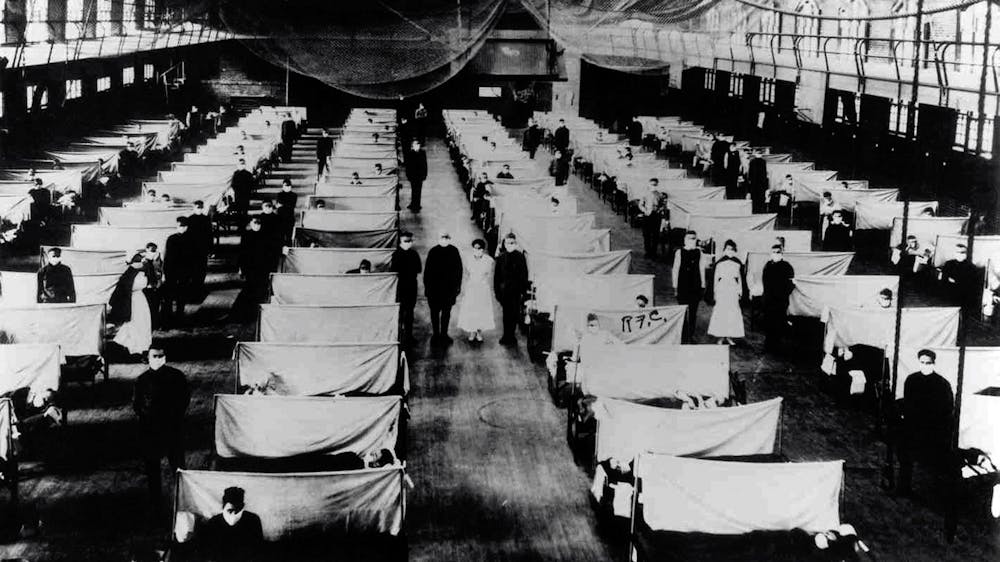
The 1918 flu came back with a vengeance after a mutation and lack of preparedness set the stage for tens of millions of deaths during the second wave.
It is possible – though at this point it seems unlikely – that the U.S. could control the virus before a vaccine is developed. If that happens, it would be time to start thinking about a second wave. The question of what it might look like depends in large part on everyone’s actions.
The 1918 flu pandemic was characterized by a mild first wave in the winter of 1917-1918 that went away in summer. After restrictions were lifted, people very quickly went back to pre-pandemic life. But a second, deadlier strain came back in fall of 1918 and third in spring of 1919. In total, more than 500 million people were infected worldwide and upwards of 50 million died over the course of three waves.
It was the combination of a quick return to normal life and a mutation in the flu’s genome that made it more deadly that led to the horrific second and third waves.
Thankfully, the coronavirus appears to be much more genetically stable than the influenza virus, and thus less likely to mutate into a more deadly variant. That leaves human behavior as the main risk factor.
Until a vaccine or effective treatment is developed, the tried-and-true public health measures of the last months – social distancing,universal mask wearing, frequent hand-washing and avoiding crowded indoor spaces – are the ways to stop the first wave and thwart a second one. And when there are surges like what is happening now in the U.S., further reopening plans need to be put on hold.
During an interview with CNN's John Berman, Rogers said that the White House didn't seem to understand the significance of the bounty story, and had changed its messaging on it multiple times in just the last few days.
"My concern was they spent more time in the first three days trying to tell folks that it was either fake news or it wasn't important or I didn't know," he said. "All of that's nonsense. I would have felt better if the president would have come out and said, 'You know what, I didn't get that brief, or at least I don't remember getting that brief, and by the end of the day, I'm going to get that brief.'"
Rogers went on to hammer the president for continuing to butter up Russian President Vladimir Putin at a time when his government is allegedly funding the targeted killings of American soldiers.
"You don't run out and invite, you know, Vladimir Putin back to the G7 right in the midst of him paying cash, maybe, to the Taliban to kill U.S. soldiers or our allies," he said. "I mean, there has to be consequences for that kind of behavior, and inviting him to the G7 isn't it, right? That's a gift."
Republicans have been skipping House Intelligence Committee hearings for months, and Democrats think they know why.
GOP lawmakers have skipped all but one of the panel's public and private meetings since Congress went into a coronavirus lockdown in early March, and Democrats accused them of a partisan boycott, reported Politico.
“It seems almost counterproductive on their part,” said committee chair Adam Schiff (D-CA). “It seems rather childish, but I hope that they will reconsider.”
Republicans insist they're concerned about cybersecurity during virtual meetings, two of which have been held on Cisco Webex, the same platform other congressional panels have used, or Microsoft Teams, which offers encryption.
“These things get hacked -- why are we putting ourselves at that risk?” said Rep. Brad Wenstrup (R-OH), who sits on the committee. “You border on classified information and maybe sometimes even spill into it. It’s just not the way to conduct business, and there is no reason for it."
Rep. Devin Nunes (R-CA), the GOP ranking member, repeatedly refused to comment on the absences.
The only Republican to attend a hearing in months was when then-Rep. John Ratcliffe (R-TX) took part in an April 28 roundtable, a week before the Senate heard his nomination as President Donald Trump’s director of national intelligence.
Republicans complained that Democrats won't hold in-person hearings, but Democrats say the GOP minority has been skipping hearings since February -- before the coronavirus shutdowns but after the impeachment saga.
“They have their grievances, right?” said committee member Rep. Jim Himes (D-CT). “The whole thing is absurd, but they haven’t even really negotiated.”
A senior committee official said the conferencing platforms are less of a hacking risk than lawmakers using House email or Gmail account from their home computers, and the committee plans to meet in person by the end of July to work on an annual budget bill.
The committee will also wrap up its probe of national security threats posed by China, and the panel will review the intelligence community's handling of the coronavirus pandemic.
During a segment in MSNBC's "Morning Joe," regular contributor John Heilemann said recent comments by Vice President Mike Pence make it appear that he is putting distance between himself and Donald Trump and may be a sign of the parting of the ways as the president's fortunes plunge.
Speaking with host Joe Scarborough, Heilemann explained that Pence is not the only one who seems to be moving away from the president.
"We're not at the point yet, I want to be not hyperbolic about it, but we're getting to a point where we're going to get the answer to a question you've been asking me three and a half years, which is when are Republicans going to abandon Donald Trump and stop following him down the path to political doom as they have done for three and a half years," he began.
"I have said to you, Joe, there will come a day when the math, the pure math of this -- it's not about principle, policy -- it's about the electoral math, the day will come when it'll be more costly politically to stick with Donald Trump than it will be to leave Donald Trump," he continued. "When we get to that moment, Republicans will abandon Donald Trump, this is a matter of pure self-interest."
"[Senate Majority Leader] Mitch McConnell standing up and wearing a mask is a direct repudiation to Donald Trump. [South Dakota Republican Senator] John Thune the other day stood up and said the White House needed to change its message," he elaborated. "You pointed to the others. Mike Pence is now effectively repudiating the president, he's on the phone with governors yesterday congratulating the governors who are shutting back down their states right now. That's not an explicit repudiation of Donald Trump, but Mike Pence in a mask and not saying 'full speed ahead on the economy, you governors who are being careful are doing the right thing,' is Mike Pence understanding his political interests and Donald Trump's interests are starting to diverge because the president has put them all in a position they could all be doomed."
"You look up at the Senate and Republican senators, most of them did not mention Donald Trump yesterday about making statements on the Russian story," he continued. "These are the sounds of Republicans starting to see the sign where the split has not yet come but it's on the horizon and as Donald Trump keeps propelling them down the path towards political doom he will see people abandon him in explicit ways. We are not that far-off from that as his numbers continue to nose-dive."
An online publisher helped secure an unpaid White House job for his wife after his website published columns that figured prominently in the Ukraine impeachment scandal.
Jimmy Finkelstein, a wealthy New Yorker who owns The Hill, was involved in discussions with White House lawyers to secure a volunteer position for his wife, former CNN producer Pamela Gross, assisting her longtime friend Melania Trump in the early days of the administration, reported Politico.
The White House never announced her hiring, although she spent about six months advising the first lady, and the unpaid arrangement was never disclosed in dozens of articles about Melania Trump published by The Hill between August 2017 to February 2018, when Gross was advising her after leaving her job as a producer for “CNN Tonight with Don Lemon."
Gross primarily worked from New York, but she filled out a security clearance questionnaire and was given a White House email and cell phone, as well as a temporary access badge.
“Pamela was proud to help the first lady serve our country and the nation’s children in this way," Finkelstein said in a statement. "For Pamela, this was not simply a very worthwhile effort. It was deeply meaningful on a personal level. As the daughter of a 91-year-old Holocaust survivor sent to the Auschwitz death camp as a child, she felt that joining the first lady in helping children, here and around the globe, was tremendously humbling and personally rewarding.”
Several former employees said Finkelstein often bragged that his wife was friends with the first lady, and staffers cited at least one example where they perceived he wanted to please the Trumps and expressed concerns that he had become too close Trump after his nomination appeared certain.
Finkelstein called Bob Cusack, The Hill’s editor in chief, and managing editor Ian Swanson during the 2016 Republican National Convention to complain about an article on Melania Trump's speech, which appeared to contain plagiarized material, one former employee recalled.
Two employees say they noticed Finkelstein at a victory party for Trump during the primaries while watching cable news, and C-SPAN video confirms their account.
The state of Ohio has so far avoided the explosive growth in COVID-19 cases that is currently plaguing states such as California, Texas, and Arizona.
Despite this, many rural Ohio Republicans are seething at GOP Gov. Mike DeWine, who has earned acclaim from across the country for his leadership in the pandemic.
The Columbus Dispatch reports that Republican leaders in Warren County last week sent DeWine a stinging rebuke that said he "overstepped his bounds" in trying to prevent the spread of the disease.
Additionally, the paper reports that "Republicans in six deeply red counties in the west-central part of the state sent DeWine a letter expressing similar disdain" that accused him of "disappointing your party faithful."
Shelby County Republican Chairwoman Theresa Kerg tells the Columbus Dispatch that while she voted for DeWine in 2018,
“What he’s doing, and the way he operates, appears to be more like a Democratic governor,” Kerg told the paper.
Kerg specifically said that she was opposed to DeWine asking Ohio residents to wear face masks when they left their homes.
“I think that it is up to us as citizens to decide if we want to go out and take a chance of getting it, if we want to wear a mask or not,” Kerg said.
A barrage of conflicting reports has followed bombshell revelations that President Donald Trump was briefed on Russia offering bounties for killing U.S. troops, and doing nothing in response.
Senior White House officials have reportedly known about the bounties since early 2019, and former national security adviser John Bolton allegedly told the president around that same time, and another report quoted sources who say the issue was included in his daily briefing Feb. 27, 2020 -- but additional sources told The Daily Beast the confusion points to a fundamental problem.
"But the problem is not just a matter of dissembling, according to several sources," The Daily Beast reported, "it’s a matter of Trump not wanting to know about intelligence outside his comfort zone, and the reluctance of officials to push information on him they know he will resist, especially if their conclusions are less than clear-cut. Those may go into a PDB, but not get mentioned in a face to face briefing."
Any intelligence coming out of Afghanistan is going to be complicated, with shifting alliances between competing factions, and taken with a grain of salt, but sources said the intelligence circulating on the bounties was believed to be credible and most certainly would have been included in at least one PDB.
"But the source noted that the chances that Trump would have read that by himself are 'basically zero,'" the source told The Daily Beast.
"Although intelligence officials regularly brief presidents about sensitive matters they are not always 100 percent confident about," the website reported, "top officials in that space and in the national security community have chosen several times to avoid briefing President Trump, two current and two former senior officials involved in the briefing process [said]."
Officials said staffers are especially reluctant to bring troubling information about Russia to the president, in part because they're afraid he'll tweet about it.
“Trump has little patience for intelligence briefings, especially when the news isn’t good for him," one former official said. "These briefings happen irregularly, and are often free-for-alls. He also shows little respect for classified information and might tweet about it — which would in counter to efforts to handle the issue out of the public eye.”
One source with direct knowledge said Trump reflexively questioned the New York Times story breaking the bounty news, because he perceives the newspaper as critical of him, and then he re-emphasized his desire to pull U.S. forces out of Afghanistan before November.
“Why are we still there?” Trump fumed behind closed doors, that source told The Daily Beast.
One source close to the White House said the president is eager to bring troops home from Afghanistan as a political stunt aimed at shoring up his base.
“The polling on this is overwhelming — it’s consistently 70-30 in favor of getting out, and cuts across party lines," that source said. "But the core MAGA base in places like Wisconsin, Michigan, and Pennsylvania would be particularly excited by this.”