


U.S. News
Trump shows he’s clueless about coronavirus — as his supporters cheer his racism
On Tuesday, at President Donald Trump's rally in Phoenix, Arizona, he once again used the term "Kung Flu" to describe coronavirus — a term widely considered racist.
"Wuhan. Coronavirus. Kung Flu. COVID-19," he said — to tremendous applause of the rallygoers.
He then mocked the technical term, COVID-19 for the virus, calling it "an odd name" and claiming that nobody knows what the 19 is for. (COVID-19 means the coronavirus disease isolated in 2019).
This marks the second time that Trump has publicly used the term "Kung Flu" — a phrase that, just weeks ago, members of the Trump administration were trying to deny had been used in front of a Chinese-American reporter.
Watch below:
‘The people want to vote’: Citizens bang on doors of locked polling place in Kentucky
On Tuesday, a judge issued an injunction forcing the only polling place in Louisville, Kentucky, to keep its doors open for another half an hour after a chaotic scramble that left dozens of voters who had arrived on time locked out of the Expo Center.
Kentucky has among the strictest voting deadlines in the country, with polls closing at 6 pm ET. Although state laws generally count anyone who got in line before the polls closed as still eligible to vote, problems arose because several people reportedly had to wait up to half an hour to park — with some of them arriving well before polls closed but not making it to the door until three minutes after.
Reporters captured images of outraged people banging on the doors, demanding election officials let them inside.
The last-minute judicial order allowing them to vote came after a challenge from Democratic Senate candidate Charles Booker. Rival Senate primary candidate Amy McGrath also filed for an injunction.
Watch below:
Trump supporters mocked for ignoring public health guidelines at rally: 'The Superspreadysburg Address'
On Tuesday, Jonathan Lemire of the Associated Press posted an image of the Students for Trump rally at the Dream City megachurch in Phoenix, Arizona — and revealed how the rallygoers were not social distancing and few were wearing masks, even though an event organizer said masks would be widely used and even though Phoenix has mandated mask use in public settings.
Ethics expert warns ‘America is on the brink of total destruction’ over DOJ-Roger Stone ‘corruption’ bombshell
Walter Shaub, the former head of the Office of Government Ethics, issued a dire warning Tuesday on the allegation that officials at the “highest levels” of the Dept. of Justice pressured prosecutors to ask for an extremely light sentence for Roger Stone, a good friend and former associate of President Donald Trump.
“America is on the brink of total destruction,” Shaub warned on Twitter.
And he put his warning in context.
“Short of assassinating opponents or using the military to quell public protests, I can’t think of a form of corruption worse than a nation’s leader influencing the administration of justice to protect friends and prosecute enemies.”
Shaub was responding to a tweet from attorney, commentator, and writer for Yahoo News and Just Security, Luppe Luppen, who posted a copy of Assistant United States Attorney Aaron Zelinsky’s opening statement. Zelinsky was a prosecutor for former Special Counsel Robert Mueller. He is set to testify before Congress Wednesday as a whistleblower, presumably against the DOJ and Attorney General Bill Barr.
Zelinsky was one of four prosecutors on the Roger Stone case who abruptly withdrew just before the sentencing recommendation was to be made.
“What I heard – repeatedly – was that Roger Stone was being treated differently from any other defendant because of his relationship to the President,” Zelinsky’s statement reads.
Shaub is far from the only expert to sound the alarm bell.
Former US Attorney Barb McQuade, now an MSNBC and NBC News legal analyst and University of Michigan Law professor calls for Barr to go.
Matthew Miller, a former DOJ chief spokesperson now an MSNBC justice and security analyst:
Mimi Rocah, a former SDNY prosecutor, Pace Law School professor, legal commentator:
Joyce Vance, a former US Attorney, now a University of Alabama Law Professor and MSNBC contributor:
Rachel Barkow, an NYU Law Professor and Faculty Director of the Center on the Administration of Criminal Law:
Lindsey Graham rejects Trump's claim Obama is guilty of treason: 'I don’t know what he’s talking about'
In a recent interview on the Christian Broadcasting Network, President Donald Trump was asked specifically what crime President Barack Obama committed as part of the vague conspiracy narrative the president calls "Obamagate." Trump responded, "treason."
But on Tuesday, Politico reported that the president's staunchest Republican allies in the Senate aren't willing to back him up on this — including Senate Judiciary Chairman Lindsey Graham (R-SC).
“I don’t know what he’s talking about,” said Graham. “I don’t have any evidence to believe he committed treason.”
Some of his GOP colleagues agreed, with Sen. Thom Tillis (R-NC) saying, “I don’t think that President Obama committed treason,” and Sen. Kevin Cramer (R-ND) saying, “It’s a silly, comedic thing, and you guys got to stop taking it all so seriously.”
Treason is the only crime specifically defined in the U.S. Constitution — so done because the framers feared a broader definition could be used by an authoritarian leader to target political opponents. The Constitution says that treason "shall consist only in levying War against [the United States], or in adhering to their Enemies, giving them Aid and Comfort."
Portland train attacker Jeremy Christian removed from trial after losing it in expletive-laced courtroom rant
Portland knife attacker Jeremy Christian had to be removed from the courtroom on Tuesday after losing it and going on an expletive-laced attack during a victim's statement during his sentencing, KOIN reported.
A jury unanimously convicted Christian of killing 2 people and critically wounding a third person while riding on a MAX train 3 years ago. He was slated to be sentenced Tuesday after survivors and the victims' families appeared and addressed the court.
There were only 19 people in Judge Cheryl Albrecht’s courtroom for the sentencing and the first to speak was Demetria Hester. Before she finished her victim impact statement, Christian stood up, ripped off his facemask and started screaming: "I should have killed you!"
He was then handcuffed by deputies and removed from the courtroom.
“Mr. Christian was warned that if he acted out in court, he would be removed,” Judge Albrecht said. “He will not be coming back to court.”
He will not be returned to the courtroom for the rest of the victims' statements.
See the video below (disclaimer: extremely graphic language):
‘Irresponsible’ Fox LA reporter mocked for getting suckered by police union: ‘Earned your Copaganda Badge’
Bill Melugin of Fox LA was ridiculed on Tuesday after a story he pushed fell apart.
On Monday evening, Melugin tweeting a story crazy story, complete with a quote from the LAPD police union.
The story immediately struck many people as absurd, especially in light of the fake Shake Shack poisoning that was pushed by New York police unions.
And then the story began to fall apart.
And then the story unraveled further when it reveals the off-duty officer was not in uniform.
Then the Starbucks was inside a Target store and the company released a statement that they found "no suspicious behavior" after reviewing surveillance footage.
Melugin was harshly mocked for believing the police union claims. Here's some of what people were saying:
When Supreme Court justices defy expectations
The U.S. Supreme Court recently ruled in the important and much-anticipated case, Bostock v. Clayton County, Georgia, that the LGBTQ community is protected from employment discrimination.
The 6-3 ruling took many by surprise, in part because two conservative justices were in the majority, and one of them, Justice Neil Gorsuch, wrote the majority opinion.
In this transformative moment in U.S. history, when the public supports the recognition of fundamental human rights, including the right to marry the person of one’s choice, the law appears to be catching up with society. And the U.S. Supreme Court has decided cases in ways that reflect social realities.
The principles of equality and nondiscrimination are at the heart of American democratic tradition. As a public law scholar, I believe the bold decision in Bostock is consistent with a historic pattern of some justices defying expectations when faced with a major social transformation.
Instead of ruling to maintain the discriminatory status quo, they have demonstrated their commitment to these basic values of democracy by addressing historic injustices.
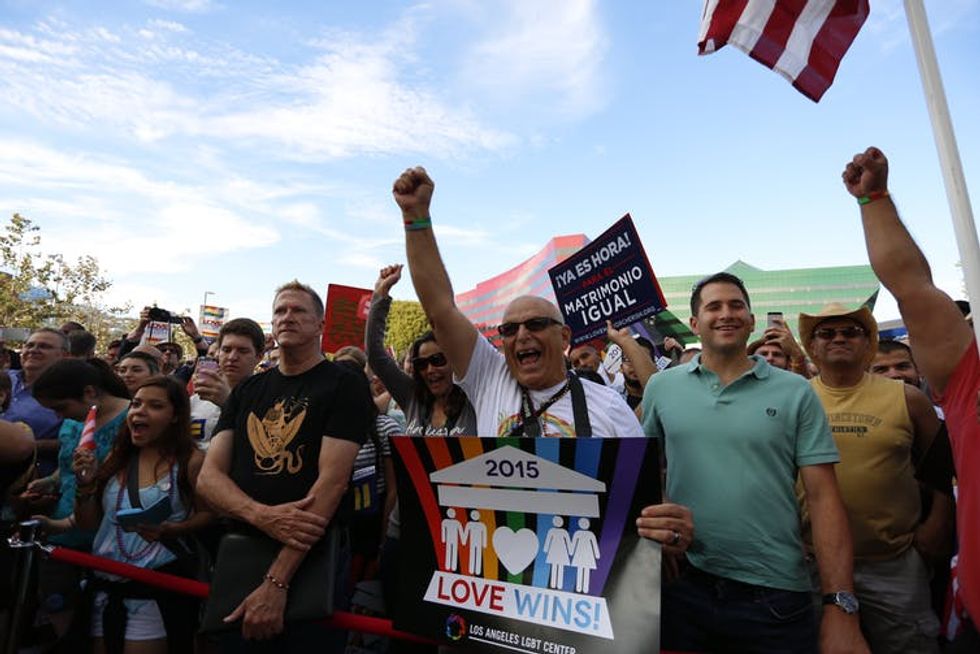
Proponents of same-sex marriage across the country celebrated its legalization in 2015.
Disappointed presidents
One classic example of a justice defying expectations to promote civil rights is Chief Justice Earl Warren, who was appointed by President Dwight Eisenhower and served on the court between 1953 and 1969.
Warren arrived at the court as a Republican with conservative credentials. He had been a proponent of President Franklin D. Roosevelt’s decision to place Japanese Americans in concentration camps.
But as a Supreme Court justice, Warren did not meet the expectation that he would bring a conservative viewpoint to decisions. Instead, he championed civil rights as chief justice.
In 1954, he wrote the landmark opinion in Brown v. Board of Education, a unanimous decision which led to desegregration of public schools by overturning an 1896 precedent and rejecting the idea that “separate but equal” was constitutional. Social science showing the psychic injury that racism caused was crucial to this outcome.
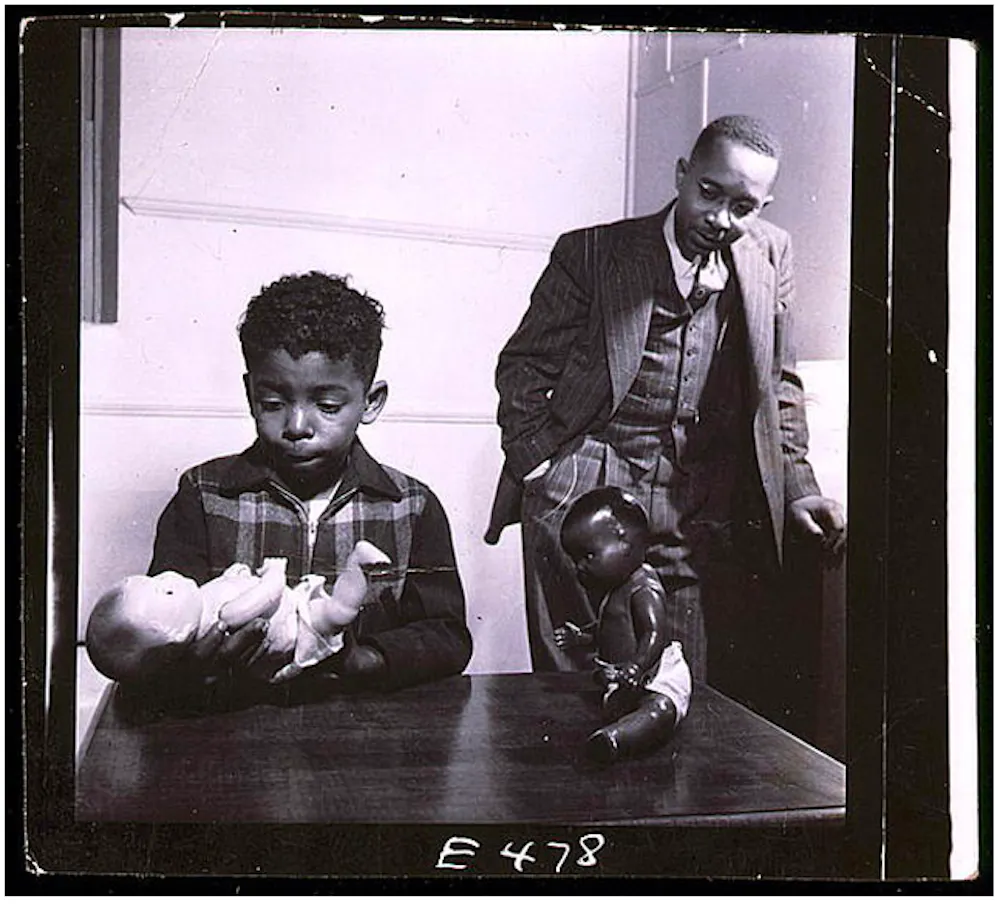
The research conducted by Dr. Kenneth Clark and his wife, Mamie Phipps Clark, helped move the Supreme Court, in Brown v. Board of Education, to declare segregation in public schools unconstitutional.
Gordon Parks, photographer; Library of Congress
Some have speculated about Warren and his unexpected shift. His sense of guilt over his active involvement in the Japanese American incarceration was apparently influential. The notion among the legal community about Warren’s opinion in Brown v. Board of Education is that “the Japanese Americans paid the ransom to free the Blacks.”
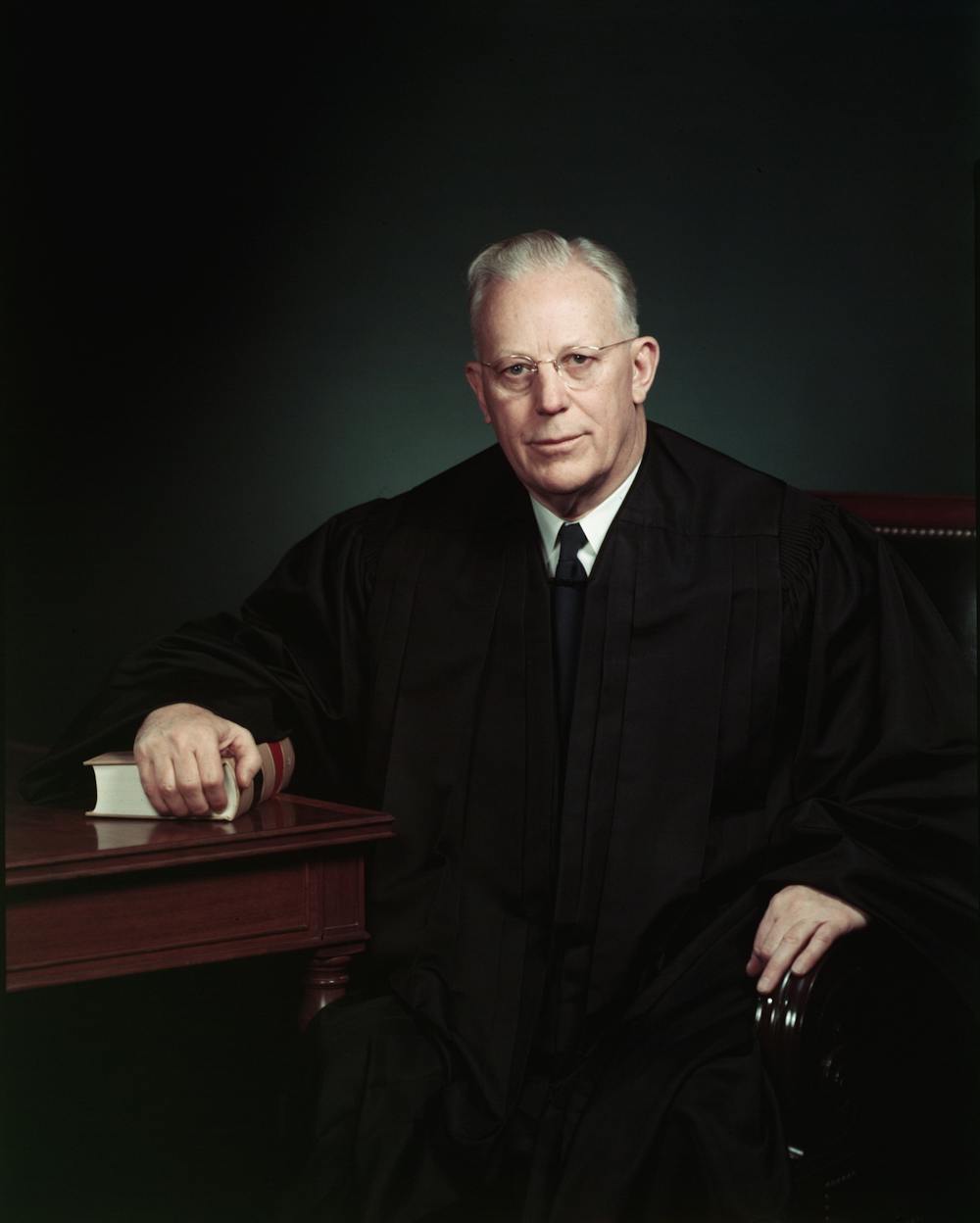
Earl Warren came to the Supreme Court as a conservative and later turned into a champion for civil rights.
Although Eisenhower thought Warren would be conservative in his judicial philosophy, that was hardly the case. In this and subsequent cases, what was called the “Warren court” became synonymous with a series of rulings that expanded the scope of constitutional rights.
When asked what he considered his most serious mistakes, Eisenhower replied: “They are both sitting on the court.”
He was referring to Justice Warren and Justice William Brennan, a Republican who had been on the New Jersey Supreme Court and whom Eisenhower appointed to the Supreme Court in 1956. Both judges were more liberal in their judicial philosophy than anticipated.
In these instances and others, presidents have been known to be disappointed by the decisions of those they appoint.
Unusual coalitions
When justices are confronted with a new type of discrimination and are unconstrained by past precedent, they may have the ability to form coalitions on the court to advance civil rights. For instance, the advocacy campaign against sexual harassment outside of the court, aimed at addressing egregious misconduct in the workplace, appears to have exerted influence inside the court.
Even though women had experienced sexual harassment for centuries, no one had even coined a term for the phenomenon until the 1970s, when the federal government began to formulate new policies.
Policymakers recognized that sexual harassment was illegal when it took the form of coercing employees to perform sexual acts in exchange for rewards or to avoid losing their jobs or work-related benefits.
Subsequently, the Equal Employment Opportunity Commission, the federal agency with responsibility for dealing with employment discrimination, was inundated with complaints.
When the Supreme Court first considered this issue in Meritor v. Vinson in 1986, the notion was barely a decade old. Moreover, the central question was a novel one, whether an employee could sue for a different type of sexual harassment, a so-called “hostile work environment.”
In a 9-0 decision written by Chief Justice William Rehnquist – who was appointed by President Richard Nixon and elevated to chief justice by President Ronald Reagan – the court unanimously ruled that the protections in federal civil rights law did cover this type of sexual harassment.
The Meritor ruling, despite criticism of its treatment of relevant evidence and employer liability standards, was hailed as a victory for advocates of civil rights.
As with Bostock, the ruling in the Meritor decision was surprising. Conservative justices had taken a liberal position and joined liberal justices in an effort to combat egregious misconduct in the workplace. They did this by expanding the scope of discrimination on the basis of sex with the new and more expansive interpretation of sexual harassment.
Marriage equality
Another remarkable social change in American society is the recognition of same-sex marriage, known as marriage equality. Litigation began over this issue in the late 20th century with Baehr v. Lewin (1993), in which the Hawaii Supreme Court held that the failure of a clerk to issue marriage licenses to a same-sex couple was a form of sex discrimination.
As the Human Rights Campaign, Lambda Legal and other public interest organizations mounted campaigns advocating for same-sex marriage, public attitudes gradually shifted in favor of official recognition of customary marriages of same-sex couples.
This social movement culminated in the landmark U.S. Supreme Court decision Obergefell v. Hodges in 2015. Acknowledging that the U.S. had undergone a significant social transformation in accepting diverse types of intimate relationships, the court resolved to make the law match the times.
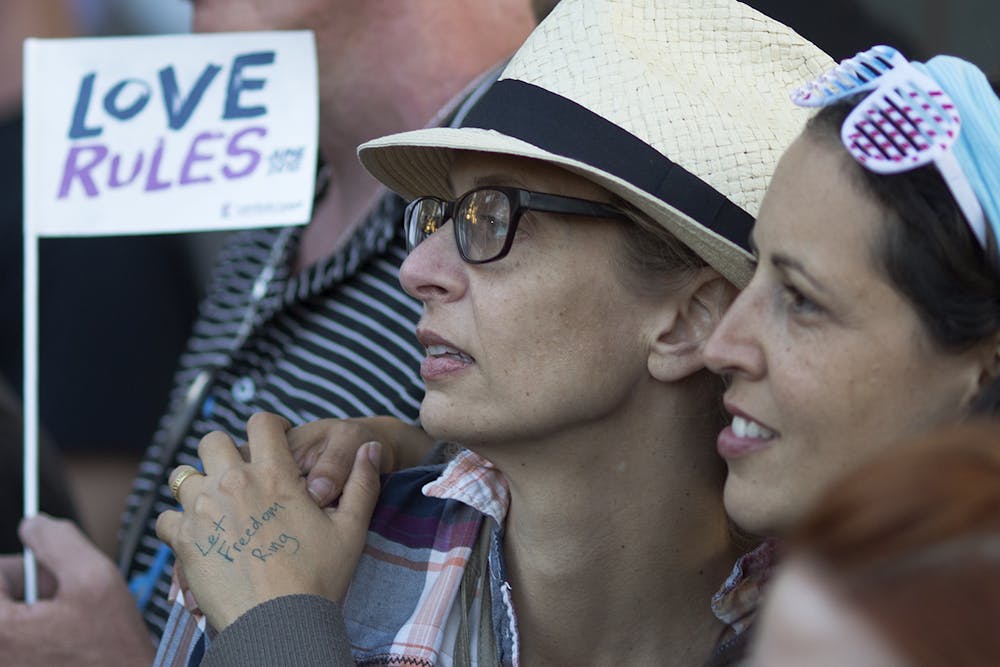
Amy Snow and Christelle Snow (R), who married in April 2015 under California law, celebrate the Supreme Court ruling on same-sex marriage in June 2015.
The 5-4 decision, which held that the right to marry is fundamental and guaranteed by the Constitution, was authored by Justice Anthony Kennedy. Kennedy said he voted in favor of this position even though it did not correspond to his own Catholic religious tenets.
Kennedy said he undertook writing the landmark opinion because of his religious beliefs: “It seemed to me I couldn’t hide,” he told an interviewer. “The nature of injustice is you can’t see it in your own time,” Kennedy said. “And as I thought about it more and more, it seemed to me just wrong under the Constitution to say that over 100,000 adopted children of gay parents could not have their parents married.”
Social upheaval creates new context
In the midst of immense social upheaval, courts and individual justices grapple with rules that must be reassessed in a new context – so it seems less surprising that justices consider carefully the meaning of equality and sex discrimination in light of the changing times.
This set of examples suggests that it may be unwise to presume that judges will vote in particular ways because of their backgrounds or judicial philosophy. Over the years, justices have felt the exigencies of the times that sometimes lead them to rule in ways that will protect the American constitutional order. Chief Justice John Roberts, expected to be more ideologically conservative in his rulings, has been praised for his role in building consensus, his temperament and his fair-mindedness.
While this certainly does not happen all the time, it may at least indicate that the U.S. political system can survive the ongoing crises of the 21st century associated with hyper-polarization. Ideological considerations, while often important in judicial decision-making, do not necessarily provide a guide to future decisions.
[You’re too busy to read everything. We get it. That’s why we’ve got a weekly newsletter. Sign up for good Sunday reading. ]
Alison Dundes Renteln, Professor of Political Science, Anthropology, Public Policy and Law, University of Southern California – Dornsife College of Letters, Arts and Sciences
This article is republished from The Conversation under a Creative Commons license. Read the original article.
Trump's aides wanted Air Force One 'turned around in mid-air' to spare him embarrassment of low Tulsa turnout: report
According to a report from Business Insider, when President Trump's advisors looked out at the rows of empty seats before his rally in Tulsa, Oklahoma, this past weekend, they began "frantically texting friends and supporters who lived nearby in a late bid to fill the indoor arena's 19,000 seats."
According to one Trump staffer, they wished Air Force had turned around in mid-air in order to save Trump any embarrassment.
"Ultimately, Trump went through with his 2020 campaign's big return rally in Oklahoma after months in a COVID-19 quarantine lockdown, empty seats and all," Business Insider reports. "None of the eight Trump advisers interviewed by Insider had positive things to say about an event that has since sparked all manner of soul-searching and finger-pointing as the president's campaign looks to find its footing against presumptive Democratic nominee Joe Biden with a little more than four months to go until Election Day."
According to the report, a "big shakeup" in the Trump campaign is likely due to the debacle.
Read the full report over at Business Insider.
Connecticut man who attacked Black teens will also face charges for attack on Black cop: report
Matthew Lemelin was arrested this week with his brother Michael after terrorizing three Black teens in Manchester, Connecticut and throwing racial slurs in the process.
According to the Hartford Courant Matthew will be charged with intimidation based on bigotry or bias, while his other brother Michael faces second-degree reckless endangerment. Due to the racist outbursts, it could mean that the charges could be escalated to a hate crime.
Matthew, however, is facing more serious charges from an incident in May in which he attacked a Black police officer with a racial slur. Officers said that he had to be subdued with a stun gun.
The recent arrest, the younger Lemelin brother claimed he was drunk and angry on an early Sunday when he went after the three Black teens riding by him on bicycles on Main Street. He claimed that the boys called him a "white cracker," his warrant says. He responded with his own racial slur and then told his brother about the incident.
The teens said that they were riding to the grocery store to pick up diapers for a friend's sister. They said that they were simply talking to each other when they heard Lemelin curse at them as they drove by.
"Rob what?" or "Rob who?" the boys said the man shouted. He then called them a racial slur. The boys kept riding but then saw another man driving quickly toward them in a Jeep Cherokee, nearly hitting one of the boys. A witness confirmed the "near miss," the warrants claim.
One of the brothers then chased the teens, grabbed a bicycle after the child dropped it and ran. They then took the bike riding it back to Main Street.
"The teenagers told police that people who were outside the nearby Cumberland Farms store told them they knew the men who had terrorized them and that the pair always yell, 'white lives matter!'" at them, according to the warrants.
Michael told police his brother asked for a ride to the grocery store, so they headed back home without incident. He also confirmed his brother had been "pounding back the beers" and was shouting racial slurs at people.
"Surveillance video from the Walgreen’s pharmacy at Main Street and East Middle Turnpike, however, shows the driver of a Jeep apparently searching for the teens -- 'the exact opposite of what Michael Lemelin claimed had happened,'" court documents show.
The video shows the teens running for safety when the Jeep pulls in beside them outside of a bar.
Twitter posts warning on new ‘abusive’ Trump tweet for ‘threat of harm’ to protestors
Twitter has hidden and appended a warning to one of President Donald Trump's tweets, noting it violates the company's rules. The company also flagged his remarks as "abusive" several hours after the President posted it Tuesday morning.
"We’ve placed a public interest notice on this Tweet for violating our policy against abusive behavior, specifically, the presence of a threat of harm against an identifiable group," the company's safety account said.
Visitors to Trump's Twitter page now see this, instead of the actual tweet:
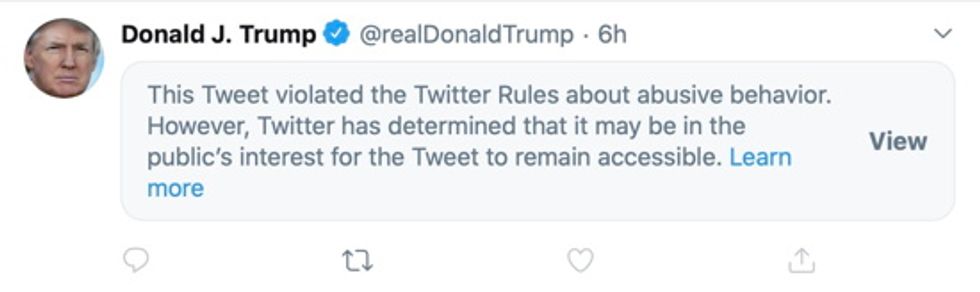
The warning appended to Trump's tweet reads: "This Tweet violated the Twitter Rules about abusive behavior. However, Twitter has determined that it may be in the public’s interest for the Tweet to remain accessible."
This is a screenshot of the actual tweet, which can still be read, with the warning attached.
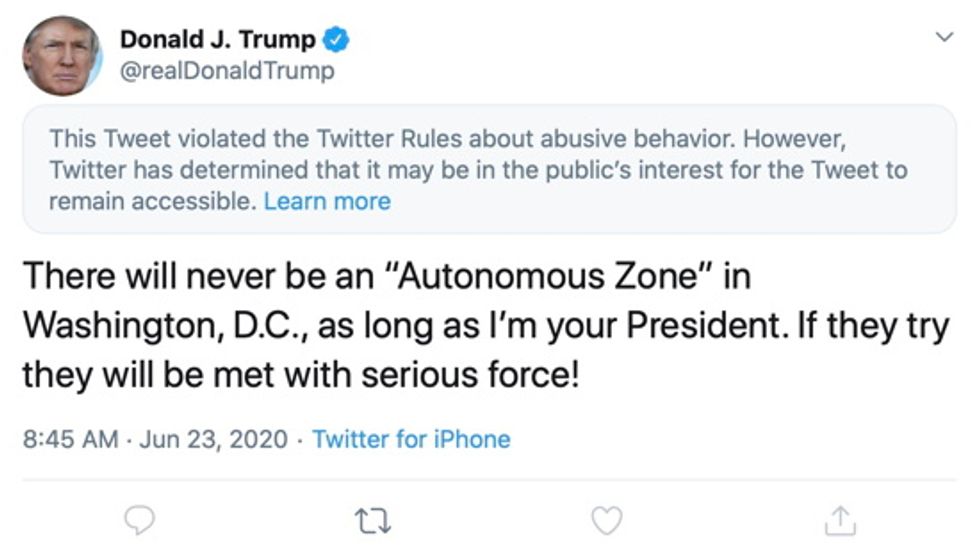
This is not the first time Twitter has been forced to flag Trump's tweets. Late last month the social media giant added a "get the facts" label to two of the President's tweets. A Twitter spokesperson explained the label was applied because the tweets “contain potentially misleading information about voting processes and have been labeled to provide additional context around mail-in ballots.”
Speaker Pelosi: Senate Republicans are ‘trying to get away with murder — the murder of George Floyd’
House Speaker Nancy Pelosi (D-CA) accused Republicans in the Senate of trying to get away with not doing anything about George Floyd's murder.
Speaking to CBS Radio, Pelosi was asked by Steve Futterman about ways that Republicans in the Senate could come together with the Congressional Black Caucus's bill on policing.
"Well, you be the judge. We're saying 'no chokeholds.' They're not saying, 'no chokeholds.' I mean, there's a big difference. What's the compromise? 'Some chokeholds'? I don't see what the compromise is. You know, 'No racial profiling?' Maybe 'some'? So the point, Steve, is the following: They understand that there's a need to get something done. The press has given them so much play for this bare leaves, unsalvageable piece of legislation and then say, 'Well, can't you compromise with that?' No, because it is -- 'no.' And we are, 'yes.' It isn't, 'maybe.'"
If Republicans want to work with Democrats on actual legislation, they're going to have to deal with actual policing problems, she explained.
"And so, in other words, for something to happen, they're going to have to face the realities of police brutality, and the reality of the need for justice in policing, and the recognition that there are many, many good people in law enforcement, but not all, and that we have to address those concerns. So, when they admit that and have some suggestions that are worthy of consideration -- but so far they were trying to get away with murder, actually. The murder of George Floyd," Pelosi said.
See the transcript below:
Copyright © 2026 Raw Story Media, Inc. PO Box 21050, Washington, D.C. 20009 |
Masthead
|
Privacy Policy
|
Manage Preferences
|
Debug Logs
For corrections contact
corrections@rawstory.com
, for support contact
support@rawstory.com
.


