Local news station WCNC reports that the group has set up a "Burn Your Mask Challenge" on social media after North Carolina Gov. Roy Cooper said this week that he's considering mandating wearing face masks in public.
Reopen NC organizer Ashley Smith tells WCNC that asking people to wear masks during a pandemic that has killed 117,000 Americans in just three months is an infringement of basic liberties.
"This comes down to an issue of rights, and what the constitution guarantees American citizens and it is my right to buy property and destroy it," she said. "For me personally, I will not comply."
Smith also said that "it's extremely selfish to tell someone they have to wear a mask."
Dr. Mandy K. Cohen, the Secretary of the North Carolina Department of Health and Human Services, tells WCNC that masks have become essential in slowing the spread of the disease.
"[Studies] continue to show us the importance of wearing a face covering to slow the spread, and face coverings really shows effectiveness when we can get many many folks doing that all together," she said.
Even before the Supreme Court’s June 15 decision, many Americans already – and incorrectly – believed that federal law protected lesbians, gay men and transgender people from being fired or otherwise discriminated against at work.
The road to the ruling confirming that belief involved years of advocacy and many losses – and while this decision is a landmark in that effort, more legal work remains to be done to determine the full scope of LGBTQ workers’ rights.
Concerns about sex discrimination
The Civil Rights Act of 1964 was a historic law that banned U.S. employers from discriminating against workers on the basis of their race, color, religion, national origin and sex.
During the bill’s debate, members of the House and Senate had lengthy discussions about discrimination on the basis of race, color, religion and national origin – but the “sex” category sparked little serious debate.
Protecting gay, lesbian, and transgender rights was still a ways off. In 1979, the Ninth U.S. Circuit Court of Appeals found that discrimination on the basis of sexual orientation was not sex discrimination, and therefore was not illegal. That same year, the Fifth Circuit dismissed a similar suit. In 1984, the Seventh Circuit likewise found that a person who had been fired after fully transitioning to a woman could not sue for discrimination.
It wasn’t until 1998 that the Supreme Court acknowledged the existence of LGBTQ issues in the workplace. In Oncale v. Sundowner Offshore Services, a male plaintiff claimed that he had faced sexual harassment from his male co-workers. Their employer responded that the law did not prohibit same-sex harassment. A unanimous court, led by Justice Antonin Scalia, disagreed and allowed the suit to proceed.
But that ruling did not make clear whether workers could be fired, demoted or disciplined on the basis of their sexual orientation or gender identity. Congress tried to address the question, and the Senate and the House of Representatives have separately passed bills recognizing this form of discrimination – but never in the same legislative session, which means it couldn’t become law. And different appeals courts have issued rulings that disagree with each other, producing inconsistent national standards.
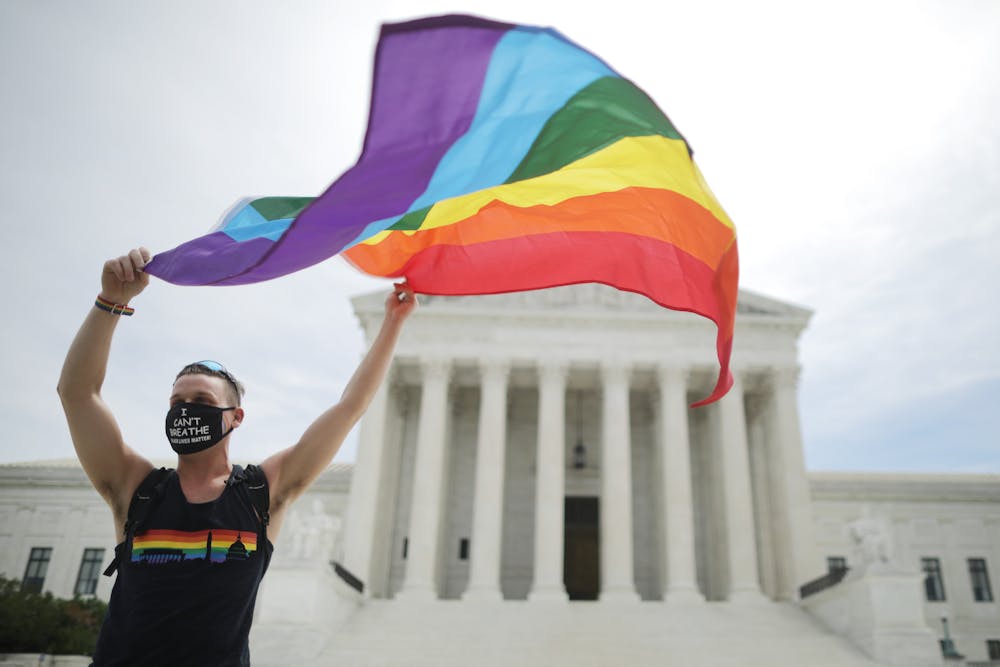
A man holds a pride flag in front of the U.S. Supreme Court building after a ruling protecting LGBTQ workers’ rights.
In fall 2019, the Supreme Court agreed to review three cases about employment discrimination against LGBTQ workers.
Two of the cases, Bostock v. Clayton County and Altitude Express v. Zarda, involved gay men who claimed they were illegally fired for being gay. The plaintiff in the third case was Aimee Stephens, who lost her job shortly after informing her employer that she intended to transition and would begin representing herself at work as a woman.
The core question in each was how to understand the law’s ban on sex discrimination.
Associate Justice Neil Gorsuch, appointed to the court by President Donald Trump in 2017, wrote the majority opinion in the 6-3 ruling that resolved all three cases. Joined by Chief Justice John Roberts and Associate Justices Ruth Bader Ginsburg, Stephen Breyer, Sonia Sotomayor, and Elena Kagan, he declared that discrimination against homosexual, bisexual, and transgender people is inherently sex discrimination, and therefore illegal.
Gorsuch’s reasoning was straightforward: “An employer who fires an individual for being homosexual or transgender fires that person for traits or actions it would not have questioned in members of a different sex.” He imagines two model employees, one man and one woman, arriving at the boss’s holiday party with their wives: If the woman would be fired but not the man, Gorsuch wrote, that is sex discrimination.
A changing understanding
Gorsuch is best known as a conservative jurist, concerned about the specific texts of laws and the original intentions behind them. He rested his interpretation of the Civil Rights Act on the evolution of the law over the years. Since the law’s passage, the Equal Employment Opportunity Commission and federal courts have come to understand a broader definition of sex discrimination, covering motherhood, differential pension programs, pregnancy and sexual harassment.
This history, Gorsuch wrote, signals that the law was meant to be read, and used, in inclusive ways: “refus[ing] enforcement … because the parties before us happened to be unpopular at the time of the law’s passage … would tilt the scales of justice in favor of the strong … and neglect the promise that all persons are entitled to the benefit of the law’s terms.”
He summarized the court’s finding: “An employer who fires an individual merely for being gay or transgender defies the law.”
Concerns, and questions, remain
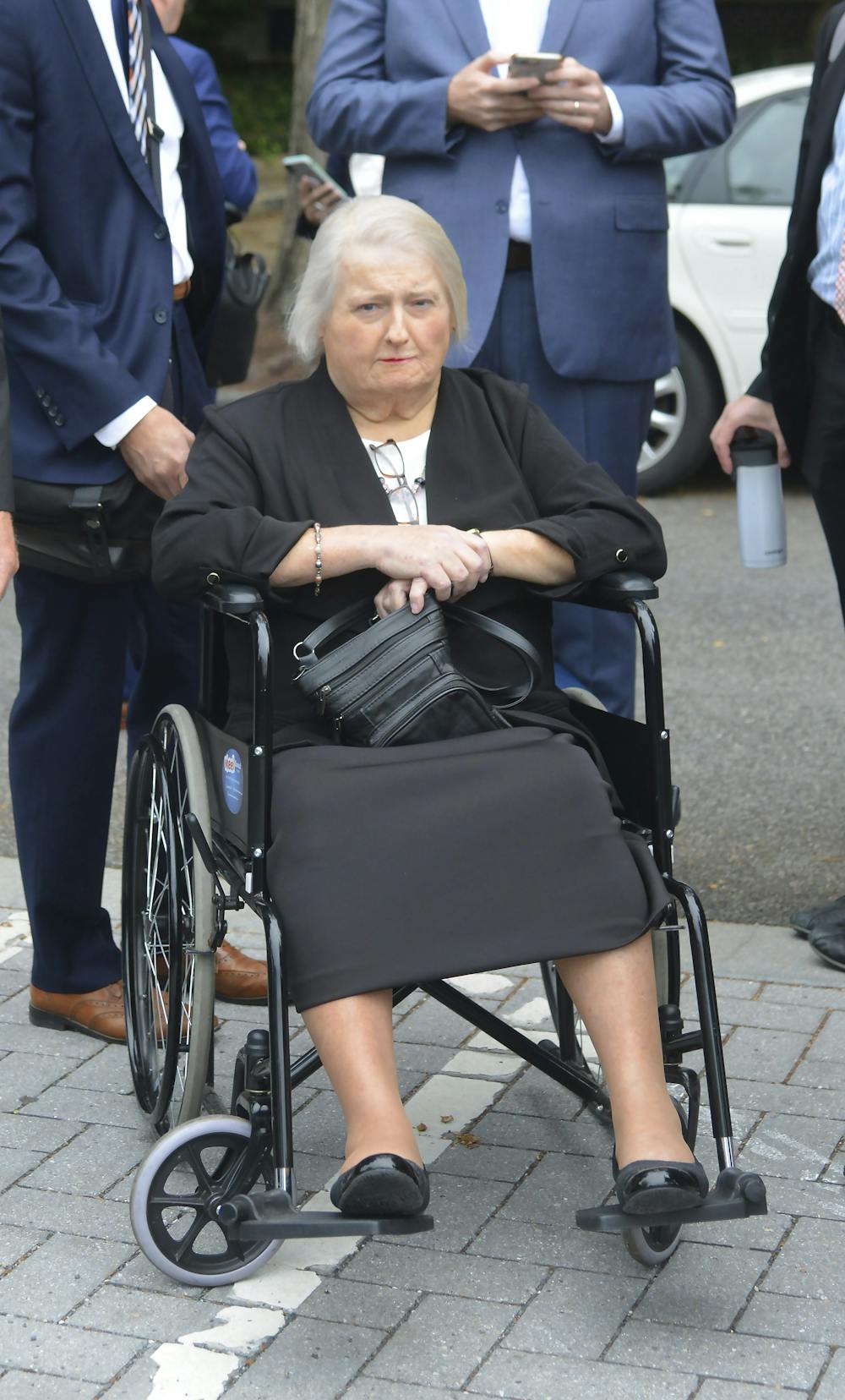
Aimee Stephens, a transgender woman whose firing from her job was at the center of the Supreme Court case, died in May, before the ruling in her case was delivered.
Dissents came from Associate Justice Samuel Alito, joined by Clarence Thomas, and from Associate Justice Brett Kavanaugh.
Alito expressed concern that the new ruling “will threaten freedom of religion, freedom of speech, and personal privacy and safety.” He offered specific example concerns, including allowing people with penises to use women’s bathrooms, stacking women’s athletic competitions with athletes with “the strength and size of a male … and students who are taking male hormones,” assigning college roommates based on gender identity rather than sex, requiring religious organizations to hire LGBTQ people, and limiting free speech disapproving of LGBTQ individuals or their relationships.
Alito also feared that the court’s opinion might lay broader groundwork for a constitutional ruling protecting people from discrimination based on sexual orientation and gender identity as strictly as it protects them from sex discrimination.
Many of these concerns may come before federal courts, and ultimately the Supreme Court, in years to come. Gorsuch’s ruling specifically did not decide on whether the results might, in some cases, tread inappropriately on religious liberty.
LGBTQ advocates are celebrating a major acknowledgment of their human rights, though with some sadness: Donald Zarda and Aimee Stephens, two of the three people at the center of the cases, died before learning of their cases’ resolution. And advocates know many more disputes – and court cases – are yet to come.
President Donald Trump claimed his predecessor took no action to reform police, but MSNBC's "Morning Joe" rolled video proving those claims are false.
Trump announced his own version of law enforcement reform in the wake of nationwide protests against police brutality, and took a shot at former President Barack Obama and Vice President Joe Biden -- his Democratic rival in November's election.
"President Obama and Vice President Biden never even tried to fix this during their eight-year period. The reason they didn't try is they had no idea how to do it," Trump said Tuesday in the White House Rose Garden.
In fact, the nation's first Black president made multiple moves to reform police and reduce bias in policing, but Trump's administration has rolled most of those back.
"Obvious fact-check there on President Trump's claim about his predecessor's efforts to reform policing," said co-Mika Brzezinski. "In fact, the Trump administration has spent much of its time unraveling those Obama administration police reforms."
Host Joe Scarborough mocked the president's easily disproved lies.
"You know," he said, "it would be as if Donald Trump criticized his predecessor for not knowing how to properly walk down a ramp and drink a glass of water."
Co-host Willie Geist said the president's obvious lies were a form of abusive behavior, and listed evidence of those lies.
"I think the term gaslighting has been overused in the last few years, but that is explicit gaslighting, which is to say, telling us something is true that is demonstrably not true," Geist said. "Obviously, President Obama and his administration, they launched an initiative to allow the Justice Department to investigate police departments as they did in Ferguson, Missouri, for example. The Trump administration backpedaled on that, unrolled that. Shortly before that, as you heard there, President Obama announced an initiative to stop selling surplus military equipment to police departments. The Trump administration undid that, as well."
"There's a long list," Geist added. "He's just making things up, and he did it again yesterday."
The Texas Tribune is using data from the Texas Department of State Health Services to track how many people have tested positive for the novel coronavirus in Texas each day. The state data comes from local health officials, and it may not represent all cases of the disease given limited testing. Here's what we know about the daily numbers.
On March 4, DSHS reported Texas’ first positive case of the coronavirus, in Fort Bend County. The patient had recently traveled abroad. A month later on April 4, there were 6,110 cases in 151 counties. As of June 16, there are 93,206 cases in 237 counties. The Tribune is measuring both the number of cases in each county and the rate of cases per 1,000 residents.
Number of cases
Harris and Dallas counties, the two largest in the state, have reported the most cases and deaths.
Cases per 1,000 residents
The rate of cases per 1,000 residents is especially high in the panhandle’sMoore County, where infections are tied to a meatpacking plant. The rate of cases is also high incounties with state prisons such as Walker and Jones. In other rural areas where the presence of the virus has yet to be confirmed, testing has been scarce.
COUNTY
NUMBER OF CASES
CASES PER 1,000 PEOPLE
DEATHS
Harris
17,282
3.75
284
Dallas
14,537
5.62
285
Tarrant
7,498
3.71
197
Travis
4,664
3.88
106
Bexar
4,437
2.30
89
El Paso
3,948
4.71
109
Potter
2,789
23.07
36
Fort Bend
2,402
3.25
49
Walker
1,873
26.18
27
Collin
1,787
1.89
38
Statewide
93,206
3.25
2,029
How many people are in the hospital?
On April 6, the state started reporting the number of patients with positive tests who are hospitalized. It was 1,153 that day and 2,518 on June 16. This data does not account for people who are hospitalized but have not gotten a positive test. As of mid-April, concerns that Texas hospitals would be unable to accommodate a surge of COVID-19 patients seem to have been assuaged.
As he makes decisions about how quickly to restart the Texas economy, Abbott says he is watching the number of hospitalizations and the hospitalization rate — the proportion of infected Texans who require hospitalization.
Hospitalization rate
The hospitalization rate is calculated by dividing the number of people who are currently hospitalized by the number of active cases, which is the number of total cases minus deaths and estimated recoveries. Estimated recoveries is a DSHS estimate of how many people require hospitalization and how long it takes most people to recover from the virus.
How many people have died?
The first death linked to the coronavirus in Texas occurred March 16 in Matagorda County. As of June 16, 2,029 people who tested positive for the virus have died.
New deaths from coronavirus each day
The average number of deaths reported over the past seven days shows how the situation has changed over time by deemphasizing daily swings.
How have the number of cases increased each day?
On March 24, the Texas Department of State Health Services changed its reporting system to track case counts directly from counties instead of relying on official case forms, which came in later and caused the state’s official count to lag behind other tallies. Increases in testing also led to more detected cases. Health experts say that even gradual steps to reopen businesses will increase the number of people who become sick from the virus. In May, a large one-day spike was reported after testing was done at meatpacking plants in the Amarillo region.
New cases of coronavirus each day
The average number of cases reported over the past seven days shows how the situation has changed over time by deemphasizing daily swings. The number of new cases reported drops on weekends, when labs are less likely to report new data to the state.
Note: On March 24, the state changed how it reported numbers resulting in a sharp increase in cases. On June 16, the state included 1,476 cases previously reported by the Texas Department of Criminal Justice from Anderson and Brazoria County in its cumulative case count. The new cases for June 16 do not include those cases.
Daily infection rate
Gov. Greg Abbott said he is watching the state's infection rate — the percentage of positive cases to tests conducted. The average daily infection rate is calculated by dividing the 7-day average of positive cases by the 7-day average of tests conducted. This shows how the situation has changed over time by de-emphasizing daily swings. Public health experts want the daily infection rate to remain below 6%.
Infection rate is not shown because the state did not release viral testing data
Note: On May 19, the state started breaking out virus tests from antibody tests. Previously, about 50,000 total antibody tests were counted as virus tests, artificially deflating the infection rate. On June 7, the state upgraded the system that labs use to report testing data. A few days later, the state revised the test numbers for June 6 to show a decrease in total viral tests for that day, meaning the number of new viral tests reported was a negative number making the daily infection rate incalculable for that day.
How many people have been tested?
As of June 16, Texas has administered 1,522,434 tests for the coronavirus since March. Expert opinions differ on how much larger that figure needs to be. We do not know the number of Texans who have gotten a test because some people are tested more than once. The state’s tally also does not include pending tests.
Coronavirus test results reported to the state each day
The average number of tests reported over the past seven days shows how the situation has changed over time by deemphasizing daily swings.
Note: Antibody tests were included in the new total tests counts for each day before May 14. The state broke out the number of new daily antibody and viral tests after that date. On June 7, the state upgraded the system that labs use to report testing data. A few days later, the state revised the test numbers for June 6 to show a decrease in total viral tests for that day, meaning the number of new viral tests reported was a negative number.
The DSHS data also might not include all of the tests that have been run in Texas. The state has said it is not getting test data from every private lab, and as of mid-May only 3% of tests were coming from public labs. Even as demand for testing has increased, both public and private labs continue to prioritize Texans who meet certain criteria, but every private lab sets its own criteria.
On May 21, DSHS disclosed for the first time that as of a day earlier, it had counted 49,313 antibody tests as part of its "Total Tests" tally. That represents 6.4% of the 770,241 total tests that the state had reported on May 20. Health experts have warned against counting antibody and standard viral tests together because they are distinctly different tests. Antibody tests detect whether someone was previously infected, while standard viral tests determine whether someone currently has the virus.
Antibody tests are typically reported a day late.
How is this impacting Texans of color?
While early reports from other parts of the country indicate black Americans are disproportionately likely to get sick or die from the new coronavirus, it’s virtually impossible to determine if that grim reality is playing out in Texas because information released by state health officials is notably incomplete.
The limited data provided to the Tribune offers a murky glimpse of the virus' impact on Texas communities of color. Race and ethnicity are reported as unknown for a significant portion of the completed case reports. (Agency officials said some people prefer not to provide the information.)
Although state leaders acknowledge the demographic data is lacking, they have indicated the state won't be taking steps to mandate reporting to fill in the gaps.
What else should I know about this data?
These numbers come from the Texas Department of State Health Services, which updates statewide case counts at 3 p.m. each day. The data is from the same morning, and it may lag behind other local news reports.
From March 13 through March 24, the Tribune added cases from Lackland Air Force Base in San Antonio, where hundreds of American evacuees from China and cruise ships were quarantined. Those case counts came from the Centers for Disease Control and Prevention.
Carla Astudillo, Mandi Cai, Darla Cameron, Chris Essig, Anna Novak, Emily Albracht and Alexa Ura contributed to this report.
Previously, The Texas Tribune incorrectly stated our formula for calculating the average daily infection rate. This has been corrected.
Huffington Post notes that the Simon & Schuster blurb for psychologist Mary Trump's upcoming book claims that the president's niece will describe "the appalling way Donald, Fred Trump’s favorite son, dismissed and derided him when he began to succumb to Alzheimer’s."
Additionally, the publisher says the book will go in depth about "the strange and harmful relationship between Fred Trump and his two oldest sons, Fred Jr. and Donald," which Mary Trump claims "created the damaged man who currently occupies the Oval Office."
In addition to its revelations about Trump's alleged mistreatment of his late father, the book will also reportedly detail how Mary Trump leaked damaging information to the New York Times detailing how the family committed fraud to avoid paying taxes.
Imagine the reaction if during the recent far-right reopen rallies supported by Trump that backers of Joe Biden attacked and killed protesters. Not only would right-wing media demand Biden’s execution, Trump’s hatchet man at the Department of Justice, William Barr, would likely have indicted Biden as an accessory to murder.
While that scenario is far-fetched, the reverse is not. Since the police killing of George Floyd sparked unprecedented protests against systematic racism, at least four Trump supporters, including some involved in his 2016 campaign, have attacked Black Lives Matter protesters with weapons, leading to at least one death.
Disturbingly, perpetrators have been released or given light charges despite severely wounding and killing protesters. The real number of attacks by Trump supporters may be substantially higher as there have been hundreds of attacks, terrorist plots, and threats of violence by far-right forces against anti-racist protesters. Trump has encouraged the violence as well, fitting with his role as the stochastic-terrorist-in-chief for the last four years. These attacks are unlikely to be the last by Trump supporters against those protesting for racial justice.
On June 15, Steven Ray Baca, shot and critically wounded Scott Williams in Albuquerque, New Mexico. Protesters were attempting to remove a statue of Juan de Oñate, a 16th-century Spanish conquistador notorious for massacring some 1,800 Acoma Native Americans, and amputating and enslaving survivors. Videos show Baca at the statue assaulting three people unprovoked. Baca can also be seen with a can in his hand that protesters claimed was mace he used on them. After throwing a woman to the ground and apparently injuring her, the crowd forces out Baca and he draws a gun. As Baca leaves another fight ensues and he shoots Williams.
Baca is a Trump supporter as well and figure in far-right politics. He was an alternate delegate from New Mexico to the 2016 Republican National Convention. Sporting a MAGA hat, Baca attended a Trump rally in Albuquerque in September 2019, writing it was an “Awesomene time and a great rally!!!” In January, Baca joined the board of the Albuquerque Tea Party, which described him as a “hard-core conservative.” He ran for city council last year on a Trumpian platform. Baca said he feared the city was becoming a “third world country,” wanted to criminalize the homeless, give the police department “its teeth back,” and stop “spending money on illegal aliens.” Baca has been charged with aggravated battery with a deadly weapon. Within hours of the shooting, the statue of Juan de Oñate Baca allegedly was protecting was removed by the city, which is now “discussing the removal of other conquistadors.”
On June 5, a Texas man brandished a chainsaw at Black Lives Matter supporters in McAllen. Daniel Peña ranted, in apparent reference to the killing of George Floyd by police officer Derek Chauvin, “It was a f*cking n*gger and a bad cop.” He then assaulted protesters, ripped signs from their hands, and revved a chainsaw at them while yelling more racial slurs. Sources claim Peña, who has been slapped with six counts of deadly conduct and one charge for assault causing bodily injury, was a Trump supporter. No independent evidence has surfaced, but he did find a prominent supporter close to the president.
Trump campaign senior adviser Mercedes Schlapp amplified a tweet that lauded Pena’s racist assault that read in part, “I’d want this guy with me in a ride or die moment.” After being contacted by the media, Schlapp said, “I deeply apologize ... I would never knowingly promote the use of that word.” Schlapp did not apologize for seemingly endorsing a potential chainsaw massacre.
Vechirko is also a Trump donor. He’s given more than $300 to the “Trump Make America Great Again Committee” and the Republican National Committee since 2018. Vechirko, who has a criminal history that includes arrest for domestic assault, is among 19 documented vehicle attacks against protesters in three weeks. The attacks are reminiscent of the neo-Nazi who murdered anti-racist activist Heather Heyer with a car as she protested right-wing extremists in Charlottesville in 2017, and deadly vehicle attacks by religious extremists inspired by the Islamic State. Despite the grave danger he created, Vechirko was released without charges. The Democratic governor of Minnesota, Tim Walz, claims Vechirko appeared confused and was frustrated because the highway was closed. The state has not indicated what is confusing about intentionally driving an 18-wheeler at high speed towards thousands of people, or why being frustrated at traffic mitigates an assault that could have resulted in mass casualties. There is a petition with nearly 50,000 signatures demanding Vechirko be charged.
On May 30 in Omaha, bar owner Jake Gardner killed a 22-year-old African-American man, James Scurlock, during anti-racist protests in the Nebraska city. Gardner, reportedly a volunteer with the Trump campaign in 2016, allegedly “used racial slurs against Scurlock before firing his gun.” Douglas County Attorney Doug Klein took less than 48 hours to decide Gardner acted in self-defense and declined to press charges. Reports indicate Gardner provoked a confrontation and flashed a gun at protesters. Klein later petitioned for a special prosecutor who will lead a grand jury that will determine if charges will be filed against Gardner, whose two bars have since been evicted from the buildings they are in and shuttered.
Arun Gupta contributes to The Washington Post, YES! Magazine, In These Times, The Progressive, Telesur, and The Nation. He is author of the forthcoming, Bacon as a Weapon of Mass Destruction: A Junk-Food Loving Chef’s Inquiry into Taste, from The New Press. Follow him on Twitter @arunindy or email at arun_dot_indypendent_at_gmail_dot_com.
Facebook says it will block ads from foreign state media during the US election, as well as allowing users to hide all paid-for political messages.
The move comes with the social media giant under growing pressure over its hands-off approach to misinformation and inflammatory posts -- including from Donald Trump -- and following criticism it turned a blind eye to foreign interference in the 2016 presidential poll.
Facebook's head of global affairs acknowledged the company fell short during the contentious poll in which it has acknowledged Russia-backed content reached as many as 126 million Americans on its platform.
Nick Clegg, writing in the UK's Daily Telegraph newspaper on Wednesday, said the company would be "blocking all ads in the US during the election period from state-controlled media organisations from other countries."
Anyone running political ads on the platform would have to be authorized to do so, Clegg said, adding that between March and May Facebook had stopped "more than 750,000 political ads targeting the US from running because the advertiser had not completed the authorisation process."
He said the social media giant now had more than 35,000 people working on safety and security issues, three times the number of four years ago.
In a separate opinion piece, chief executive Mark Zuckerberg said he wanted to use the vast reach of his company for good in this November's election.
The threat to democracy "is real and ongoing, but our systems are more prepared than ever."
Register to vote
Announcing a campaign aimed at getting four million people registered to vote, he said Facebook was creating a new hub with "authoritative information, including how and when to vote, as well as details about voter registration, voting by mail and information about early voting."
Facebook first announced the voter hub at the beginning of June, as well as promising to review policies that led to the decision not to moderate controversial messages.
For users who have already made up their minds "and just want the election to be over," Zuckerberg wrote, the network is "also introducing the ability to turn off seeing political ads."
The feature will start to be rolled out from June 24 and will mean users can turn off political, electoral and social issue ads.
Zuckerberg has been strongly criticized for his company's decision not to moderate controversial, incendiary and inaccurate posts by the US President.
Twitter's decision in May to hide one of Trump's tweets for "glorifying violence" exposed turmoil at Facebook, with employees rebelling against Zuckerberg's refusal to sanction false or inflammatory posts by the US president.
But writing in USA Today, he again defended his network's guidelines.
Facebook has "rules against speech that will cause imminent physical harm or suppress voting, and no one is exempt from them," he wrote.
"But accountability only works if we can see what those seeking our votes are saying, even if we viscerally dislike what they say."
The best way to ultimately hold politicians accountable is by voting, Zuckerberg wrote.
A USDA plan to loosen regulation of genetically modified crops could benefit Florida billionaire Randal Kirk whose company hired Trump fundraiser and lobbyist Roy Bailey.
Michael Gregoire, then the acting administrator of the Animal and Plant Health Inspection Service, withdrew a proposed regulation to give more power to APHIS to evaluate whether genetically modified plants could become harmful weeds. This happened just 21 days after Bailey became a lobbyist for Intrexon, one of Kirk’s companies.
The regulation that Trump’s Agriculture Department drafted instead would let developers determine whether their crops should be regulated based on comparing plant traits to traits that already aren’t regulated. It becomes effective Aug. 17
“This common-sense approach will ultimately give farmers more choices in the field and consumers more choices at the grocery store,” said Greg Ibach, the USDA undersecretary for marketing and regulatory programs.
Records show Intrexon paid Bailey’s lobbying firm, Bailey Strategic Advisors, about $180,000 from 2017 through 2019 to meet with officials from the White House, the president’s office, the vice president’s office and agencies including the USDA.
Bailey also has served as the finance chair of America First Action, a super PAC that raised more than $40 million to try to re-elect Trump.
Under the Plant Protection Act, signed by President Bill Clinton, the Animal and Plant Health Inspection Service, is supposed to regulate genetically engineered crops to reduce risk of spreading plant pests or harmful weeds. But Trump’s regulation would allow the developers of genetically engineered plants to decide if their companies should be exempted.
The center said assessing the risk of plant pests must account for unintended as well as intended effects of genetic modification. For instance, the genetic engineering of Arctic apples to resist browning involved silencing genes that generate enzymes to help protect against disease and insects in some plants.
APHIS only regulates genetically engineered plants that were produced using genetic material derived from plant pests such as the common soil bacteria Agrobacterium.
With the American public's attention consumed by the COVID-19 pandemic and mass protests against police brutality, the U.S. Labor Department earlier this month quietly gave corporate sponsors of retirement plans something they've been agitating over for years: a government green light to invest workers' savings into funds managed by notoriously predatory private equity firms.
The move, announced on June 3 by Labor Secretary Eugene Scalia, allows large managers of 401(k) plans and individual retirement accounts (IRAs) to put workers' retirement savings into private equity investments that offer the possibility of huge returns — and devastating losses.
Scalia released the guidance in response to a request for clarification of the Trump administration's policy by Partners Group and Pantheon Ventures, private equity firms that collectively manage more than $140 billion in assets. The labor secretary presented the guidance as an effort to "level the playing field for ordinary investors."
Eileen Appelbaum, co-director of the Center for Economic and Policy Research (CEPR), warned in an article published by Common Dreams on June 7 that "investing retirement savings in private equity exposes ordinary retirees to high risk."
Appelbaum noted that U.S. workers "have socked away $6.2 trillion in 401(k) accounts and another $2.5 trillion in IRA accounts."
"If just 5 percent of the money in these retirement funds were available to private equity," wrote Appelbaum, "it would be a windfall of $435 billion — real money even to private equity millionaires and billionaires."
David Sirota, Jacobin editor-at-large and former speechwriter for Sen. Bernie Sanders' 2020 presidential campaign, pointed out in his Too Much Information newsletter Monday that Blackstone CEO Stephen Schwarzman — a major donor to President Donald Trump — has been lobbying for looser restrictions on retirement investments for years.
"In life you have to have a dream," Schwartzman said in a call with analysts days after Trump's inauguration in January 2017. "One of the dreams is our desire and the market's need to have more access at retail to alternative asset products . . . A lot of people are not allowed to put those into retirement vehicles and other types . . . If there's a change in that area that becomes a huge opportunity for the firm."
Sirota wrote that thanks to the Labor Department's guidance, "private equity firms will now be allowed to access — and skim fees off of — the $9 trillion in 100 million workers' 401k plans and IRAs."
"Now that Trump's Labor Department has opened the floodgates," Sirota added, "a lot more money could end up flowing into these opaque deals, enriching private equity executives and their friends — while leaving workers' meager retirement savings even further depleted."
The Financial Times reported that private equity shares jumped in the wake of Scalia's announcement and "outpaced the broader stock market rally."
"Carlyle climbed almost 4 percent while Blackstone and Apollo gained more than 2 percent each," FT reported.
In a column for Forbes on Saturday, Edward Siedle called the Labor Department's guidance "a huge win for the private equity industry" and "a monstrous setback to American workers who invest in 401(k)s for retirement security."
"Department of Labor watchdogs just opened the door for private equity wolves to sell the highest cost, highest risk, most secretive investments ever devised by Wall Street to 401(k) plan sponsors," wrote Siedle. "401(k) investors will be devoured like lambs to the slaughter."
Three months into the coronavirus pandemic, which has now killed more than 116,000 Americans, people across the United States are reporting lower levels of happiness than at any point since the 1970s—nearly 50 years ago.
According to the Covid Response Tracking Survey, conducted late last month by NORC at the University of Chicago, just 14% of Americans report that they are "very happy."
The researchers compared their findings to those of the General Social Survey, taken every other year since 1972, and found that at least 29% of respondents to that poll have always reported feeling "very happy" with their lives.
Just two years ago, when the last General Social Survey was taken, 31% of Americans said they were "very happy."
As many Americans avoid large gatherings, cancel planned vacations, suffer job loss, and stay at home as much as possible even while state economies are reopening, 50% of respondents told the Covid Response Tracking Survey that they feel isolated, up from 23% in 2018.
The survey was taken between May 21 and May 29, with 2,279 Americans polled. While the research was being conducted, a nationwide uprising over police brutality and racial injustice exploded after George Floyd became the latest black American killed by police officers during an arrest.
The protests gave way to new incidents of police officers using excessive force, with Washington, D.C. officers tear-gassing protesters, reportedly at the direction of the White House; NYPD officers driving an SUV into a crowd of demonstrators, and hundreds of other cases.
The survey was also taken as the country faced its worst unemployment crisis since the Great Depression. More than 33 million Americans were out of work in early May. Long lines at food banks across the country and reports of a third of Americans being unable to pay their rent or mortgage payments in May have illustrated the precarious financial circumstances in which many lived before the pandemic.
Meanwhile, the government has been reticent to offer more financial assistance to Americans than a one time $1,200 direct payment and an extra $600 per week on top of regular unemployment benefits, which are set to expire in July. Democratic and Republican leaders alike have scoffed at more robust proposals that would allow workers to socially distance for the duration of the pandemic without losing their incomes—similar to measures which were adopted by other wealthy countries at the beginning of the pandemic.
"It's been one thing after another," Lexi Walker, a respondent who experienced several personal losses just before the pandemic, reported to the survey. "This is very hard. The worst thing about this for me, after so much, I don't know what's going to happen."
The survey also found that Americans currently feel little optimism about the future. Only 42% believe their children will have a better quality of life, compared with 57% who said so in 2018.
SAN DIEGO — A gun control organization has filed a lawsuit on behalf of victims of last year’s shooting at the Chabad of Poway, accusing the manufacturer of the weapon used in the fatal attack, the gun store that sold the weapon to the accused shooter and his parents of negligence.The lawsuit filed by Brady Legal, the litigation arm of the gun control group Brady United, also names the state of California for failing to conduct an adequate background check that would have shown the accused shooter, John T. Earnest, was underage and not eligible to buy a weapon.The suit was filed Monday in San ...
Google on Tuesday confirmed that it booted one far-right website from its ad platform and put another on notice for hosting "dangerous and derogatory" comments about civil rights protests.
The internet giant said that it stopped channeling money-making ads to ZeroHedge and warned The Federalist that it too could be blocked from Google Ads for violating policy about content.
“To be clear, The Federalist is not currently demonetized," a Google spokesperson said in response to an AFP inquiry.
"We do have strict publisher policies that govern the content ads can run on, which includes comments on the site. This is a longstanding policy."
The action against ZeroHedge and warning sent to The Federalist related to content in comments sections that consistently violated Google's policy about dangerous and derogatory content, according to the internet company.
The offending content was related to false information about recent Black Lives Matter protests, US media reported.
ZeroHedge said in a post at the website that it is appealing Google's decision and expects to "remedy" the situation.
The policy at issue was put in place by Google three years ago as part of an effort to avoid advertisers from having their marketing messages appear next to vile or hateful content on websites.
Fox News host Laura Ingraham, who has no background in medicine, used her primetime platform this week to deride Dr. Anthony Fauci, the 36-year head of the National Institute for Allergy and Infectious Diseases, as "the medical deep state."
Ingraham, who is not a doctor, also spoke directly to President Donald Trump's campaign, instructing it to ignore the "alarmist COVID drivel" surrounding a planned rally for June 20 in Tulsa, Okla.
"The president and his campaign should simply not react to any of this alarmist COVID drivel from here on out," Ingraham, who holds no advanced degrees in a scientific field, said on Monday.
"None of these people, sadly including Dr. Fauci, can be really taken all that seriously anymore given what we've seen, because science — just like journalism and entertainment — has become obscenely politicized," she continued.
Ingraham mocked Fauci over an interview in which he warned that "we could get back to some degree of normality within a year or so, but I don't think it's this winter or fall."
"The medical deep state strikes again," she snipped.
Ingraham on Monday once more lambasted "the science," which she claimed "has deemed it OK — essential, actually — to pack together outdoors in large crowds to protest in the name of liberal political causes" but "considers it unacceptably dangerous to attend large indoor gatherings."
"I'm sure it's just a coincidence that these super-spreader events happen to exactly match the campaign rally that Trump had planned over the weekend," she added.
"Now, why did none of these people wailing about the health hazards of Trump's future rallies voice any real sustained concern about the shoulder-to-shoulder protesters screaming at the top of their lungs?" she asked. (Epidemiologists have indeed raised concerns that the protests against police brutality sweeping the nation in the wake of the death of George Floyd may be a "super-superspreader" event.)
However, the prospect of Saturday's rally at the 20,000-seat BOK Center — which the campaign pushed back one day in response to backlash over the event coinciding with Juneteenth — has rattled not just Fauci and his cabalistic government public health agency but also local health officials who share the fear that it could precipitate a super-spreader event, as well.
The Tulsa City-County Health Department on Friday warned that the city had recorded its "highest daily increase of COVID-19 cases to date," and it believed that indoor gatherings were likely responsible.
"Initial investigations on cases reported this week have identified an outbreak linked to indoor gatherings, which large groups of people congregated in close contact for prolonged periods of time," the department said in a statement. "Investigations continue to determine how many of the new cases are associated with this outbreak."
"COVID is here in Tulsa," department director Dr. Bruce Dart cautioned the next day. "It is transmitting very efficiently."
"I'm concerned about our ability to protect anyone who attends a large, indoor event, and I'm also concerned about our ability to ensure the president stays safe, as well," he said, adding his wish that the rally be postponed.
However, Fauci, the alleged deep-state miscreant, did not go so far as to endorse postponement, saying in a Friday interview with an ABC News podcast that any large group presents "a danger."
"When you start to chant and shout, even though the instinct is to pull the mask down, which you see," Fauci said. "Don't do that, because there is a risk there. And it's a real risk."
The Tulsa Health Department on Tuesday was reported a total 64 deaths and 554 active cases; when the department issued its outbreak warning last Friday, it reported only 373 active cases.