FORT LAUDERDALE, Fla. — Nearly 50 years ago, the Lauderhill Point apartments were built to bring safe, affordable housing to a blighted stretch of what is now Lauderhill.Instead, the 22 buildings that make up the property have become infamous for problems that have remained consistent despite numerous name and ownership changes: Murders, shootings, gang control and rampant drug dealing.From 2014 to 2019, Lauderhill Police said they responded to more than 2,400 calls at the property — nearly two a day. Among the 215 criminal reports they gathered were 14 cases involving a gun and six with a kni...
President Donald Trump continues to bristle about technology companies pointing out his post-election lies about election fraud.
On Tuesday, Twitter added two disclaimers to Trump's posts pushing conspiracy theories about the 2020 election, which was won by President-elect Joe Biden. Facebook issued four different disclaimers.
In response, Trump lashed out at Section 230 of the Communications Decency Act of 1996, which allows technology companies protections for moderating content.
On Tuesday evening, Trump threatened to veto military funding in an attempt to force Congress to change the legislation.
Here are the disclaimers Trump received on Tuesday:
Attorney General Bill Barr revealed on Tuesday that he has appointed U.S. Attorney John Durham as a special counsel in his ongoing probe into the origins of the Russiainvestigation. But he may have made a critical error that could undermine the appointment order in the future.
Speaking to the Associated Press, Barr said that he has actually made Durham a special counsel in October but kept the news under wraps until now. He made clear that his intention was to protect the investigation from a potential Joe Biden administration.
"I decided the best thing to do would be to appoint them under the same regulation that covered Bob Mueller, to provide Durham and his team some assurance that they'd be able to complete their work regardless of the outcome of the election," he said.
Robert Mueller became the special counsel after Trump fired then-FBI Director James Comey in 2017, who has been overseeing the investigation. Many feared Trump would corruptly block the investigation from moving forward, so Deputy Attorney General Rod Rosenstein picked Mueller to run it. There is no such justification now for setting up a new special counsel to continue under President Joe Biden, and there's a particularly rich irony in the tactic: Barr's obsession with the Russia investigation, and his decision to task Durham with reviewing it, stemmed from his misguided belief that it was a duplicitous effort by the Obama administration to undermine Trump. But Barr's action looks much more like the accusations he has baselessly lobbed at his predecessors than anything carried out under Obama.
Special counsels have added protection that normal U.S. attorneys lack. Under the DOJ regulations, a special counsel can only be fired for cause, while U.S. attorneys serve at the pleasure of the president. The regulations also require the special counsel to report to the attorney general, who will soon be a Biden appointee. But Congress is to be notified if the attorney general ever overrules any step the special counsel would like to take in the probe.
As many pointed out, there seems to be a big problem with Barr's decision to set Durham up as a special counsel: The regulations don't seem to allow it:
An individual named as Special Counsel shall be a lawyer with a reputation for integrity and impartial decisionmaking, and with appropriate experience to ensure both that the investigation will be conducted ably, expeditiously and thoroughly, and that investigative and prosecutorial decisions will be supported by an informed understanding of the criminal law and Department of Justice policies. The Special Counsel shall be selected from outside the United States Government. [emphasis added]
Durham was already working within the government when he was appointed, apparently making him ineligible for the position Barr wants him to hold. It's not clear how or if this mistake could be used against Durham, though it's possible any target of his investigation could claim he's unauthorized to act in the role. And this mistake could potentially be exploited by a future attorney general if they sought to remove Durham from the position.
The order naming Durham as a special counsel assigns him to
investigate whether any federal official, employee, or any other person or entity violated the law in connection with the intelligence, counter-intelligence, or law-enforcement activities directed at the 2016 presidential campaigns, individuals associated with those campaigns, and individuals associated with the administration of President Donald J. Trump, including but not limited to Crossfire Hurricane and the investigation of Special Counsel Robert S. Mueller, III.
What's not clear about this is whether there's actually any factual predicate to justify this investigation. No serious justification has ever been put forward, though the president and his allies have hyped various bogus conspiracy fictions surrounding the probe that have been repeatedly debunked; Barr has been clearly sympathetic to these false narratives. One FBI lawyer, Kevin Clinesmith, was caught having created a minor alteration to a document used in an application to surveil Carter Page, a one-time associate of the Trump campaign. Clinesmith has pleaded guilty for this crime, though it likely would have only resulted in termination were Barr not on a mission of vengeance.
The Clinesmith revelation is noteworthy, though, because it was actually discovered in a review of the Russia investigation conducted by Justice Department Inspector General Michael Horowitz, who referred the case to prosecutors. But precisely because Horowitz had so closely reviewed the origins of the Russia investigation — finding that it was launched with sufficient predication, and finding no other crimes apart from Clinesmith's case — the natural question was: Why is Durham investigating at all? Horowitz has reviewed the conduct surrounding the probe, so isn't any further investigation unnecessary and duplicative? Doesn't Barr's move, after all that, reek of a witch hunt?
One justification Barr gave for Durham's appointment was that he had a wider scope than Horowitz, who was limited to reviewing DOJ conduct. Barr has indicated that Durham's probe encompassed the activity of the intelligence agencies, such as the CIA, suggesting to many that he was pursuing wild conspiracy theories floated by Trump supporters who believed there was an international plot against the incoming president in 2016. Barr was even reported to have flown to foreign countries such as Italy to probe their own officials about potential involvement in the plot.
But according to Barr's interview with the AP, these avenues have dried up. The attorney general "said Durham's investigation has been narrowing to focus more on the conduct of FBI agents who worked on the Russia investigation, known as Crossfire Hurricane," according to the report.
It added: "The focus on the FBI, rather than the CIA and the intelligence community, suggests that Durham may have moved past some of the more incendiary claims that Trump supporters had hoped would yield allegations of misconduct, or even crimes — namely, the question of how intelligence agencies reached their conclusion that Russia had interfered in the 2016 election."
This raises the question, once again: If Durham is just focused on the FBI, why was the Horowitz probe insufficient?
Barr's announcement of the probe also seemed to have come at a convenient time. He also told the AP on Tuesday that he has seen no evidence of the kind of wide-ranging election fraud conspiracies that Trump and his allies have been alleging. Trump has, in fact, been claiming he won the election in a landslide, despite having lost decisively to Joe Biden. Barr's admission that there's no evidence for this is a devastating blow for the president who has relied on the attorney general as a faithful defender.
To soften the blow, then, Barr might have thought it was prudent to release the news of a new special counsel that is looking into Trump's grievances. Trump may appreciate the move as an apparent effort to undermine Biden and further his own conspiratorial claims. Perhaps Barr thought bringing the good news with the bad to the president was the best way of keeping his job through Jan. 20 and avoid a humiliating termination.
Barr was also seen visiting the White House for several hours on Tuesday, for undisclosed reasons.
On Tuesday, as New York began recording more results from New York City, President Donald Trump's share of the U.S. vote dropped below 47 percent — a barrier he also failed to crack in 2016, although in that election he had stronger third-party candidates that may well have siphoned votes from him.
Indeed, President-elect Joe Biden is on track to win the highest percent of eligible voters in half a century, and the highest portion of the total vote since Franklin Roosevelt's first win in 1932.
And yet, as NBC News reporter Sahil Kapur noted, the electoral college was much closer than the popular vote. Biden carried the "tipping points" — the closest states and districts that would have given Trump the election had they gone the other way — by a grand total of 70,000 votes.
The upshot is that although Biden's victory was overwhelming, the electoral college was heavily tilted towards Republicans — and it would have taken only a trivial shift in the the nationwide popular vote for Trump to have won a second term.
Republican Party muckety-mucks in Georgia are worried about the upcoming Senate runoff elections in January. No, not about the threat of massive Democratic turnout, which is certainly possible. They're worried that their own voters will sink the chances of both Republican incumbents, Kelly Loeffler and David Perdue.
The problem some Republicans perceive is that Donald Trump and the various conspiracy theorists he has empowered keep declaring that the Nov. 3 election was "rigged" and that Democrats — especially in cities with large Black populations — are somehow manipulating vote totals.
That's completely false, of course. But the claim is being pumped throughout right-wing media, from Trump's Twitter account to Fox News to email lists to all the sleazy sub-Fox knockoffs like Newsmax and OAN to viral Facebook posts. Polling shows that it's working, with 63% of Republican voters claiming they don't believe the election was "free and fair."
So worry has started to spread among the party elite in Georgia: How can they get GOP voters to turn out, if those voters keep hearing that Democrats are going to steal the election?
Earlier this month, Sophia Tesfaye explained the concerns in Salon, arguing that "Trump's attacks on America's electoral system [could] depress GOP turnout," because "the president GOP voters adore has said that America's elections are rigged."
I'm much more skeptical. I suspect Republican voters understand full well that Trump and his allies are lying about voter fraud, and they're playing along because they believe doing so is politically advantageous. On Jan. 5, their actions will tell the truth: They'll turn out to vote in Georgia in huge numbers, because they don't really believe the elections are rigged.
In Democratic circles, it's long been a concern that conspiracy theories about elections can discourage voter turnout. Voting is a chore under the best of circumstances, and long lines and other voter suppression tactics — largely aimed at the Democratic base — can make it a miserable experience. People aren't going to do it if they're convinced that voting doesn't matter. As such, Democratic politicians and organizers tend to push back hard against conspiracy theories, and even try to avoid talking about long lines at polls or similar impediments, fearing it might scare voters away from even trying.
The difference, however, is that Democratic voters aren't steeped in bad faith the way Republicans are. But like their elected leaders, they are fluent in speciousness. They understand that Trump's conspiracy theories aren't sincere expressions of belief, but shibboleths uttered to score political points and to justify future election cheating. Republican voters understand perfectly that Trump's lies are part of a con game — and they imagine they're in on the con.
Certainly, since Tesfaye's article was published, GOP fears have been rising that Trumpian conspiracy theories could cause Perdue and Loeffler to lose to Democratic challengers Jon Ossoff and the Rev. Raphael Warnock (respectively) in next month's special election.
On Thursday, the Washington Post ran a piece of delicious schadenfreude bait, reporting that Perdue and Loeffler are facing a "conundrum" by "asking Trump supporters to put their faith in the same voting system their president claims was manipulated to engineer his defeat."
"Would you bother voting in an election you thought was hopelessly corrupt?" Matt Shuham and Kate Riga at Talking Points Memo write in their coverage of this conundrum, pointing out that the situation is even more dire for Republicans when "even the elected Republican leadership of your state" is being accused of being in on the conspiracy to steal the election for Democrats. That's a reference to Trump's attacks on Georgia Gov. Brian Kemp and Secretary of State Brad Raffensperger, both Republicans and (at least until now) allies of the president.
Some prominent Trump supporters, in fact, are actively discouraging voting in the election. "I choose not to vote in another fraudulent election with rigged voting machines & fake mail ballots," Lin Wood, a right-wing attorney who represents Kenosha shooter Kyle Rittenhouse and has filed lawsuits alleging fraud in the presidential election, tweeted on Sunday.
Another PAC, this one linked to Trump's nefarious ally Roger Stone, has been encouraging voters to write in Trump's name instead of voting for either GOP senatorial candidate. (It's hard to say what the point of that would be, other than a theatrical protest: Trump is not a Georgia resident, and write-in votes don't even count in a two-person runoff election.)
"Georgia Republicans are now actively pleading with Trump," Greg Sargent of the Washington Post writes, hoping that he can "explain to voters that the voting was actually legitimate in their own state."
Fears are running so high that Donald Trump Jr., seemingly undercutting his father's "rigged" narrative, tweeted last week that it was "NONSENSE" to say Georgia votes don't count and that Peach State voters must "IGNORE those people" who are spouting conspiracy theories — such as, um, his dad? — and come out to vote on Jan. 5.
But the fact that Don Jr. doesn't even seem to register that he's contradicting his father's outrageous lies is exactly why I don't believe that all these bewildering claims will actually depress Republican turnout. Don Jr. clearly understands and expects his audience to understand that Trump is lying about the 2020 election, and that they should go ahead and vote without any worry that Trump actually means what he says or that the elections are actually rigged.
This conclusion is borne out by polling evidence. For instance, while the majority of Republican voters will insist to pollsters that they believe the election wasn't fair, when asked about whether their own vote was counted, a strong majority — 72% — say yes.
This discrepancy suggests that Republican voters know they're "supposed" to say the election was rigged in Joe Biden's favor, because saying so pleases their overlord and benefits their medium-term political agenda. But ultimately, they don't really believe it.
Then there's the biggest poll of them all: Election Day. Despite the fact that Trump has been claiming for years that the election would be "rigged", his voters were not dissuaded from turning out. On the contrary, Trump got 74 million votes, 11 million more than in 2016 and second only to Biden's 80 million as the largest vote total in American history. That isn't the behavior of people who actually think their votes will be magically disappeared by the "deep state." That's the behavior of people who know perfectly that their votes count — indeed, in the American political system writ large, their votes count disproportionately — and who only say otherwise as a nod and a wink to Trump's con.
Trust me, I enjoy reading about Republican panic, and the possibility that their anti-democratic conspiracy theories could blow up in the party's face and cost it control of the Senate. I cackled through coverage of Perdue and Loeffler's teams sweating bullets at the thought that infighting will sink their election chances. But I don't buy a word of it. Democrats are going to have to fight tooth and nail to win those Georgia's runoff races, because Republican voters will turn out in droves. At the end of the day, the typical GOP voter knows all this talk of rigged elections is smoke and mirrors, and will behave accordingly.
On Tuesday, right-wing attorney Sidney Powell, one of multiple high-profile lawyers trying to prove widespread election fraud against President Donald Trump, filed a new lawsuit challenging the election results in Wisconsin, where President-elect Joe Biden won by just over 20,000 votes — demanding that the state "decertify" the election.
But one other provision of the lawsuit caught the eye of Washington Post reporter Dave Weigel. Powell is also demanding that election officials in Wisconsin turn over security tape footage from an election center in Detroit, Michigan — an entirely different state.
The lawsuit also names Derrick Van Orden, a failed GOP congressional candidate in Wisconsin, as one of the plaintiffs — but Van Orden promptly clarified on Twitter that he is not affiliated with Powell's lawsuit in any way.
The blunder comes one day after Powell drew widespread mockery for another lawsuit in Michigan, citing a source claiming voting irregularities in Edison County — a county that doesn't exist. Last week, she also attracted attention for misspelling "District Court" two separate ways in a lawsuit in Georgia.
Powell's misadventures have grown so embarrassing that, although initially she was praised by Trump campaign lawyer Jenna Ellis for having "released the kraken" on Democrats in mid-November, Rudy Giuliani recently clarified on Twitter that "Sidney Powell is practicing law on her own. She is not a member of the Trump Legal Team. She is also not a lawyer for the President."
Shortly after reports that Rudy Giuliani discussed a pre-emptive pardon with outgoing President Donald Trump, The New York Timesreported that the president is also debating pre-emptive pardons to his family.
"President Trump has discussed with advisers whether to grant pre-emptive pardons to his children, to his son-in-law ... according to two people briefed on the matter," reported Maggie Haberman and Eric Schmidt. "Mr. Trump has told others that he is concerned that a Biden Justice Department might seek retribution against the president by targeting the oldest three of his five children — Donald Trump Jr., Eric Trump and Ivanka Trump — as well as Ms. Trump’s husband, Jared Kushner, a White House senior adviser."
"Donald Trump Jr. had been under investigation by Robert S. Mueller III, the special counsel, for contacts that the younger Mr. Trump had had with Russians offering damaging information on Hillary Clinton during the 2016 campaign, but he was never charged. Mr. Kushner provided false information to federal authorities about his contacts with foreigners for his security clearance, but was given one anyway by the president," continued the report. "The nature of Mr. Trump’s concern about any potential criminal exposure of Eric Trump or Ivanka Trump is unclear."
Pardons can be issued before charges are handed down. However, they do not shield from state liability; Ivanka is currently caught up in an investigation by New York authorities for consulting fees paid out to her that were used in a Trump tax writeoff.
On Tuesday, Trump campaign deputy communications director Matt Wolking shared a picture of Jen Psaki, President-elect Joe Biden's incoming White House press secretary, wearing a pink hammer and sickle hat during a meeting with Russian officials.
In reality, the hat was just a gag gift exchanged among officials during an official diplomatic event, according to USA TODAY.
Undaunted, Psaki hit back at the GOP, accusing them of spreading Russian propaganda by promoting the image out of context.
The Dept. of Justice is investigating a bribery scheme that involves what amounts to the possible purchase of a presidential pardon.
The investigation into the "potential crime" is "related to funneling money to the White House or related political committee in exchange for a presidential pardon, according to court records unsealed Tuesday in federal court," CNN reports.
Federal prosecutors believe a large cache of cell phones and other "devices revealed emails that showed allegedly criminal activity, including a 'secret lobbying scheme' and a bribery conspiracy that offered 'a substantial political contribution in exchange for a presidential pardon or reprieve of sentence' for a convicted defendant whose name is redacted, according to the redacted documents."
On Tuesday, The Washington Postreported that Homeland Security investigators are planning a widespread crackdown on criminals intending to exploit people's desperation for doses of the upcoming COVID-19 vaccines.
"Pfizer and Moderna, the two drug companies that applied for emergency vaccine approval this week, have said they will produce enough doses for about 20 million people this month. Health-care employees, law enforcement personnel and other front-line workers are expected to be first in line," reported Nick Miroff. "Production will ramp up after that, but it will probably take several months for companies to make enough doses for the nation’s entire population of 330 million. Fraudsters looking to exploit that unmet demand are a concern for Homeland Security Investigations (HSI), a division of U.S. Immigration and Customs Enforcement (ICE) that announced a new operation this week to stop them."
Already, federal officials have busted COVID-19 fraud schemes involving counterfeit N95 masks and fake tablets of hydroxychloroquine — an anti-malaria drug touted by President Donald Trump as a potential cure even as studies have failed to find any evidence it helps COVID-19 patients.
However, physical fake vials of vaccine are not the only threat.
“We’re especially concerned about financial fraud schemes, as people who are thinking they’re going onto legitimate websites are asked to provide financial or personal data,” said ICE Assistant Director for Global Trade Investigations Steve Francis. “We’re trying to stay ahead of these criminal organizations, who are very creative in finding ways to try to exploit people.”
According the report, "ICE has opened more than 700 pandemic-related criminal investigations since April, seizing $27 million in illicit profits and shutting down 70,000 website domains."
Legal experts were stunned on Tuesday after newly unsealed court documents showed that the Department of Justice is investigating a "pardon bribery scheme" involving money directed to the White House.
"The Justice Department is investigating a potential crime related to funneling money to the White House or related political committee in exchange for a presidential pardon, according to court records unsealed Tuesday in federal court," CNNreported. "The case is the latest legal twist in the waning days of President Donald Trump's administration after several of his top advisers have been convicted of federal criminal charges and as the possibility rises of Trump giving pardons to those who've been loyal to him."
"At the end of this summer, a filter team, used to make sure prosecutors don't receive tainted evidence that should have been kept from them because it was privileged, had more than 50 digital devices including iPhones, iPads, laptops, thumb drives and computer drives after investigators raided the unidentified offices," CNN reported. "The grand jury investigation also appears to relate to unnamed people acting as unregistered 'lobbyists to senior White House officials' as they sought to secure a pardon and use an intermediary to send a bribe, the unsealed court records say."
Legal experts were shocked by the revelations in the court filings.
Former Southern District of New York U.S. Attorney Preet Bharara simply said, "whoa."
Fordham Law Prof. Jed Shugerman surprised by the amount of electronic devices seized -- and wondered if any GOP senators may be in the redactions.
Watergate figure and former Nixon White House counsel John Dean offered his prediction.
Court reporter Adam Klasfeld said he had never seen anything like it.
Rep. Ted Lieu (D-CA), a former military prosecutor, blasted the White House after the report.
Attorney Bradley Moss suggested it may involve Rudy Giuliani.
Former DOJ attorney Norm Eisen also wondered if Giuliani may be involved.
MSNBC chief legal correspondent Ari Melber broke it down:
The consequences of 400 years of the Atlantic slave trade are still felt today. Untangling the power structures and systemic racism that came with slavery is ongoing, with police brutality, memorials to slave owners and reparations forming part of the discussion.
But as the United Nations marks Dec. 2 as the International Day for the Abolition of Slavery, a practice it notes “is not a merely a historic relic,” modern society also has to reckon with another question: Who has access to the records about slavery’s past?
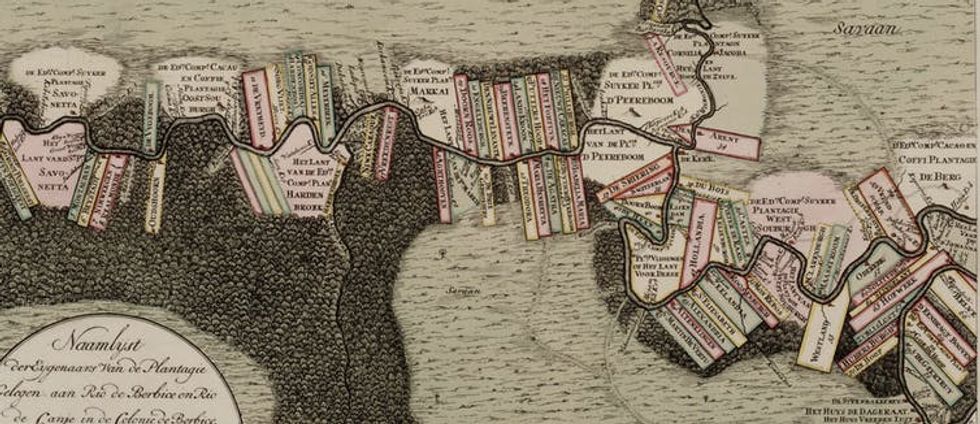
During the revolt, former slaves organized a government and controlled most of the colony for almost a year. The Dutch either fled altogether or holed up on a well-fortified sugar plantation near the coast. A regiment of European soldiers sent from neighboring Suriname mutinied and joined the rebels they had come to defeat. But obligated by treaties, indigenous peoples such as Carib and Arawak fought on the side of the Dutch. The revolt ended when the rebels, out of food and arms, were overpowered by enemies who had received an infusion of men and supplies from the Dutch Republic.
The uprising, unusual among Atlantic slave rebellions for its length, size and near success, is barely known outside Guyana. But even African-descended Guyanese, it turns out, know less than they would like. Almost 13,000 people, intrigued by new information about a foundational chapter in their history, had tuned in to watch my presentation on Facebook and Zoom.
A rare cache
First colonized in 1627 to trade with Amerindians, Berbice passed into the hands of an investment company 100 years later that exploited the colony, which was growing coffee, cacao and sugar.
Yet, all of the records related to the rebellion – in fact, most of the country’s historical records – are in archives in London and The Hague.
The sources for the uprising are extensive. There are the usual colonial records, such as the colonial governor’s daily journal, letters from officials and merchants and military reports. They are tainted by self-interest, Euro-centrism and racism.
More rare in the history of Atlantic slavery are letters sent by rebel leader Kofi to his Dutch counterpart. An African from the Gold Coast who had been forcibly taken to Berbice as a child, Kofi sought to end the military conflict through diplomacy.
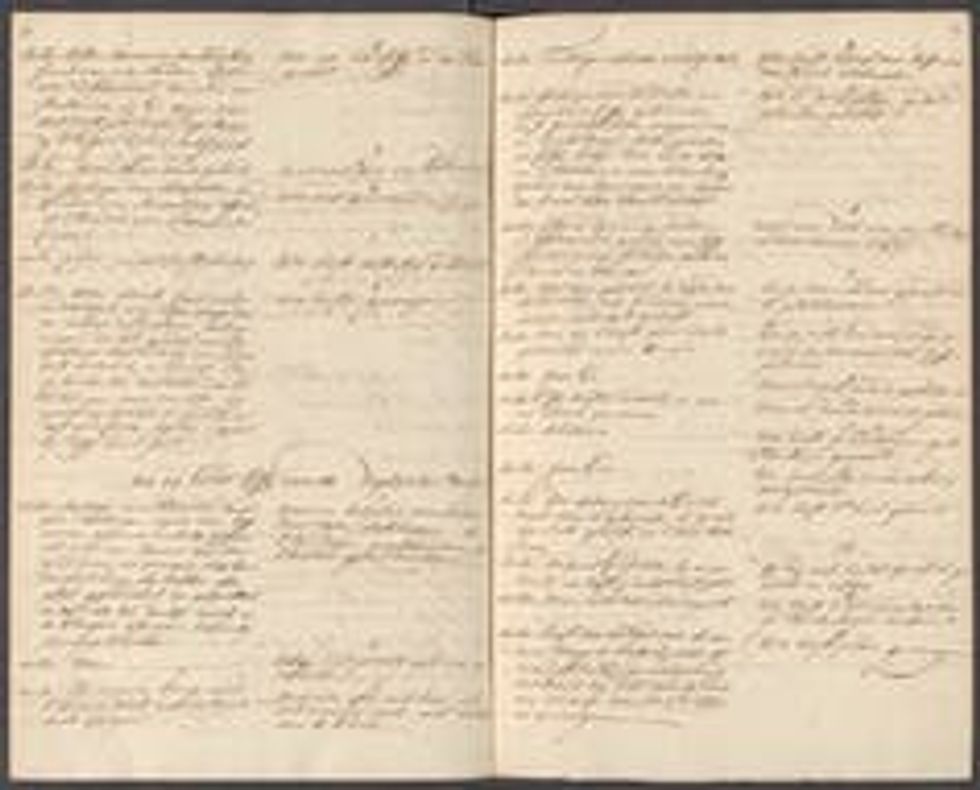
And then there are the extraordinary testimonies of 900 suspected rebels and bystanders. They were taken as part of the Dutch kangaroo court to investigate guilt in the rebellion and condemn people to the rack, the pyre and the gallows.
These records, too, are problematic. The people on the stand feared for their lives. A Dutch clerk translated their answers from Creole into Dutch, summarized them, and put them in the third person. Using them requires, like most historical records, great care.
Still, the testimonies represent the voices of African-Guyanese ancestors. But the manuscripts have lain in the Dutch National Archives since the 19th century. They are in standard Dutch rather than the Creole language of Dutch Berbice likely more prevalent among the enslaved population at the time, and their existence was heretofore unknown in Guyana.
The copious records reveal not only the political course of the rebellion but how people felt about it. Many young men joined enthusiastically. Older people and Creoles (people born in the colony) had more to lose in terms of family and meager possessions and were more reluctant.
To remain on the sidelines, they lived quietly on their plantations, dodging anyone, whether Europeans, rebels or Amerindians, or by hiding in the savanna or rainforest until the coast was clear. They were motivated by a desire not only to survive but also to remain masterless and ungoverned.
In his letters to the Dutch, Kofi proposed dividing the colony in two. It seems likely that he intended to keep several sugar plantations in production, perhaps with forced labor, in order to participate in the world market. Some 30 years later, Haitian revolutionary Toussaint L’Ouverture, too, would force self-emancipated Haitians to work in the cane fields for similar reasons. Many ordinary Guyanese were not up for this.
At my Zoom lecture on Nov. 24, listeners asked many questions. But they were particularly interested in the court testimonies.
Why, some asked in the chat, were these records still housed in the National Archives in The Hague? Shouldn’t they have been gifted back, or better yet, transcribed and translated? That way, African-Guyanase would be able to interpret the records for themselves and tell their own stories.
As it happens, the Dutch National Archives recently put all of Berbice’s records online – but that does not solve the language problem. I was able to put my Guyanese host in touch with a staff member at the National Archives who seemed receptive to the idea of publishing a translation of the investigations in English.
Reckoning with slavery requires having access to the records of the past. After all, writing one’s own history, too, is an act of emancipation.
Scientists at the University of Pennsylvania and the biotech firm Regeneron are investigating whether technology developed for gene therapy can be used to make a nasal spray that will prevent infection with the new coronavirus.
The idea is to use a weakened virus as a delivery truck to carry genetic instructions to cells within the nose and the throat, which will in turn create powerful antibodies to stop SARS-CoV-2 from invading our bodies.
"The advantage of our approach is that you don't need a competent immune system for this to be effective," James Wilson, a professor of medicine at Penn who is leading the project told AFP.
The technology is currently being tested in animals and Wilson believes that, if successful, it could provide people with around six months of protection from a single dose, sprayed up the nose, and therefore complement vaccines that could soon be approved.
Wilson is a pioneer of gene therapy -- delivering genetic code into a patient's cells to correct for defects and treat disease.
His research team discovered that the Adeno-Associated Virus (AAV) group of viruses, which infect both humans and other primates but aren't known to cause disease, can be engineered to ferry healthy DNA into cells.
This approach led in 2019 to the approval of Zolgensma, the first drug for the treatment of spinal muscular atrophy, and today AAVs are being investigated for dozens of more possible applications.
Wilson was contacted by the US government in February to see if he and his lab could use the technology against Covid-19.
But it wasn't until Regeneron developed two promising lab-made antibodies against the coronavirus, which bind to a surface protein of the pathogen and stop it from invading our cells, that his team could move ahead.
Regeneron's antibodies are themselves in clinical testing but have received emergency approval for patients with mild or moderate Covid-19 who are at high-risk of getting severe disease -- and were notably used recently to treat President Donald Trump.
Researchers are hoping that the nasal spray could be squirted through the nostrils, enter nasal epithelial cells, and hijack their protein-making machinery so that they make Regeneron's antibodies.
Normally, only immune cells create antibodies, which makes the new idea a particularly innovative approach.
Since the coronavirus enters the lungs through the nasal passage, the spray could halt the infection in its tracks.
What's more, AAVs cause only a mild immune response so the side effects could be less severe than the frontrunner vaccines, which work by training the immune system to recognize a key protein of the virus.
Penn and Regeneron hope to complete their animal studies by January, before applying to the Food and Drug Administration to begin human trials.