David Dinkins, New York City's first Black mayor, has died, US media reported late Monday. He was 93.
The Democrat served as leader of the city from 1990 to 1993 after defeating Rudy Giuliani and Edward Koch.
His tenure was marked by racial strife -- most notably the Crown Heights riots -- and criticism that he was not up to the job.
Dinkins died from natural causes at home, the New York Times reported, less than two months after his wife Joyce also passed away.
A compromise candidate who remains New York's only Black mayor, he inherited a city marked by racism, poverty and violence.
More than a million New Yorkers were on welfare following the recession, and over 1,000 murders were being reported annually.
Dinkins was elected as a stabilizing force, and famously described New York as a "gorgeous mosaic," but he struggled to make headway.
Responsible for enlarging the police force to combat crime following the murder of a Utah tourist, he slashed the city's budgets for education, housing, health, and social services.
But Dinkins also appointed one of the city's most diverse cabinets -- including numerous women, and New York's first Puerto Rican fire commissioner and an openly gay Black psychiatrist as its mental health commissioner.
He was incapable of controlling his headstrong cabinet, the New York Times said, and he was heavily criticised for the subsequent policy gridlock.
Known for his tailored linen suits and unfailing courtesy, critics often suggested that Dinkins was "too nice" to lead the city.
'We have made history'
Born July 10 1927, Dinkins grew up in Trenton, New Jersey, the New York Times reported.
In 1945, he joined the Marines and later attended the historically Black Howard University, where he majored in mathematics.
He married classmate Joyce, and the couple moved back to New York where Dinkins practised as a lawyer after putting himself through Brooklyn Law School, the New York Post reported.
He was appointed City Clerk in 1975 and served for a decade, the NYT said, before winning the mayoralty in 1989.
Dinkins was ousted by Giulini after only a single term in office, but in his concession speech, the Washington Post said that he told the crowd: "My friends, we have made history. Nothing can ever take that away."
After office, he taught at Columbia University and hosted a local radio programme, the Post added.
He is survived by his children, Donna and David Jr., two grandchildren.
President Donald Trump's administration allowed President-elect Joe Biden's transition to move forward on Monday -- but that doesn't mean an end to his campaign's legal challenges.
"As it seeks to overturn the election results and keep President-elect Joe Biden from assuming power, President Donald Trump’s legal team, fronted by lawyers such as Rudy Giuliani, Jenna Ellis, and until recently Sidney Powell, has been operating out of a conference room at the 2020 campaign’s downsized headquarters in Arlington, Virginia," The Daily Beast reported Monday. "Aiding Trump’s so-called 'elite strike force' team in that effort has been an on-air host at One America News Network (OAN), a vociferously pro-Trump cable-news channel that has been endorsed by the president."
Bobb has repeatedly denied on-air that Trump lost the election that he did, in fact, lose.
"Christina Bobb chairs the Weekly Briefing on OAN. She’s also a lawyer by trade. And in recent days, she’s been spotted by several Trump officials at their office in the conference room with the rest of the president’s team. Her presence has caused a bit of confusion among actual campaign staff, who wondered if she was there to embed with the Trump legal “strike force” as a reporter," The Beast explained. "But according to multiple knowledgeable sources, Bobb has actually been assisting the president’s long, long, long-shot legal effort—effectively taking on a secondary role as a pro-Trump lawyer even as she continues her job as a pro-Trump TV host."
"Such an arrangement would be absolutely unthinkable in other newsrooms. But OAN’s editorial stance is so committedly pro-Trump that it almost, almost makes sense. Bobb certainly hasn’t hidden her feelings for the president or his current legal endeavors. Even when compared to the output of other OAN on-air staff, she has shown intense commitment to the premise that Trump actually won the election that he clearly lost," The Beast explained.
On Monday, writing for CNN, former federal prosecutor Elie Honig tore into President Donald Trump's legal strategy to try to get the Supreme Court to throw out votes and overturn the election.
"If the Trump campaign's legal team is counting on the Supreme Court to save them, they're delusional," wrote Honig, referencing a statement by Trump lawyers Rudy Giuliani and Jenna Ellis claiming that their latest case's dismissal by a federal judge advances their ability to appeal up the decision. "In this case, and in the larger effort to contest the outcome of the 2020 election, Trump's team is just about out of runway."
"In a news conference laden with false statements and incomprehensible legal claims, Ellis labeled Trump's legal team an 'elite strike force.' But their utter failure to uncover evidence of widespread voter fraud, or to articulate a coherent legal theory, suggests otherwise," wrote Honig. "Indeed, Saturday's ruling by federal judge Matthew Brann — an appointee of President Barack Obama who previously held various positions in Pennsylvania's Republican party — is one of the harshest rebukes I've ever seen from any judge. Brann heaped scorn on the Trump campaign's 'strained legal arguments' which, he noted, are 'without merit ... and unsupported by evidence.' He ridiculed one of the Trump team's primary constitutional claims as a 'Frankenstein monster.' And Brann noted that the Trump campaign position, if adopted, would 'disenfranchise almost seven million voters.'"
The problem for Trump's team, Honig noted, is that although they are appealing to the Third Circuit, they can't introduce new evidence or facts at the appellate level. Moreover, he added, there is no evidence their appeal will even be accepted: "While losing parties in federal court generally can appeal as a matter of right to the court of appeals, nobody has a right to be heard by the US Supreme Court," and even if they agree to hear it, "there's little in the record thus far to suggest the Trump team will prevail."
And even if the Trump team gets around all that and the Supreme Court somehow awards Trump Pennsylvania's electors, said Honig, that would still not be enough electors for the president to win.
"Through all the angry podium-pounding, through all the noise and bluster, Trump's lawyers have nothing," concluded Honig. "Their legal effort has been doomed from the day it started, and they're just about at the end of the line."
President Donald Trump filed another appeal for his Pennsylvania suit to stop the votes from being counted in the state. This suit goes to the Third Circuit Court, and the filing was due at 4 p.m. In true Trump-legal team style, however, the filing didn't drop until 4:19 p.m.
"This latest filing - where Trump is now seeking to prevent certification in Pennsylvania - has now ascended the Mount Rushmore of banana-pants," tweeted appellate lawyer Raffi Melkonian. "Among other insanities - 1) you needed to file this days ago; 2) why are you asking for an extra 1,000 words on the motion when YOU ARE FILING A 14,000 WORD APPELLATE BRIEF ALSO TODAY; 3) It is not called a TRO."
Former acting Solicitor General Neal Katyal found it odd that the Trump legal team would try to file a restraining order in a U.S. district court of appeals when it wasn't in the first case.
Making his way through the legal filing, Reuters crime and justice reporter Brad Heath cited the point that Trump's team isn't trying to disenfranchise 6.8 million voters. They're trying to disenfranchise a subset of 1.5 million voters. Later on in the filing, however, the campaign says that irregularities mean the whole election should be thrown out and handed to the Republican-led legislature to decide. That would essentially nullify the 6.8 million votes they say they're not trying to disenfranchise.
"Trump's lawyers say the only issues they want the Third Circuit to resolve are whether they should have been able to amend their complaint to reinstate claims they dropped by mistake, and whether they can revive a related injunction motion," tweeted Heath. "Trump's lawyers want to be able to go back to the district court so they can argue that a bunch of election procedures they didn't like - curing of mail-in ballots, canvassing observation, etc - were part of a deliberate scheme to help Joe Biden become president."
Trump's lawyers went on to say that telling counties to count absentee ballots without secrecy envelopes was a scheme to help Biden win. "Nevermind that the state Supreme Court said they shouldn't be counted and it appears they, therefore, weren't," tweeted Heath.
The filing doesn't include much about why Judge Matthew Brann's ruling should be reversed, other than lawyers saying they didn't want to wait too long to amend their complaint because it would prejudice defendants.
Former Federal Prosecutor Joyce White Vance said that the courts may have to decide at what point to issue sanctions for such absurd lawsuits.
“Petitioners do not allege, and there is no evidence of, any fraud in connection with the challenged ballots; Petitioners do not allege, and there is no evidence of, any misconduct in connection with the challenged ballots; Petitioners do not allege, and there is no evidence of, any impropriety in connection with the challenged ballots; Petitioners do not allege, and there is no evidence of, any undue influence committed with respect to the challenged ballots.”
The attorney backpedaling is not surprising.
It’s one thing to speculate via tweet, but quite another for an attorney, who is an officer of the court, to make representations to a judge. Trump’s lawyers are constrained in what they can assert by three major restrictions that apply to lawyers: professional ethics, rules of civil procedure and rules of evidence.
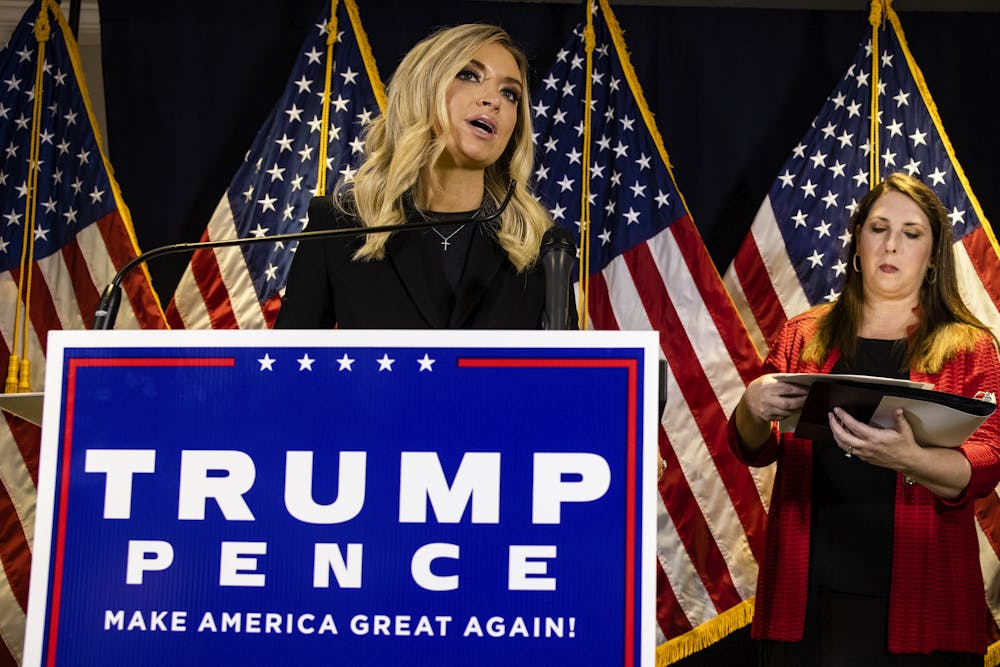
White House Press Secretary Kayleigh McEnany, left, at a press conference where Trump campaign and GOP officials pushed theories of voter intimidation, fraud and illegal votes but were unable to provide proof.
As members of the bar association – the state entity that grants attorneys their license to practice law – lawyers have a professional ethics obligation “not to abuse legal procedure” by filing “frivolous” claims. Rule 3.1 of the Model Rules of Professional Conduct, some version of which applies in all states, forbids a lawyer from bringing a claim or argument “unless there is a basis in law and fact for doing so that is not frivolous.”
The bar requires lawyers to “inform themselves about the facts of their clients’ cases and the applicable law” and “determine that they can make good faith arguments” supporting their clients’ positions.
At least outside the context of criminal defense, lawyers must be able to honestly represent to the court that they have a basis for believing they have a path to getting relief either based on existing law or “a good faith argument for an extension, modification or reversal of existing law.”
Violating this requirement could expose the lawyer to sanctions from the state bar, which could range from a reprimand to a fine to a license suspension. More practically, it can erode courts’ confidence in the lawyer’s reliability and damage the lawyer’s professional reputation.
In Trump’s case, this means his attorneys can only say the election was stolen if they know of actual, credible reports of systematic fraud.
President Trump leaves a Nov. 5, 2020, press conference at which he alleged the election had been rigged and stolen.
Formal disciplinary administrative proceedings against lawyers by the bar for this kind of misconduct are rare. But less rare are motions by opposing parties for sanctions under a different rule.
Federal Rule of Civil Procedure 11 allows an opposing party to move for sanctions against a lawyer who files a frivolous claim or makes a frivolous argument. Most states have an analogous rule for their courts.
Rule 11 provides that when making a claim before the court, the attorney certifies, “after an inquiry reasonable under the circumstances,” that:
it’s not being made for an improper purpose, such as to harass or delay;
the claims are warranted by existing law or a nonfrivolous argument for a change in the law; and
the factual assertions have evidence to support them, or will likely have such support after a reasonable opportunity for investigation and discovery.
For example, if a corporation’s lawyer files an antitrust complaint that she knows to be a stretch, just to block a rival’s merger deal and give her client time to complete its own merger deal first, that would be a violation of Rule 11.
The rule allows any opposing party to ask for sanctions, or for the court to order sanctions on its own initiative. Frequently, such sanctions include paying the other side’s attorney fees for having to do the work to oppose the frivolous claim or argument.
As an election law scholar and practitioner, I believe that perhaps the most compelling rule keeping lawyers cautious is the practical consideration that making unsubstantiated claims of fraud is not only unethical but also a waste of time.
Eventually — and, under the accelerated time frame of these cases, that means pretty quickly — the lawyers are going to have to present actual evidence to judges. Without such evidence, judges will dismiss the claim.
And a lawyer making fraud claims without evidence runs the risk that an impatient judge might dismiss an entire case, even if other, legitimate claims are being made.
When it comes to the election fraud claims, watch what the lawyers do, not what the politicians say.
According to Democratic attorney Marc Elias, "Pennsylvania Supreme Court AFFIRMS our 5 victories in Philadelphia and REVERSES our one loss in Allegheny County."
The suit was attempting to throw out ballots legally cast.
"Guided by these principles and for the reasons discussed at length in this opinion, we conclude that the Election Code does not require boards of elections to disqualify mail-in or absentee ballots submitted by qualified electors who signed the declaration on their ballot’s outer envelope but did not handwrite their name, their address, and/or date, where no fraud or irregularity has been alleged," the court said in the opinion Monday.
"The [Trump] Campaign does not contest that these ballots were all timely received by the Philadelphia Board prior to 8:00 p.m. on November 3, 2020 (election day); that they were cast and signed by qualified electors; and that there is no evidence of fraud associated with their casting. The Campaign instead contends that these votes should not be counted because the voters who submitted them failed to handwrite their name, street address or the date (or some combination of the three) on the ballot-return outer envelope," it also characterizes.
Pennsylvania is slated to certify the election tally today, meaning Trump will have little recourse to change it.
One of Trump's Pennsylvania suits was thrown out of court last week, which attorney Rudy Giuliani appealed to the Supreme Court.
“One might expect that when seeking such a startling outcome, a plaintiff would come formidably armed with compelling legal arguments and factual proof of rampant corruption … That has not happened,” Judge Matthew Brann wrote in the opinion last week. “Instead, this Court has been presented with strained legal arguments without merit and speculative accusations, unpled in the operative complaint and unsupported by evidence.”
President Donald J. Trump has publicly praised his legal team’s efforts since the election didn't result in a win for the Trump campaign, but is privately "frustrated with the slapdash nature of his election defense fight," several people familiar with the discussions told NBC News Monday.
According to the report, Trump has been "complaining to aides and allies about his personal attorney Rudy Giuliani and recently-removed lawyer Sidney Powell’s over-the-top performances at a news conference at the Republican National Committee headquarters last week. Both Giuliani and Powell have continued to make conspiratorial and baseless claims about widespread voter fraud, for which they have provided no evidence."
Trump is reportedly telling aides he is concerned his team is comprised of “fools that are making him look bad."
Trump was also reportedly displeased with the optics of the brown substance, presumed to be hair dye or a makeup product, dripping down Giuliani’s face during the nearly two-hour news conference Thursday, according to one of the sources familiar with the president’s reaction.
The president may be embarrassed and ready to move on, but not publicly.
As President-elect Joe Biden announces more picks for his incoming administration, it is quite obvious that the former vice president will have a very different governing style from President Donald Trump. The Biden/Trump contrasts are the focus of an Associate Press article published on November 21 — and according to AP reporters Jill Colvin, Steve Peoples and Jonathan Lemire, White House staffers are terrified of offending or upsetting Trump during this lame-duck period.
"The circle around the president has grown smaller in recent weeks," the journalists explain. "Staffers who normally would leap at the chance to set foot in the Oval Office now try to avoid it for fear of crossing a temperamental president who has been angrily demanding answers from aides as to how to further contest the election."
Ordinarily, the lame duck period is one in which the outgoing administration and the incoming administration get together in the White House to discuss pressing matters. But Trump, almost three weeks after the election, is still refusing to concede to Biden and continues to claim, without justification, that the election was stolen from him because of widespread voter fraud. And the West Wing is "largely empty," according to AP.
"Even (Trump's) personal attorney, Rudy Giuliani, has been forced to steer clear of the White House after the former New York mayor's son, a White House staffer, announced he had tested positive for the virus," Colvin, Peoples and Lemire report. "Rudy Giuliani has taken over the president's legal efforts to contest the election, despite a lack of evidence behind those challenges. Trump snapped at aides when he was told that Giuliani and the rest of his legal team could not meet at the White House on Friday after they, too, had been exposed."
Biden will inherit some major crises when he is sworn in as president on January 20, 2021, including a deadly pandemic that has killed more than 1.3 million people worldwide (according to Johns Hopkins University in Baltimore) and a brutal recession. In light of the problems Biden's administration will have to contend with, members of the Trump Administration should, ideally, be doing everything they can to make the transition as smooth as possible — instead, as AP reports, people in the White House are walking on pins and needles for fearing of upsetting Trump.
Last week, the AP reporters note, "The Trump West Wing, never a well-oiled machine, was even less organized than usual. Staffers in the press office, who control the White House briefing room, found out from reporters on Thursday that the coronavirus task force, led by Vice President Mike Pence, had scheduled a briefing there. Trump finally made an appearance Friday to discuss prescription drug prices — an event he had demanded, to push back against the storyline that he was in hiding. But he again skirted reporters' questions, as he has for more than two weeks now."
Colvin, Peoples and Lemire stress that Biden, despite Trump's refusal to acknowledge him as president-elect, is focusing on picks for his incoming administration.
"Trump has largely abandoned governing, despite a pandemic that has now killed more than 250,000 people in the U.S. and is raging out of control," the AP reporters note. "He has rejected the results of the election, concocted conspiracies that are now believed by his most loyal supporters and refused to allow his government to participate in the peaceful transition of power to the next administration while trying to pressure state legislators and election officials to overturn the will of the voters. Denied the briefings, access to agencies and funding that are part of a traditional transition, Biden has nonetheless tried to move forward."
Attorney Ken White, a former federal prosecutor, has taken a look at some of the Trump campaign's latest legal filings and has found them to be equal parts "shockingly ridiculous" and "stunningly incompetent."
Writing on Twitter, White explains how Trump attorney Rudy Giuliani and other pro-Trump plaintiffs made a series of crucial errors that allowed their case to be dismissed by a federal judge with prejudice.
"The Trump Campaign, and two Trump voters, sued in federal court in PA, then filed a First Amended Complaint that ditched a lot of their initial arguments," White writes. "At oral argument Rudy Giuliani asked the judge to amend the complaint again to revive one of the claims they dismissed. In his ruling the judge made rulings destroying the entire premise of Trump's -- and the voters' -- right to sue, and eviscerated the premises of their arguments and the remedies they sought."
White goes on to show how the Trump campaign has already blown its efforts to appeal the case as well.
"Now, on appeal, Trump is attacking only the refusal to let them amend," he explains. "They're not appealing the substantive rulings the judge made that destroy the entire premise of their suit and rule out the remedies they are seeking... there's a strong argument that by framing the appeal this way Trump is giving up any challenge to the things the trial court ruled, things that render the amended complaint dead on arrival."
White concludes that this strategy is at best "incredibly reckless," before saying that "more likely it's malpractice."
The United States Court of Appeals for the Third Circuit has granted the Trump campaign's motion for an expedited hearing in a case that is being handled by attorney Rudy Giuliani.
Last week, federal Judge Matthew Brann tossed out a case in which Giuliani had asked for 680,000 ballots to be invalidated in Pennsylvania. But Giuliani's team had removed legal claims about the demand from its motion to the court.
In his ruling, Brann said that Giuliani could not file an amended complaint in his court. The Trump campaign responded by filing an amended motion for expedited review with the Third Circuit of appeals.
On Monday, the federal appeals court decided to hear the case. The court also accepted the Trump campaign's expedited timeline.
"It is critically important for Appellants’ claims to be heard before the December 8, 2020 'safe harbor' date under 3 U.S.C. §5 of Pennsylvania certifying its Presidential electors, which is only 16 days away," attorneys for the Trump campaign noted in the motion.
The court has ordered attorneys for both sides to file briefs before November 24 at 4:00 p.m.
The Supreme Court of the United States on Monday took no action to overturn a lower court decision that allowed the counting of late-arriving mail-in ballots in Pennsylvania.
President Donald Trump's campaign had sought to exclude mail-in ballots that arrived after election day.
In 4-4 decision in October, the high court upheld the Pennsylvania Supreme Court's ruling that said ballots postmarked by election day can arrive up to three days after the election.
The court later handed the Trump campaign a victory with an order saying that late-arriving ballots must be segregated before being counted.
The Trump campaign had hoped that the Supreme Court would hear the case prior to Pennsylvania's certification of the 2020 election.
But on Monday, the court's regular order list for its November 20 conference did not include any action on the case.
The court could take action at its December 4 conference, which is after Pennsylvania's November 23 deadline for counties to certify the election.
President Donald Trump is throwing an epic temper tantrum over his election loss, but one of his biographers said losing has been the defining feature of his life.
The president cultivates an image of winning, but journalist Tim O'Brien wrote a new Bloomberg column cataloguing some of the key moments in Trump's life where he got smacked down by the individuals and institutions he challenged.
"It’s worth recalling that none of Trump’s grotesque and damaging behavior of late was unexpected," O'Brien wrote. "He’s spent most of the year telegraphing his desire to stain the Constitution and stave off relinquishing the presidency. He labeled the electoral process fraudulent before the election even took place, and everything he’s done since has been in character: deploying a squad of incompetent, tragicomically bonkers stooges led by Rudy Giuliani, Jenna Ellis and Sidney Powell to challenge the legitimacy of the vote and continuing to threaten and corrupt the Republican Party so it enables his caudillo act."
"At the end of the day, Trump at his core is who Trump has always been — a vaudevillian bully," he added. "His history is also chock full of examples of people and institutions that not only stood up to him but batted him back after he puffed his chest and swung his fists."
It started in childhood, when Trump's parents shipped their self-described "brat" son off to military school, where teachers literally smacked him into submission, and continued through his business career and into his political life.
"There are more examples of the bully being thumped, just as there are myriad examples of Trump manipulating institutions and making end runs around the law," O'Brien wrote. "At the end of the day, however, Trump didn’t make the media crumble, the courts acquiesce, law enforcement look away or Democrats succumb. He has inflicted long-term damage on public trust and leadership, visibly rendered in the nation’s failed response to the COVID-19 pandemic, but he hasn’t managed to fashion a throne for himself despite his fascination with dictators, propaganda and blunt force."
With the Trump campaign's amateurish, absurd, but nonetheless dangerous attempt to overturn the results of the November election continuing to flop in court, members of the president's legal team late Sunday issued a statement distancing themselves from right-wing attorney Sidney Powell after she spent the past several days peddling bizarre and entirely baseless claims of vote hacking involving Venezuela, Cuba, and "communist money."
Trump attorneys Rudy Giuliani and Jenna Ellis said Powell is "practicing law on her own" and "is not a member of the Trump Legal Team," a statement that comes just days after Powell appeared at a press conference with Giuliani and Ellis at Republican National Committee headquarters in Washington, D.C., where the trio rambled on about a vast conspiracy against the president for which there is zero evidence.
"She is also not a lawyer for the president in his personal capacity," Giuliani and Ellis added.
An unnamed Trump campaign official told the Washington Post late Sunday that Trump had come to believe Powell was damaging the credibility of his already floundering legal ploy. "She was too crazy even for the president," the official remarked, not mentioning the fact that Trump has readily touted Powell's narrative in recent social media posts and hailed her as part of his "truly great" legal team.
During the Trump attorneys' press conference last week, Ellis described Powell as part of an "elite strike force" of lawyers expertly working to advance the Trump campaign's legal aims—a characterization that critics didn't hesitate to mock while also stressing the very real threat posed by the ongoing coup attempt and the lasting damage it could inflict.
"It's OK to laugh at this hilarious clown car and yet appreciate that what's going here is deadly serious," tweeted attorney Deepak Gupta. "These tactics will go nowhere but still infect our democracy with doubt. Meanwhile, the transition delays risk grave harm to public health and economic and national security."
The attempt by Trump's top attorneys to disavow Powell came a day after a federal judge dismissed the campaign's last-ditch attempt to stop Pennsylvania from certifying its election results, a move expected to come Monday. In his blunt ruling (pdf) over the weekend, U.S. District Court Judge Matthew Brann said the Trump campaign's complaint was riddled with "strained arguments" and "speculative accusations."
Kristen Clarke, president and executive director of the Lawyers' Committee for Civil Rights Under Law, a group that intervened in the Pennsylvania case, said in a statement that Brann's ruling "should put the nail in the coffin on any further attempts by President Trump to use the federal courts to rewrite the outcome of the 2020 election."
"The court could not be any clearer in underscoring the baseless and meritless nature of the claims presented in this case," said Clarke. "Voters across the Commonwealth overcame tremendous obstacles to register their voice and this suit sought to disenfranchise them without a scintilla of evidence."