"Lindblad Expeditions and Laundrylux Distribution, two companies that hired Trump-linked lobbyists Jeff Miller and Brian Ballard, received millions of dollars in small business relief loans," CNBC reported.
While Laundrylux denies any link between Ballard's lobbying, it raises questions about the ethics and transparency of distribution for the PPP bailout. Ballard recently helped raise over $560,000 for Trump's joint fundraising committees with firm partner Daniel McFaul. Ballard also serves as a Republican Party regional vice-chair while also working as a lobbyist for Laundrylux.
"Lindblad is a New York-based cruise company with destinations including Alaska, Costa Rica, Egypt and the British Isles," said CNBC, noting that they got a loan between $5 million and $10 million.
Laundrylux is a commercial laundry machine company that rents equipment. They pocketed between $1 million and $2 million.
There are also law firms that have ties to Trump who got federal loans like Kasowitz Benson Torres, founded by Marc Kasowitz, which got between $5 million and $10 million. Jay Sekulow's firm got between $1 million and $2 million. Both men helped defend Trump during the impeachment hearings.
President Donald Trump is under fire for lying about the mortality rate of coronavirus patients in the U.S. versus other countries in the world.
According to Johns-Hopkins, which is considered the gold standard for coronavirus datas and statistics, the mortality rate for those suffering from COVID-19 is the second-highest among the top 20 nations "currently most affected by COVID-19 worldwide." Only the UK, which chose to ignore the data and try out the failed "herd immunity" tactic, is higher.
Even looking at the "observed case fatality ratio," the U.S. comes in sixth-highest.
And looking at another source, Worldometers, which is more extensive (although some say possibly less-reliable,) in coronavirus deaths per 1 million population, the U.S. ranks ninth-worst.
Here's Trump's dangerous lie, which includes his racist name for coronavirus:
An international group of 239 scientists on Monday urged authorities including the World Health Organization to recognize that the coronavirus can spread in the air at distances well beyond two meters (six feet), and to revise their prevention guidelines accordingly.
In a commentary that appeared in the Oxford Academic journal Clinical Infectious Diseases, researchers wrote that studies have shown "beyond any reasonable doubt" that viruses can travel tens of meters in the air, and analyses of certain spreading events had demonstrated the same was true of the SARS-CoV-2 virus that causes COVID-19.
"Hand washing and social distancing are appropriate, but in our view, insufficient to provide protection from virus-carrying respiratory microdroplets released into the air by infected people," wrote the authors, led by Lidia Morawska of the Queensland University of Technology.
Their recommendations included greater ventilation for indoor environments; the introduction of high efficiency air filters and ultraviolet lamps; and to avoid overcrowding in buildings and on public transport.
When an infected person coughs or sneezes, they expel droplets of various sizes. Those above five to ten micrometers fall to the ground quickly within a meter or two, while droplets under this size can become suspended in the air in what is called an "aerosol," remaining aloft for far longer and traveling further.
There has been a vigorous debate in the scientific community about how infectious microdroplets are in the context of COVID-19, but for the time being the WHO advises that it occurs "in specific circumstances" that occur in hospitals, for example when a patient is intubated on a ventilator.
On the other hand, studies of particular spreading events have shown that microdroplet transmission isn't limited to hospitals.
The air flow from an air conditioning unit appeared to waft the coronavirus to several tables in a Chinese restaurant in January where patrons became infected, according to a study that appeared in Emerging Infectious Diseases.
The authors of the new commentary recognized that the evidence for microdroplet transmission was "admittedly incomplete," but argued that the evidence for large droplets and surface transmission was also incomplete yet still formed the basis for health guidelines.
"Following the precautionary principle, we must address every potentially important pathway to slow the spread of COVID-19," they wrote.
The paper comes as countries ease their lockdowns, bringing people back to workplaces and students back to schools and colleges.
"We hope that our statement will raise awareness that airborne transmission of COVID-19 is a real risk and that control measures, as outlined above, must be added to the other precautions taken," they concluded.
Two public health measures – testing, to identify those infected, and contact tracing, to identify those who may have encountered an infected person – have become essential as countries around the world reopen their economies and fresh surges of COVID-19 infections appear.
Even as testing ramps up, contact tracing with a wide enough net remains a daunting task. Contact tracing involves public health staff conducting interviews with infected people. Public health experts are calling for 180,000 more contact tracers, but progress on contact tracing has not been going well, according to Dr. Anthony Fauci, the head of the National Institute of Allergy and Infectious Diseases.
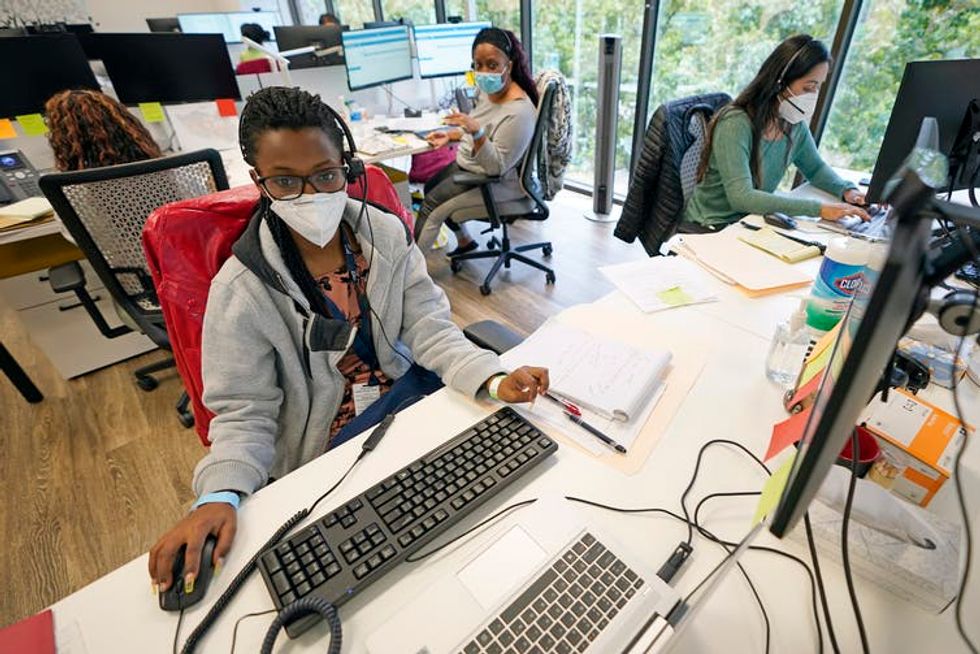
Contact tracers work at Harris County Public Health contact tracing facility in Houston, Texas.
Enter digital innovations that offer a tantalizing promise: to automate the laborious task of alerting people who have been exposed to the virus. Numerous governments have championed such apps as a means of augmenting manual contact tracing. As an economist who tracks digital technology’s use worldwide, I’ve found that the experiences of these countries reveal challenges to getting enough people to use the apps. Unfortunately, these challenges appear to me to be all but insurmountable in the U.S.
Privacy and trust
Contact tracing apps detect when a smartphone is in the presence of another app-enabled smartphone whose owner has tested positive for SARS-CoV-2.
These apps come in two types. One mimics traditional contact tracing by uploading to a central public health server the ID numbers of smart phones that have been close to an infected person’s smart phone. Depending on the app, public health authorities can be notified of the smart phone owners’ identities.
The alternative is an “exposure notification” app that prioritizes privacy by using random numbers to ensure that no one can learn anyone else’s identity. All data are stored on the users’ phones. The Apple-Google collaboration supports these types of apps.
[The Conversation’s newsletter explains what’s going on with the coronavirus pandemic. Subscribe now.]
South Korea’s, India’s and Germany’s experiences suggest a three-question test for gauging the potential of such apps: Does the government have its citizens’ trust, leading citizens to believe that the government is not collecting data or, if it is, will not misuse it? Are citizens willing to “pay” for improved health outcomes by accepting some loss of privacy? Are there events in the nation’s history that help shift the balance in favor of citizens’ willingness to share data?
Arguably, it has one of the most intrusive digitally aided tracking systems anywhere. The system shares locations of infected people, even with the media, and issues emergency text alerts.
All of this was widely accepted, except when intrusion crossed a line. When a COVID-19 cluster was linked to gay clubs and bars and led to calls to out people who visited such establishments, it raised concerns about discrimination against the LGBTQ community. The government stopped singling out particular clubs or bars in its alerts.
Why were Koreans willing to tolerate this level of official intrusion? The explanation can be traced to the country’s history. The previous administration had botched its response to the 2015 MERS outbreak, when it shared no information about hospitals visited by infected citizens. This led to public support for legislation giving health authorities access to CCTV and smartphone location data on infected citizens and the right to issue alerts.
India: partially mandated adoption
In preparation for reopening post-lockdown, the Indian government declared its Aarogya Setu contact tracing app to be mandatory for office workers, with police enforcement in some cases. But then, concerns mounted. The app had few privacy safeguards. It collected data using both GPS and Bluetooth technologies, stored it in centralized servers with no data protection law in place.
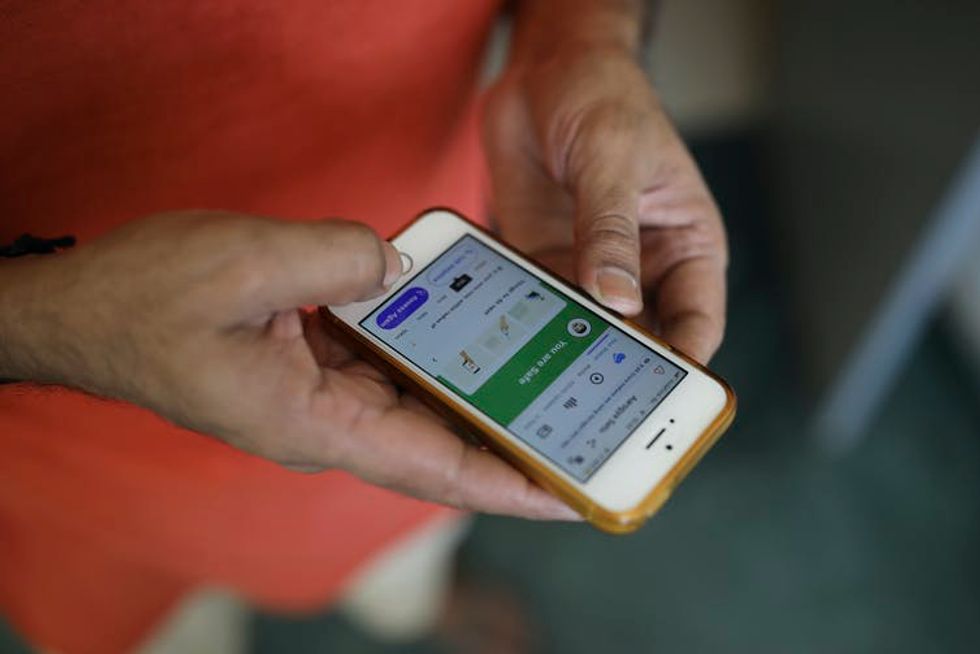
A man uses India’s Aarogya Setu contact tracing app on his mobile phone in New Delhi.
In response, the government switched the app from mandatory to “advisable,” with enough loopholes for organizations to set individual mandates. In addition, the app was uploaded to a public GitHub repository, which, in principle, opens the app – though not the data it collects – to public scrutiny.
Ironically, Prime Minister Narendra Modi enjoyed overwhelming public support even as the country endured the most stringent of lockdowns anywhere, with unspeakable hardships for many. However, the app stored citizens’ data on centralized servers, which compounded fears of digitally enabled state surveillance. Also, the app had been co-created by a ministry headed by Modi’s lieutenant, Amit Shah, who has a troubling history of abuse of power. All this made voluntary adoption difficult.
This U-turn occurred despite widespread confidence in Chancellor Angela Merkel, especially with her administration’s handling of the coronavirus response. Again, history provides a guide. Germans have lived through two notorious surveillance regimes: the Gestapo during the Nazi era and the Stasi during the Cold War.
Even with a decentralized, privacy-protecting approach, Germany’s new app is unlikely to achieve the level of adoption of South Korea’s. However, the government’s investment in an effective traditional contact tracing approach using public health staff to investigate contacts makes a digital alternative less urgent.
Prospects for digital contact tracing in the US
What do these cases say about adoption of digital contact tracing in the U.S., which leads the world in COVID-19 cases and deaths?
There is also no cohesive nationwide plan to deploy such apps. The White House, federal agencies and state governments have failed to champion them, which means that adoption rates are likely to be low and people won’t see enough value in using them to risk their privacy. Apps may appear in pockets – companies, college campuses, local communities – creating a fragmented, unreliable system of digital contact tracing.
In short, the U.S. is left relying almost entirely on tried-and-true though time-consuming and expensive manual contact tracing. As it stands, only seven states and the District of Columbia have sufficient numbers of contact tracers. Compliance is another challenge. Officials in Rockland County, New York have issued subpoenas to force people to cooperate with contact tracing efforts.
Ironically, the U.S. may need digital contact tracing more than any other country but appears to me likely to turn its back on the very lifesaving innovations it has helped develop.
Sources tell the New York Post that both Guilfoyle and Trump Jr. recently attended a "maskless" party at the Hamptons on Long Island, and that attendees are "freaking out" over news of her COVID-19 infection.
"Page Six revealed on June 29 that the couple were the guests of honor at a Bridgehampton house party that looked 'as if COVID had never happened,'" the paper reports. "Our spy said there were about 100 maskless partiers, including Ramona Singer, at the outdoor event, held on the roof of the 51 Sandpiper Lane mansion, hosted by famed Hamptons builder Joe Farrell."
COVID-19 infections have been spiking across the United States over the past several weeks, and the United States is now averaging more than 50,000 new cases per day.
A Minnesota doctor who serves on the state Senate announced on Sunday night that he is being investigated by the state medical board over comments he has made about the coronavirus pandemic, reports the StarTribune.
Sen. Scott Jensen, R-Chaska, is under fire for comments he made on Fox News, where he told Laura Ingraham that the Minnesota Department of Health was “coaching” doctors to apply COVID-19 as a cause of death in some patients before receiving confirmations from labs. In a seperate interview on a local Fargo news show, Jensen told the host, "... fear is a great way to control people," later adding, “The fear with COVID-19 has been ratcheted unbelievably high. There have been a lot of figures in government who are trying to frighten people and, in that way, get them to do what they want.”
Those comments have drawn scrutiny, coupled with previous statements about opposing state-mandated vaccinations for children and his defense of Donald Trump's proposal to use hydroxychloroquine as a possible treatment for COVID-19.
According to the Star-Tribune, Jensen received a letter notifying him of the inquiry and he is not happy about it.
“When I got this letter, I was ticked,” Jensen said in the video posted online Sunday night, while also saying he feels like he is being "targetted."
Jensen went to add that he intends to co-operate saying, "If this could happen to me because of my views, it could happen to anybody.”
When a store employee in Albuquerque, New Mexico, tried to enforce the state's face mask mandate to a customer, he found himself on the receiving end of a threat, KOAT7 reports.
Cody Westfall, who works at a pet store, says the man who refused to wear a mask entered the store with a gun on his hip. When Westfall asked him if he happened to have a mask that he could put on, things took a threatening turn.
“At that point he stopped and kind of turned around to me and asked, you know, ‘are you going to make me wear a mask?’ To which point I mentioned that not only is it a personal preference for our store but as of yesterday it is now government mandated,” Westfall said.
“He looked down and then looked back up and said ‘are you sure you're going to make me wear a mask?’” Westfall added.
Westfall says he knew things were getting serious when the man threatened him a second time. He called the police as soon as the man left the store.
A Florida mother allegedly took her high-risk teenage daughter to a youth group event at their church, tried treating the girl at home with unproven drugs when she got sick -- and then hailed her as a patriot after she died.
Carsyn Davis died June 23, two days after her 17th birthday, after she contracted the coronavirus, reported the News-Press, but former Florida data scientist Rebekah Jonesdetailed shocking claims in a medical examiner's report about her illness.
The Florida Department of Law Enforcement investigated the teen's last two weeks in the medical examiner's report, which Jones said shows her mother, Carole Brunton Davis, had taken her immunocompromised on June 10 to a church-sponsored event.
Editor's note: Jones' analysis of the medical examiner's report suggested that Davis had intentionally exposed her daughter to the virus at the event, but there's no additional evidence to support that claim. This report has been updated to reflect subsequent reporting on the teen's illness.
More than 100 mask-free children attended the event, and Davis allegedly gave her daughter azithromycin, an anti-bacterial drug with no known benefits for fighting COVID-19, after she developed headaches, sinus pressure and a cough, Jones reported.
Davis -- whose Facebook page is awash in QAnon conspiracy theories, anti-vaccine and coronavirus misinformation and dubious legal theories -- next put the girl on her grandfather's oxygen machine after she "looked gray" on June 19, Jones reported.
Then she gave the girl hydroxychloroquine, an antimalarial drug touted as a cure by President Donald Trump, despite evidence of deadly side effects, and Carsyn's condition worsened.
Davis finally took her daughter to a hospital, where she was admitted to a pediatric intensive-care unit -- but declined intubation until it was too late, Jones wrote.
The hospital started plasma therapy on June 20 and 21, Jones reported, but Carsyn's cardio-respiratory system was too seriously damaged and she died days later.
"We are incredibly saddened by her passing at this young age, but are comforted that she is pain free," Davis told the News-Press after her daughter's death.
She told the newspaper her daughter was a patriotic Christian who was involved with Operation Christmas Child and organized Christmas card writing for Ten Thousand for the Troops.
"Though she never wanted anything for herself, she was always making or buying gifts for others," Davis said.
The Washington Post reports that President Donald Trump's campaign recognizes that the virus will not magically go away by November -- and is instead hoping to convince Americans they can simply "live with" the deadly disease spreading unchecked.
" White House officials also hope Americans will grow numb to the escalating death toll and learn to accept tens of thousands of new cases a day, according to three people familiar with the White House’s thinking," the paper reports. "Americans will 'live with the virus being a threat,' in the words of one of those people, a senior administration official."
One former administration official tells the Post that the campaign is betting "that people will get over it or if we stop highlighting it, the base will move on and the public will learn to accept 50,000 to 100,000 new cases a day."
Cases have continued to surge in the United States in recent weeks, even as many European countries that were initially hit hard by the virus have gotten it under control.
Italy, whose daily average infections peaked at more than 5,600 per day in late March, is now seeing under 500 new COVID-19 infections per day.
The United States, in contrast, has seen its new daily cases hit record highs, and it is now averaging more than 50,000 new cases a day.
Dr. Nicole Saphier was asked Monday morning if President Donald Trump's just-announced campaign rally in New Hampshire on Saturday will be "safe" to attend.
She didn't quite answer the question, but called the decision to move the re-election rally outdoors "great messaging."
"It's great messaging to be moving these rallies outdoors," Dr. Saphier, who is not a virologist or immunologist, but a radiologist, told Fox News' Ainsley Earhardt. "Virus transmission is markedly decreased when you move outside."
"Great messaging, great idea, move outside, give out hand sanitizer, encourage mask-wearing if you can't maintain 6 feet. That being said, Ainsley, New Hampshire is one of the lowest percent positive cases, and if you have a lot of people traveling there it is possible that they could be – that the interstate travel in itself may be promulgating some of the virus transmission and the spread."
Saphier herself didn't encourage mask-wearing, and didn't mention masks again.
She concluded by urging people to "stay vigilant,' and "pretend that you yourself have the virus, everyone around you does," and asked attendees to "maintain social distancing and hand hygiene."
Studies prove mask-wearing is the greatest action people can take to prevent the spread of the virus when not alone.
Dr. Saphier clearly is not a fan of masks.
Just three days ago she shared her feelings about masks on Twitter, defiantly insisting, "I refuse to accept wearing a mask is the new normal; this is TEMPORARY."
In her typo-laden tweet she appeared to call wearing one "nonesense."
But unlike her Fox News appearance, she did say clearly, "Avoid crowds."
Dr. Saphier is the author of "Make America Healthy Again."
In yet another sign that the "swamp is alive and well in Washington, D.C." despite President Donald Trump's repeated promises to drain it, consumer advocacy group Public Citizen released a new report Monday morning identifying at least 40 Trump-connected lobbyists who have raked in over $10 billion in federal Covid-19 relief for their corporate clients since the pandemic began.
The dozens of lobbyists with ties to Trump through his campaigns, his administration, and/or his transition team "collectively have represented at least 150 clients on Covid matters," Public Citizen notes in its new report titled "COVID Lobbying Palooza" (pdf). Those clients include such corporate behemoths as Pfizer, Comcast, McDonald's, MasterCard, and American Airlines.
"The crisis offered an especially lucrative opportunity for those lobbyists who enjoy close ties to President Donald Trump and his administration—and they seized it," reads the report, which briefly profiles all 40 of the lobbiysts and details some of their activities. "They have reported lobbying to obtain special industry carveouts for aid, government approval of their clients' products and, most commonly, Covid-related aid across a myriad of programs."
Public Citizen found that 27 clients of Trump-connected lobbyists have secured $10.5 billion in taxpayer coronavirus aid—a sum that is likely an underestimate because it does not include data from the $650 billion Paycheck Protection Program, which the White House has worked to keep under wraps.
The $10.5 billion total, according to Public Citizen "consists of $6.3 billion in grants, $4.2 billion in loans, and $67 million worth of support in the form of corporate bond purchases by the Federal Reserve."
Five of the lobbyists identified by Public Citizen—including former Transportation Department official Geoffrey Burr and former Treasury adviser Jordan Stoick—"may have violated a Trump executive order that restricts lobbying activities by former officials," the group said.
"In many cases, the forms indicate that the former officials' agencies were directly lobbied," the report reads.
Craig Holman, a registered lobbyist for Public Citizen and a campaign finance expert, told the Associated Press that the group is planning to file ethics complaints with the White House over the apparent violations.
"There does not appear to be anyone who is enforcing the executive order," said Holman. The report says an investigation into the activity is warranted.
Arguing that sweeping reforms will be necessary to prevent such profiteering in the future, Public Citizen said "few scenarios would better embody most people's image of the Washington 'swamp' than dozens of hired-gun lobbyists cashing in on their government connections during a public health emergency."
"In the short term, the government, of course, should do everything it possibly can to offer the public an unobstructed window into the details of where the trillions in public dollars are going," the group said. "In the long term, future administrations and the Congress should embrace systemic reforms to sever the conflicts of interest that incentivize government officials to favor the wealthy and well-connected over the constituents whom they are hired to serve."
During a panel discussion with Harvard Global Health Institute Director Dr. Ashish Jha and CNN's Dana Bash, Berman noted that Trump's campaign is scheduling a rally in New Hampshire next weekend, even though the administration's own guidelines are warning against large gatherings in enclosed spaces where social distancing is impossible.
"That is, again, just like several other events that we've seen put on by the White House or the campaign, Exhibit A of what the president's own government is begging people not to do," Bash remarked.
Berman then remarked that the Trump campaign itself seems to be a super spreader for COVID-19, as it has held rallies in hot spots across the United States.
"It's a traveling coronavirus roadshow from the Trump campaign right now around the country," he said. "If you look at where it has been and the damage left in its wake, whether it be Tulsa, Phoenix, and now in Montana as well."
As local officials express concerns that their hospitals could be overloaded with coronavirus patients, some are urging Gov. Greg Abbott to empower local governments to issue stay-at-home orders.
Local officials and experts inAustin, San Antonio, Houston and Fort Worth have expressed concerns in recent days that increasing coronavirus hospitalizations could overwhelm their intensive care capacities, with some saying it could happen in less than two weeks.
AsTexas hit another record high Sunday, reporting 8,181 people hospitalized for the new coronavirus, local officials predicted cities could soon run out of space to care for the sickest patients. The state reported that there still are 13,307 available staffed hospital beds, including 1,203 available staffed ICU beds statewide, but hospital capacity varies greatly by region.
On Sunday, Austin Mayor Steve Adler told the Austin American-Statesman that hospitals there could be overwhelmedin the "next 10 days to two weeks" if the amount of people admitted because of the coronavirus continues to increase, adding that 434 out of 1,500 Austin-area hospital beds for coronavirus patients are occupied.
The San Antonio Express-News also reported that the city's hospitals could be overrun with patients in the next week or two, noting that the number of hospitalized coronavirus patients in that area's trauma service region rose by 55% in the past week.
The Fort Worth Star-Telegram reported Tuesday that Rajesh Nandy, an associate professor of biostatistics and epidemiology in the UNT Health Science Center’s School of Public Health, warned that Tarrant County hospitals could reach capacity in about three weeks.
As of Saturday, 10of 12 hospitals in Texas' Rio Grande Valley had already reached capacity as the number of people being hospitalized for the coronavirus more than doubledover the last two weeks.
On Thursday, Gov. Greg Abbott ordered Texans in most counties to wear masks in public. The mandate warns people living in counties with more than20active coronavirus cases that first-time violators will face a warning while repeat offenders could face a $250 fine.
Adler and Harris County Judge Lina Hidalgo urged Abbott in television appearances Sunday to give cities the power to issue stay-at-home orders in order to fight the spread of the virus.
"What I'm being told is that there's not the staffing to go along with the surge, and if this is happening in Austin, Dallas and Houston and San Antonio all at the same time, we're in trouble," Adler told CNN’s "State of the Union" Sunday.
Adler added that while he appreciates Abbott mandating the use of face masks, he believes the lack of a united messaging has put the state in danger and hopes the message "hasn't come too late."
Hidalgo expressed similar concerns on ABC’s "This Week."
"As long as we’re doing as little as possible and hoping for the best, we’re always going to be chasing this thing. We’re always going to be behind, and the virus will always outrun us," she said.
Disclosure: Steve Adler, a former Texas Tribune board chairman, and the UNT Health Science Center have been financial supporters of The Texas Tribune, a nonprofit, nonpartisan news organization that is funded in part by donations from members, foundations and corporate sponsors. Financial supporters play no role in the Tribune's journalism. Find a complete list of them here.