The House Select Committee investigating the Jan. 6 attack on Congress and attempt to overthrow the election announced on Sunday that they would have Oath Keepers spokesperson Jason Van Tatenhove testify at the Tuesday public hearing.
"It is critically important that this witness is there, testifying to the really national network of players and people, that not only pushed Jan. 6th forward but have continued to keep up this kind of white supremacist fervor for a long time," said Brittany Packnett Cunningham, Campaign Zero co-founder and MSNBC analyst. "These are the kind of folks that people should be paying attention to, at the local level, and the state level, as well as the federal level, not just for what they did on Jan. the 6th, but also, for what they could do, moving forward."
She explained, however, that it can't only be up to the rank-and-file members of the Oath Keeper and other militia groups who made Jan. 6 happen, but those elected officials who pushed the lie that the election was fraudulent and inspired people to attack Congress.
"The folks in power, people are sitting in positions, members of Congress, and people at the highest levels need to be held accountable for this," said Cunningham. "And look at Josh Hawley, and Lauren Boebert, and Victory for White Life, Barry Miller, and they're still making laws for this country. Those folks who stormed the Capitol on the 6th would not have been there, had it not been for those members of Congress and other powerful representatives, telling them lies, and stoking the very deepest white supremacist fears. So, we have to make sure that the Oath Keepers, as they're held accountable, that those in power are as well, otherwise, we'll see this happen all over again."
Watch the commentary below:
Analyst explains why GOP officials should be held accountable just like Oath Keepers they inspired
youtu.be
MSNBC hosts Mehdi Hasan and Ayman Mohyeldin exchanged a chuckle over former President Donald Trump's rally this weekend in which he confessed that he wasn't supposed to mention the word "vaccine."
"We did so much in terms of therapeutics," Trump told his audience. "And a word I'm not allowed to mention, but I'm still proud of that word. Cause we did it — we did that in nine months, and it was supposed to take five years to 12 years. Nobody else could have done it, but I'm not mentioning it in front of my people."
"I don't know about you, Ayman, but I find it hilarious that Trump is both so scared of his base, so scared of the monster he helped create, that he won't even say the word 'vaccine' in front of these crazy anti-vaxxers," laughed Hasan. "But, he is also such a narcissist, that he had to take credit for the vaccine, even if he can't bring himself to say the V-word out loud. But I also want to emphasize how much Trump is really worrying about Ron DeSantis beating him in the 2024 primary, and running a more explicit anti-vaxxer platform."
Mohyeldin agreed, saying that the MAGA crowd has gotten out of hand and that Trump's chickens are officially coming home to roost.
"The irony is that governor Ron DeSantis will definitely lead into the anti-vax movement, and use it as a wedge issue in the 2024 campaign," he explained. "This is a governor — who wouldn't even acknowledge if he received the booster vaccine shot!"
DeSantis' wife has cancer, and the vaccine is a requirement for most in treatment. Given treatment often reduces your immune system, and not being vaccinated could put her health in added danger.
Mohyeldin brought up a clip from the new Trump documentary that is airing on Discovery+ in which Trump says, "you can't have elections that are meaningless. You can't have elections that are meaningless. You can't have elections that, if somebody controls the state of Georgia, because you know, we have a governor that the poor guy is not knowing what the hell is happening, and the secretary of state, this guy is like a hardheaded rock. I think I learned with a 2020 election that you have to be very untrusting. I assume it would be a straight-up election. It wasn't. It was very unfair."
Mohyeldin explained that Trump makes it clear he's learned not to trust elections.
"And I have a feeling, we will see the MAGA mob do the same thing with election integrity, that you just highlighted with vaccines," Mohyeldin said. "Trump and his sick offense that spread lie after lie about our election integrity, the only people who can win elections fairly to that mob are Republicans."
See the clip below:
MSNBC hosts mock Trump for being too scared of his own base to mention 'vaccines'
youtu.be
Former White House ethics czar and impeachment lawyer Norm Eisen explained to CNN that Sen. Lindsey Graham (R-SC) isn't above the law, regardless of his attempts to dodge a subpoena out of Fulton County, Georgia.
Speaking on the network Sunday, Eisen said flatly, that Graham "seems to have fully taken on Donald Trump's contempt for the rule of law. It is a great disappointment to those who have known and worked with him for decades in Washington, D.C. But as a Trump acolyte with total disregard for the Constitution of the law, he will fight to the last breath. But Fred, as I wrote in the Post, he has no basis to do that."
Graham is using the so-called "speech and debate clause" in the Constitution, saying that as a member of Congress, he is protected from being arrested based on what he says and does while speaking on the floor of the Senate, "except Treason, Felony and Breach of the Peace." Graham is being subpoenaed not for a speech to the Senate, but for a call he made to Georgia officials to help lobby to overturn the 2020 election results in Georgia.
In Bob Woodward and Robert Costa's book Peril, the reporters revealed that Graham, along with Sen. Mike Lee (R-UT) personally vetted Trump's so-called fraud claims. He personally called Secretary of State Brad Raffensperger after the election to see if some of the mail-in-ballots could be thrown in the trash because the signatures may not perfectly match. It was a conspiracy theory, Raffensperger testified last month to the House Select Committee, there wasn't a massive signature-match issue. Graham swears he was really only asking about the requirements, not telling the Republican official to toss ballots.
Graham, who regularly visits Mar-a-Lago, met with Trump lawyer Rudy Giuliani in the White House about the election conspiracy. He also spoke with retired Army Colonel Phil Waldron, who had the PowerPoint presentation that pushed the coup plot.
Eisen called Graham's ploy to dodge the subpoena based on the speech and debate clause as nothing more than a "political act."
"There is no protection for testifying about possible crimes you may have committed, so he will go far but he will lose," he explained.
See the interview discussion below:
Lindsey Graham 'has taken on Donald Trump's contempt for the law': former ethics czar
youtu.be
Former Republican Rep. David Jolly isn't as confused as others are about why Donald Trump suddenly announced that Steve Bannon is no longer blocked by executive privilege. Bannon was never blocked by such privilege because he wasn't even working for the White House at the time. At the same time, the former president can't assert privilege, only the current one can, and President Joe Biden waived it for anything dealing with Jan. 6 and the planning of the 2020 election overthrow attempt.
Still, Bannon is now trying to say he'll cooperate after refusing to do so for about a year and being held in contempt of Congress. It's essentially a "hail Mary," explained former FBI deputy Andrew McCabe.
Jolly explained that it's likely a decision Trump made because the hearings are going so poorly for him.
"Now that decision about whether or not to nominate reasonable Republicans to the committee — a decision not to include Jim Jordan and other bomb-throwers," said Jolly. "The story that's being told by witnesses is a damning story of Donald Trump himself. They have isolated the former president in terms of culpability. And there is no cross-examination if you will. There is no pushing these witnesses on the veracity of their testimony. Donald Trump knows that. He knows storytelling, and he's ready to push back."
To film oneself committing a crime might seem a guileless act of self-incrimination, but it’s becoming increasingly popular. Take the Jan. 6 insurrection as a case in point.
With 874 people arrested on charges from disorderly conduct to seditious conspiracy, many were apprehended because of video or photos shared online. This is considered performance crime: the performance of criminal activity in which filming and sharing it with an audience is intrinsic to the crime itself.
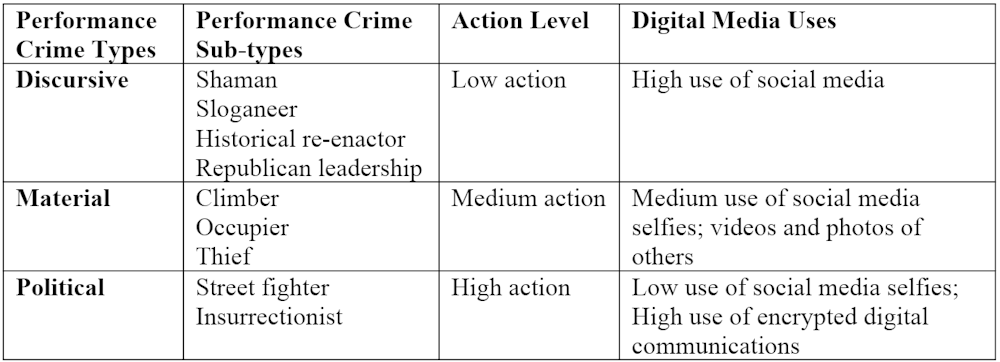
Performance crime participants may be considered self-surveillant subjects, those who effectively participate in and submit themselves to digital surveillance by uploading photos and videos of their actions. Self-surveillant subjects in the Capitol riots participated in performance crimes I have categorized as discursive, material and political.
A man is charged for his activities during the Jan. 6 Capitol riots after texting a selfie to his church group.
Text-based performances
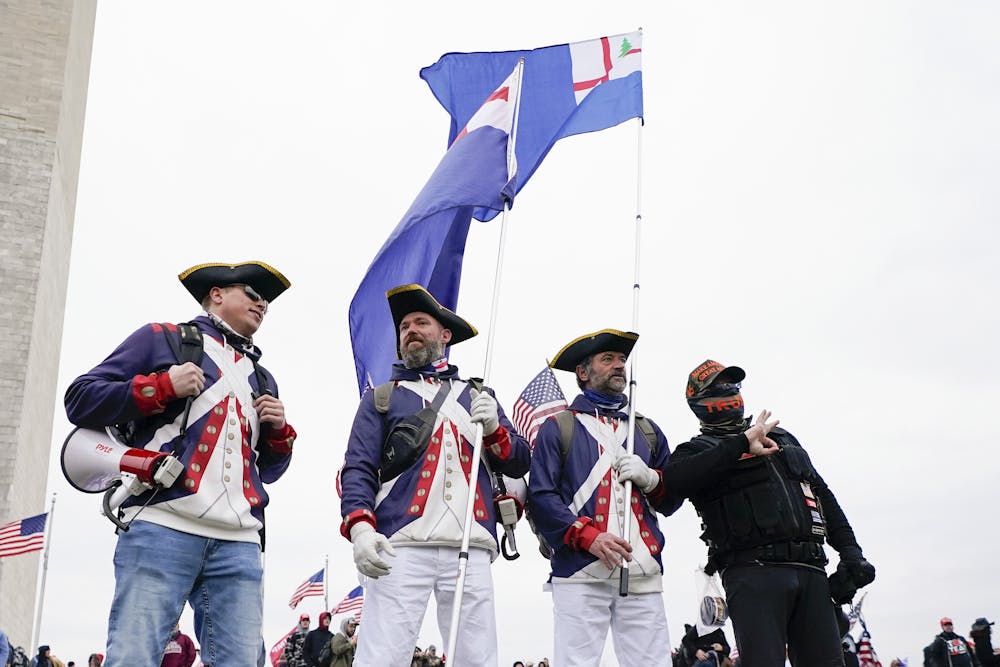
Discursive performance crimes were low-level actions that included textual (placards, signs, graffiti), visual (costumes, hats, T-shirts, tattoos) and auditory (slogans, shouting) performances in four sub-categories:
Shaman — based on the QAnon Shaman — which are performances based on adopting conspiracy theories.
Sloganeers — which included the use of slogans like “Hang Mike Pence” and “#StopTheSteal” — based on violence and disinformation.
Supporters loyal to Donald Trump attend a rally near the White House on Jan. 6, 2021, in Washington.
(AP Photo/Julio Cortez)
Many of these messages expressed specific ideologies, including a deep-state conspiracy, disinformation regarding the allegedly stolen election, and white supremacy, xenophobia and racism. Ideological expression also took place without the commission of crime, and we know discourse is not a crime.
Material crimes
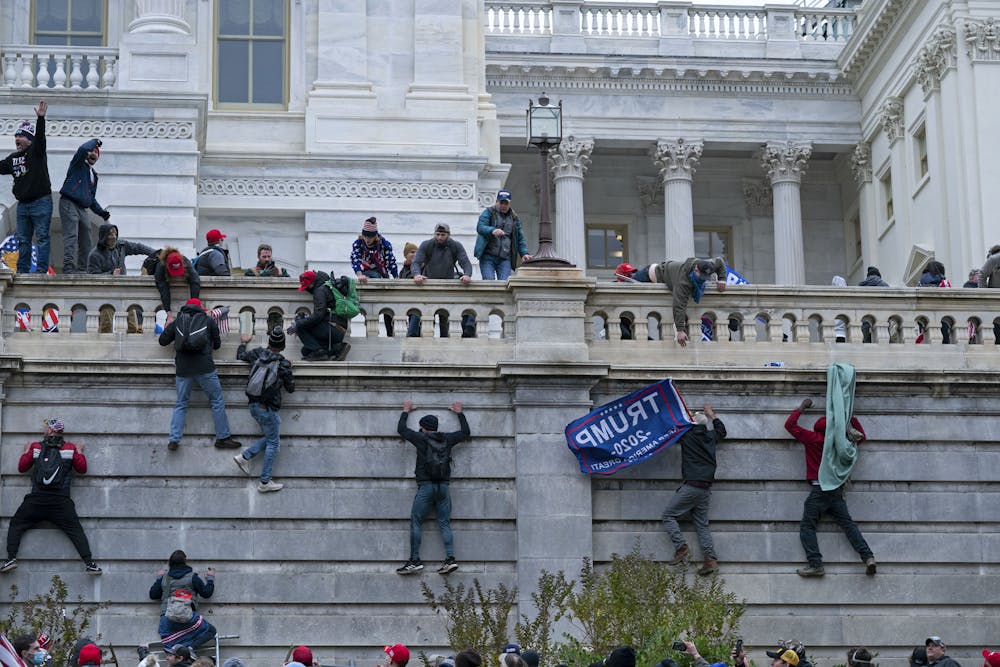
Material performance crimes were unco-ordinated, non-violent, non-instrumental, medium-level actions in three sub-categories:
Occupiers — occupied desks, ate food, read papers, put their feet up, wrote threatening messages.
Thieves — ransacked the Capitol, stole lecterns, signs, laptops and other “trophies.”
These performance crimes yielded little to no strategic advantage, but garnered online fame (or infamy) by posting on social media — posts later used as criminal evidence. Material actions served to support, intentionally or otherwise, political insurrectionists.
Rioters climb the west wall of the the U.S. Capitol in Washington on Jan. 6.
(AP Photo/Jose Luis Magana)
Political crimes
Political performance crimes consisted of co-ordinated high-level actions with political objectives such as capturing and harming lawmakers, and preventing the peaceful transition of power, in two sub-categories:
Street fighters — allegedly led by the white-supremacist, ethno-nationalist gang the Proud Boys, which led the charge against the barricades, smashed Capitol windows and fought with police.
Insurrectionists — allegedly led by militia group the Oath Keepers. They were outfitted in flak jackets, military pants, camo, helmets, bulletproof vests and backpacks, and communicated over walkie-talkie radios and the walkie-talkie app Zello. They moved with intention in military stack formations.
Political motives
Crossover among types takes place — a self-surveillant subject might carry a sign, occupy a desk and pilfer its contents. However, not all performance crimes were represented in the media equally. Rather, increasing levels of intensity of action most often correlated with decreasing levels of self-surveillance — the more physically intensive an action was, the less likely they were to film themselves engaging in it.
The more political an individual’s objectives, the less likely they were to livestream their actions. Members of the Proud Boys and Oath Keepers, for example, are up on charges of seditious conspiracy but seldom appeared as self-surveillant subjects.
Pragmatically speaking, their hands were too full to livestream as they were tug-of-warring over barricades, moving in stack formation, smashing windows, and so on. But they also astutely chose not to film illegal actions, often exempting themselves from the label of performance crime.
As the level of action taken by insurrectionists increased, their use of digital media decreased.
(Sandra Jeppesen), Author provided
Incomplete and inaccurate
The filming and uploading of performance crimes during the Capitol riots is only one piece of the media puzzle. Actions were also captured from multiple perspectives by action cameras like GoPros, through reverse-camera selfie streaming, surveillance cameras and police body-worn cameras during arguably the most livestreamed mass performance crime in U.S. history.
Another piece of the news puzzle is being debated at the hearings. Did Donald Trump — a high-profile self-surveillant subject — incite violence? Did his words and actions contribute to a performance crime at the highest level?
Real-time news on social media, while promoting performance crimes, cannot be relied on to convey complex news narratives. Despite the amount of information posted online during an event (including by those participating in performance crime), what we see in real-time on social media is incomplete and inaccurate. The hearings, including recent testimony by White House aide Cassidy Hutchinson, remind us that during a political crisis, key actions occur behind closed doors.
This makes social media coverage incomplete. Conversely, social media posts may promote misinformation and disinformation, making coverage inaccurate.
Pat Cipollone will sit down to testify before the House Select Committee to discuss his service as White House counsel during the lead-up to the Jan. 6 insurrection, and a legal affairs reporter explained what evidence he might provide to investigators.
Previous witnesses, including former White House aide Cassidy Hutchinson, have testified that Cipollone repeatedly advised Donald Trump that his efforts to overturn his election loss were unlawful, and Politico senior legal affairs reporter Josh Gerstein told MSNBC's "Morning Joe" what the House Select Committee hopes to learn from him.
"I think they want to see if he will verify key elements of Cassidy Hutchinson's very compelling account," Gerstein said. "Remember, she claims Pat Cipollone told her that they were going to be charged with all kinds of crimes, including fraud and obstruction of justice and so forth, if they allowed President Trump to go forward with his plan to visit the Capitol on Jan. 6, presumably after the rally that he held there, which did not happen. But the question is, you know, will he show her account is accurate? It's come under attack by various people since she delivered it a week or so ago, so that's, I think, the primary thing they'll be looking for Cipollone."
There will be some limits to his testimony due to executive privilege and attorney-client privilege, but Gerstein said there was still plenty of room for him to describe what took place in the White House between the election and the certification of Joe Biden's election win.
"He won't testify, as we understand it, about his direct contacts with the president, their exact conversations," Gerstein said. "But it sounds like he will talk about what he said and did with other people in the White House. It would be pretty significant to hear that concern from him because, remember, this is a Trump loyalist through and through. I mean, he defended Trump in the impeachment hearings, so he's someone who clearly was in the president's corner politically, but to hear these concerns about potential criminal charges against the White House staff will be pretty dramatic, if that is the testimony that comes forward from him."
On Friday, former White House Counsel Pat Cipollone is scheduled to speak to the House Select Committee investigating the attack on Congress and the attempt to overthrow the election. According to an MSNBC panel discussion, all Cipollone would have to do is confirm what former senior White House aide Cassidy Hutchinson previously told the committee and Donald Trump would be sunk.
"What Cipollone very importantly might or might not provide to them is corroboration of what Cassidy Hutchinson has already said," explained Betsy Woodruff Swan. "Because the committee moved forward on such an unusually short and tight timeline to have Hutchinson's public testimony they didn't take steps that normally investigators would try to take to corroborate some of the most important allegations that she made in that hearing."
She explained that the pressure on Cipollone to testify is "being ratcheted up dramatically because of what Hutchinson herself testified to in that hearing."
If he can corroborate what Hutchinson testified, it would be an "enormous win" for the committee, Woodruff Swan told MSNBC's Nicolle Wallace. As a White House counsel, Cipollone was a lawyer to the Office of the President of the United States, and not to former President Donald Trump. So, the assertion that he enjoys attorney-client privilege with Trump is wrong.
Current President Joe Biden, as the existing president, has waived all executive privilege on matters dealing with Jan. 6 and the 2020 election. Cipollone however, like many in Trump World, may be terrified of what could happen to him if he reveals too much. Hutchinson has spent the last several weeks experiencing death threats, the committee revealed. It's one of the reasons her testimony was rushed, members said.
"Remember, everything that Hutchinson said about Cipollone in her testimony, none of it was negative and none of it made it look bad," she continued. "If anything, Cipollone is one of the few number of senior Trump White House administration officials to comb through the entire Jan. 6th process looking like he was very much on team normal. He is someone that the committee clearly sees as a credible and important narrator and that means that whatever he tells them in this transcribed interview that's coming up on Friday is going to carry significant weight."
In contrast, if there are two people, like Cipollone and Hutchinson that contradict one other, that could obviously cause a problem.
"It's actually a high-stakes moment for the committee that has the potential to play a significant role in almost defining the way the rest of the investigation plays out in the coming months," she said.
Cindy McCain is in Washington, D.C., as President Joe Biden honors her late husband, Sen. John McCain (R-AZ), who died in 2018.
Speaking to MSNBC on Thursday, Mrs. McCain said that she still considers herself a Republican, but that the party has serious problems.
"I don't believe my husband would recognize it," she said of the Republican Party. "I do know one thing, he would be fighting like the dickens to pull it back together and bring it back to what it was during previous Republican administrations and previous administrations as well. I'm still a Republican. I believe in the party, and I believe in what we stand for, but right now we've lost our way. And so I'm hoping as the years go on perhaps we can right ourselves and do what Republicans do best and that is work for smaller government but work in a bipartisan fashion."
She went on to herald Rep. Liz Cheney (R-WI) for stand up to Donald Trump and pushing to support American democracy despite the danger it has posed to her political career.
"She's an amazing person, and I have talked with her both on the phone and via email, et cetera, during this time," McCain continued. "And I just think her strength and her ability to look beyond the now and look for what's good for the country, and it may harm her in the end, her political aspirations. But she can sleep at night and know that she did the right thing."
She said that the idea of a peaceful transfer of power is one of the most important things to show American stability and strength.
"Peaceful transfer of power, the way that we govern ourselves, the way we represent who we are, we have got to come back to that," she said. "I know people overseas that I deal with say to me, what happened? Is it going to get better? What's going to happen? And right now I don't have the answer for it. I believe in what President Joe Biden is doing. I'm hoping that he can help right this ship a little bit. We have a long way to go."
The Jan. 6 committee has established that former President Donald Trump reached out to two close associates who had direct links to the Oath Keepers and Proud Boys extremist groups, and its next hearing is expected to further examine those links.
Cassidy Hutchinson testified last week that Trump directed his chief of staff Mark Meadows to call Mike Flynn and Roger Stone on the night before Jan. 6, 2021, and the former White House aide said she had to talk her boss out of going to the Willard Hotel, where Flynn and Stone were staying.
According to Guardian reporter Hugo Lowell, these revelations tie the former president closer to the insurrection plot.
"Trump seeking to contact Stone and Flynn on Jan. 5 is also notable since it was Trump himself who initiated the outreach," Lowell tweeted. "This was Trump seeking their input, not them freelancing to him things like strategies to overturn the 2020 election results."
Lowell went into further detail about his latest report on MSNBC's "Morning Joe" about those Trump links to militia groups whose leaders have been charged with seditious conspiracy, and how the House Select Committee will examine those ties at their upcoming hearing set for Tuesday.
"I think the connection is the clearest we have had today," Lowell said. "It is really significant. We spent a lot of time focusing on Trump's connections to John Eastman and Mark Meadows and this political plan to stop the certification on Jan. 6, but if you step back and look at what was happening on Jan. 5, Trump knew by then that his vice president was not going to play ball and stop the certification. You can get an insight into what his frame of mind was. He was trying to get his chief of staff to call around and see what the plans were for Jan. 6, Cassidy Hutchinson filled in the blank."
"He was ordering Meadows to call Stone and Mike Flynn," Lowell continued. "These are two figures with extensive ties to extremist groups. Roger Stone has close ties to the Proud Boys way before the election was called for Joe Biden. They worked very closely together, they were personal friends. Mike Flynn, meanwhile, has his own protective detail all the way back through December with the Oath Keepers. These are people you would go to if you wanted to know what the Proud Boys and Oath Keepers were planning to do on Jan. 6. The committee now has this through-line from Trump and the White House to the extremist groups."
Multiple witnesses have placed Cipollone near the center of Trump's efforts to overturn his 2020 election loss, which the White House counsel repeatedly said were unlawful, and Times correspondent Luke Broadwater told MSNBC's "Morning Joe" that he would be able to provide valuable testimony even if some topics are protected by executive privilege and the Fifth Amendment.
"Pat Cipollone is an extremely key figure who is there for several of the major moments in this plot to overturn the election, and he may know things we don't even know about yet that he could reveal to them tomorrow during this interview," Broadwater said. "I do expect Pat Cipollone's testimony to be played next week at some of the hearings. There was conversations about whether he should testify live in front of the public, [Rep.] Liz Cheney called for that, but the committee does like to know exactly what a person is going to say before they go up there."
"They don't want to turn one of these televised hearings into, you know, a food fight," he added. "They like to know exactly what a person is going to say before they decide to put them out there, so I think we'll see Pat Cipollone video clips but not necessarily Pat Cipollone sitting at the witness stand."
Congressional investigators understand that Cipollone can't discuss his private conversations with the former president, due to attorney-client privilege, but he can tell them about discussions with other White House aides and staffers, including Cassidy Hutchinson.
"Everyone concedes that Pat Cipollone does have attorney-client privilege with Donald Trump," Broadwater said. "He has sort of resisted coming forward and talking about some of those things, so I don't think we'll see him necessarily talk about direct conversations with Donald Trump, but that doesn't mean he can't talk about lots of other material. We heard Cassidy Hutchinson talk about how Pat Cipollone and Mark Meadows were going back and forth into the Oval Office to try to get Donald Trump to call off the mob."
"Can he talk about the things he said to Cassidy?" Broadwater added. "Can he talk about the things he said to Mark Meadows? You know, we know he was there for meetings about seizing voting machines, he was there when Bill Barr offered his resignation, he was there when they had draft letters to -- false draft letters from the Justice Department, and for when he shot down plans from members of Congress, from John Eastman to put forward false slates of electors."
"There's so many things that Pat Cipollone knows," Broadwater added. "I think his testimony could be absolutely crucial for this committee, and he was probably the biggest witness left that they could get, that they hadn't yet so, you know, I expect this interview to be very important tomorrow."
Former White House Counsel Pat Cipollone has agreed to speak to the House Select Committee investigating the Jan. 6 attack on Congress on Friday.
Former Assistant Deputy Attorney General Harry Litman told CNN that Cipollone has carefully negotiated the testimony and he will likely "steer around down the middle" of the attorney/client privilege. However, former President Donald Trump is not the client of a White House counsel, the White House is. President Joe Biden has waived executive privilege for anything involving Jan. 6 or the 2020 election.
"He is a greatest hits package of crazy statements by Donald Trump," Litman said of Cipollone. "He is the one who says to Mark Meadows, 'You know, if you do this, you'll have blood on your effing hands.' He's the one who says to Mark Meadows about [Mike] Pence, 'You've got to stop it' and Meadows says, 'You've heard him. He thinks the rioters are right.' He's the one who has to go to Cassidy Hutchinson, a 25-year-old, and plead with her because Meadows won't speak to him. 'Please try to keep him from going to the Capitol.' He's the one who says, 'if I go to the Capitol, it will be every effing crime imaginable.'"
"Now, they've negotiated it up, and probably what he wants is to say he's not piercing attorney/client privilege. But all these statements I've said to you, Trump's nowhere around. So, attorney/client has to be with the client for the purpose of getting legal advice, so he's got tons to say without that."
As Litman explained, Cipollone is in "everything."
See the discussion below.
Pat Cipollone has a host of crazy things he can recall
www.youtube.com
Former Gov. Eric Greitens (R-MO) served in the Navy and one of his fellow servicemembers has published a video begging the Republican to get out of the Missouri Senate race.
In a video that is quickly going viral, Navy man Ken Harbaugh, who served for nine years during some of Greitens' year, called the Senate candidate a "broken man."
"Eric, I know you must be in a dark place to think what you're doing is worth it," said Harbaugh. "I've known you for most of my life, from our first day at Duke to the time at Oxford. I remember your excitement coming back from the Democratic Convention, and what it meant to see America's first Black president elected. I went to your weddings. Your speech at the first one, about saving the worms, I still remember it."
He recalled their work together co-founding a nonprofit group called The Mission Continues and they debated whether to take money from the Clinton Foundation. He recalled a large picture of Greitens' of JFK.
Harbaugh went on to say that he was so excited about Greitens candidacy as a pro-gay and pro-choice Republican that he took out a $5,000 loan against his life insurance policy just to donate it to the campaign.
"Things have not gone as I expected. Eric, I want you to know that there are worse things in life than running for office honorably and losing. Trust me. I've done that," said Harbaugh, who ran for office in Ohio.
"What you're doing now is not honorable," he continued. "And it is not a reflection of the Eric I knew. Even if you do win, you're going to lose more than you can imagine by campaigning like this. Your call to hunt down Republicans who disagree with you? That's my mom Eric. Just because she doesn't think the election was stolen, and let's be honest, you don't either. That's not a reason to threaten her. She was one of the few people to reach out when you were forced to resign as governor. She wrote to you about grace, and redemption. She reminded you that even the greatest sins, those against one's own family, can be forgiven."
He closed by imploring Greitens to "do the right thing" and drop out of the race because "you're going to get someone killed."
In a recent video, Rudy Giuliani appears to be channeling a former Republican president.
Giuliani explained during his "Common Sense" podcast that he is not a crook, a phrase often quoted from former President Richard Nixon, who maintained that he had nothing to do with Watergate.
“Everyone in Washington wants to make me a liar and a crook, and I’m not," Giuliani swore. "I could’ve asked for a pardon for a very good reason - because I don’t want to get framed. I know I didn’t do anything wrong. I don’t lie .. I don’t take money .. I’ve acted honorably all my life."
Cassidy Hutchinson, a top aide to Trump's then-White House Chief of Staff Mark Meadows, recently told the Jan. 6 committee that Giuliani had sought pardons from Trump.
When pardons are given by presidents or governors it means accepting guilt. In the case of former Sheriff Joe Arpaio, who was given a pardon by former President Donald Trump, he argued he wasn't guilty despite accepting a pardon. Arpaio took it to court saying that he didn't want to be required to admit guilt for the crimes for which he was pardoned.
"The power to pardon is an executive prerogative of mercy, not of judicial recordkeeping," United States v. Noonan declared.
"To vacate all rulings in this case would run afoul of this important distinction. The Court found Defendant guilty of criminal contempt," ruled U.S. District Judge Susan R. Bolton. The Supreme Court refused to hear his appeal.
Pre-emptive pardons don't apply to future offenses. While Trump could pardon someone for a crime they previously committed, he couldn't, however, give a pardon for something someone might do in the future. Asking for a pre-emptive pardon would be akin to an admission of intent to commit a crime.
Rep. Mo Brooks (R-AL), Rep. Matt Gaetz (R-FL), Rep. Marjorie Taylor Greene (R-GA), Rep. Louie Gohmert, Rep. Andy Biggs (R-AZ), Rep. Scott Perry (R-TX) and Rep. Paul Gosar (R-AZ) were all named by former Trump White House staff as people who asked for pardons related to Jan. 6 and the planning.