Twitter has been caught in another problem of applying their rules to some and not others.
Axios mentioned the recent transphobic tweets from Rep. Marjorie Taylor Greene (R-GA) directly targeting Adm. Rachel Levine, the assistant secretary for health for the U.S Department of Health and Human Services. Twitter said that they would label the tweets instead.
The site tends to label harassment instead of removing it when it comes to elected officials who violate their terms of service. Individuals will have to click through the warning to see the tweet. If Greene was a regular individual she would have likely been suspended. In the case of Greene, her individual personal Twitter account has been banned, but her official government account has been allowed to flourish.
Greene's tweet misgendered Levine while also using "vile terminology" to describe her gender reassignment surgery.
IN OTHER NEWS: GOP donors charged with funneling Chinese investors' money to Trump campaign
"The Tweet you referenced violated the Twitter Rules on hateful conduct," Twitter said when Axios reached out to the site for comment. "However, we’ve determined that it may be in the public’s interest for the Tweet to remain accessible, and has been labeled in line with our policies."
They didn't elaborate how it could be in the public interest to attack someone personally unless it's in the public interest to see Greene's behavior.
An attorney appearing on Steve Bannon's podcast explained why the jury would quickly find Donald Trump's former adviser guilty of contempt of Congress.
David Freiheit, who uses the pseudonym Viva Frei, appeared on Bannon's daily show while the former Trump adviser sat in a Washington, D.C. courtroom.
Freiheit revealed that he would be spending 25 minutes a day recapping the Bannon trial on his YouTube channel. But he worried that the trial may not last long enough.
"I mean, the question is whether or not it's going to be able to fill 25 minutes," he noted. "Because what's going to go on with the Bannon trial? Jury selection. Federal court, it goes exceedingly quickly."
"It's going to be 95+, if not 100% Democrat, anti-Trump and anti-Steve Bannon," the attorney continued. "And then what's left of Bannon's defenses? What's left to prove from the prosecution? Did you receive the subpoena? Did you respect the subpoena? Yes and No. Case closed."
On Monday, Bannon was seen entering the courthouse before jury selection began. He is facing two counts of contempt of Congress after he refused to comply with a subpoena from the House Jan. 6 Committee.
Rep. Marjorie Taylor Greene (R-GA) insisted that women who get pregnant should be forced to birth children "even if it's a circumstance they didn't plan."
"The very idea that women's rights don't matter anymore, which is what [Democrats] say," Greene opined, "and our stance for pro-life is to support women. We support their pregnancies. We support them being mothers even if it's a circumstance that they didn't plan."
"We also support women's rights," she continued, "the right to privacy, our right to have privacy in our bathrooms, the right to compete in our women's sports without being threatened by biological men. And so, yes, all of this is a slap in our face "
Greene said that she was concerned about the future of her two daughters and believes life "starts at conception."
"Mitch McConnell, you better be listening, my friend," the podcast host later warned. "You look at Sri Lanka. Now, I'm not saying that's going to happen here but that attitude is here."
Greene also called Democratic bills to enshrine federal abortion rights "evil and disgusting."
"They want to make abortion legal up until the day of birth," she griped, "and make it available for every woman that wants it across the country and they are so angry about it. They're demanding it, they're fighting for it."
The "aggressively dishonest" Trump-backed candidate for governor in Arizona is getting support for her "Ultra MAGA" campaign by state Democrats.
"Kari Lake watched her lead narrow in the polls and big players in Arizona’s Republican establishment coalesce around her top rival weeks before the state’s Aug. 2 primary for governor. So Democrats stepped in," NBC News reported. "The state party, in an email blast this week, thanked her opponent, Karrin Taylor Robson, for past donations she made to Democratic candidates."
The email was first reported by Phoenix journalist Jeremy Duda.
"Whoever wins the GOP primary will go into the general election as the favorite, so this could be a 'be careful what you wish for' situation for the Dems," Duda noted.
Duda is the author of the 2016 book If This Be Treason: The American Rogues and Rebels Who Walked the Line Between Dissent and Betrayal.
"It’s not clear if Democrats will spend money to amplify the attack on TV like they have in other races across the country," NBC News reported. "Officials at the state party did not respond to requests for comment, and outside groups like the Democratic Governors Association have yet to spend money that way. But the missive signals how aggressively the party is engaging in GOP primaries this year. In next week’s GOP primary for governor in Maryland, for example, the Democratic Governors Association has outspent term-limited Republican Gov. Larry Hogan’s preferred successor with messaging that could boost another Trump-backed candidate."
Lake has referred to Trump as the "Great MAGA King" and was endorsed by Rep. Marjorie Taylor Greene (R-GA) on Thursday.
"Asked about the Democrats’ press release following her Tuesday rally, Lake, a former TV news anchor in Phoenix, chuckled and said someone had sent it her way," NBC News reported. "She did not directly address why she thought Arizona Democrats were offering her a helping hand, but turned fire on Taylor Robson, saying she was spending millions on “dishonest ads attacking me for a small donation to a Democrat 15 years ago,” when Taylor Robson herself had made past donations to Rep. Ruben Gallego (D-AZ). Taylor Robson and allies have pointed to Lake’s past support for former President Barack Obama and her having briefly registered as a Democrat. Lake donated to Obama’s first presidential campaign."
Democrats are also intervening in Maryland's gubernatorial race, seeking to boost GOP Rep. Dan Cox over moderate Kelly Schulz.
Doug Mayer, a senior adviser to Schulz, blasted the Democratic Governor's Association (DGA) for intervening.
“They have reinvented the term hypocrisy,” Mayer said. “There’s a certain level of strategy and tactics that are acceptable. But what you don’t get to do is live on Twitter and on MSNBC as the defenders of democracy and then actively promote someone that you believe in your heart of hearts is a threat to this nation.”
The DGA is defending its across-the-aisle meddling.
"Sam Newton, a DGA spokesperson, defended the strategy as an opportunity to educate voters on 'extremism and cowardice' of Republicans who echo Trump’s lies and conspiracy theories about the 2020 election," NBC News reported. "But not all Democrats are aligned on the strategy, and some acknowledge Mayer’s concern as valid — that elevating fringe candidates could undercut their argument about the mortal threat these Republicans pose to democracy."
The move was criticized by Michigan state Sen. Mallory McMorrow, who has gone viral for boldly blasting Republicans.
"I think the stronger argument that we as Democrats have to make is, no matter which candidate it is, it’s all nonsense," McMorrow said. "It’s just trying to get people so angry and divided, and that’s not who we are. So I think that’s the better case we have to make versus trying to figure out who’s the worst candidate to put up."
Arizona Gov. Doug Ducey is among the conservative Republicans who former President Donald Trumpangrily turned against following the 2020 presidential election. Ducey’s cardinal sin, in Trump’s mind, was refusing to go along with Big Lie and acknowledging that President Joe Biden won the state fairly.
The tension between Trump and Ducey, who Trump slams as a RINO (Republican In Name Only) remain. And according to Politico reporter Alex Isenstadt, that tension is playing out in Arizona’s 2022 Republican gubernatorial primary.
In an article published by Politico on July 12, Isenstadt describes the primary as an “emerging proxy fight between” Trump and Ducey. The two-term Arizona governor, who is term-limited, has endorsed wealthy GOP donor Karrin Taylor Robson, while Trump has endorsed the ultra-MAGA Kari Lake — a far-right “Stop the Steal” extremist and conspiracy theorist along the lines of Rep. Marjorie Taylor Greene of Georgia and Rep. Lauren Boebert of Colorado. Lake is campaigning on the Big Lie and falsely claims that the 2020 election was stolen from Trump — a thoroughly debunked claim that even former U.S. Attorney General Bill Barr has described as “bullshit.”
“The primary is the latest point of contention between Trump and Ducey,” Isenstadt explains. “The former president has repeatedly assailed the Arizona governor for refusing to overturn the 2020 election outcome in Arizona, which President Joe Biden won narrowly. After the election, Ducey was famously seen putting the former president to voicemail while signing papers certifying Biden’s victory.”
The Politico reporter continues, “The contest to succeed the term-limited Ducey as governor has revolved around the 2020 campaign. Lake, a former local TV news anchor, has echoed Trump’s ongoing lie that the election was stolen and made it the centerpiece of her campaign. Robson, meanwhile, has not joined other Arizona Republicans in falsely saying Trump won the state.”
Isenstadt notes that during a recent primary debate, Lake “challenged Robson and the other candidates to say” the 2020 presidential election “was stolen.” But Robson “refused to say so, instead remarking that she wouldn’t play into Lake’s ‘stunt.’”
Ducey clearly plans to campaign hard for Robson. On Monday morning, July 11, according to Isenstadt, Ducey “held a conference call with donors in which he encouraged them to get behind Robson.”
Meanwhile, on the Democratic side, Arizona Secretary of State Katie Hobbs has been campaigning aggressively against the Big Lie and for voting rights. If Democrat Hobbs and MAGA Republican Lake are the nominees of their parties — which remains to be seen — the general election could include some testy debates on voting rights and the 2020 election. And Hobbs has demonstrated that she can be a tough, focused debater.
In an op-ed published by the Washington Post on June 14, 2021, Hobbs declared, “Voter-suppression efforts in Arizona are part of a nationwide dismantling of voting rights — the most sustained and egregious assault on U.S. democracy since the Jim Crow era.”
The lone Republican representing Maryland in Congress was implicated in Tuesday's public hearing by the House Select Committee Investigating the Jan. 6 Attack at the U.S. Capitol.
"As former President Donald Trump sought to overturn the 2020 election, nearly a dozen Republican members of Congress -— including Maryland’s Andy Harris -— gathered with the president in the White House and discussed having Vice President Mike Pence reject the election results, according to the Jan. 6 committee," The Baltimore Sunreported. "The House members’ attendance at the Oval Office meeting — which the committee said also included Pence, White House Chief of Staff Mark Meadows and attorney Rudy Giuliani — was confirmed by White House visitor logs, the committee said during a hearing Tuesday."
The newspaper reported the Congressman's office "did not return emails seeking comment."
WBAL NewsRadio reported it "reached out to Harris and is waiting to hear back."
Both the two Democrats competing in the July 19 primary to take on Harris both had harsh words.
Former state lawmaker Heather Mizeur tweeted, "Today’s #Jan6 hearing confirms what we in Maryland have always known. @RepAndyHarrisMD is a threat to national security."
Former Obama administration official Dave Harden tweeted Harris "attended a Dec 21st meeting at the White House in a concerted effort to thwart the 2020 election. Andy Harris is a traitor to our democracy."
Both also argued they were the one to defeat Harris in November.
After the MAGA rioters were cleared from the Capitol and Congress returned to the task of certifying the election results, Harris almost got in a fistfight on the floor of the House.
Rep. Colin Allred (D-TX) reported said, "are you serious, man? Haven’t you had enough violence for today?"
One day after the attack on the Capitol, Harris released a statement defending his vote to overturn the election.
"Democrats are calling for unity," he said, "yet also calling for the expulsion of members who objected in yesterday's Electoral College count. Today, Some Marylanders are even calling for my resignation, which I will not do."
Harris went on to claim that he had "legitimate constitutional concerns" despite Trump's delusions of election fraud being debunked long before the attack on the Capitol.
He claimed that "there was nothing treasonous or seditious about it."
Harris went on to deny there even was an insurrection when he voted against a bill to award the Congressional Gold Medal to law enforcement who defended the Capitol against Trump's mob.
The House Select Committee investigating the Jan. 6 attack on Congress and attempt to overthrow the 2020 election held its seventh public hearing on Tuesday revealing the links that former President Donald Trump had with right-wing extremist groups and white supremacist militias.
Among the things that were included in the day of the video were clips from the interview that former White House Counsel Pat Cipollone from last week. While the committee members made it clear that he confirmed a lot of what was known, he also revealed that he and other White House lawyers destroyed all of the legal claims made by those like Sidney Powell and Rudy Giuliani that Trump could somehow overthrow the government legally.
The legal experts live-tweeting the hearing cited several different crimes that they claimed were proved in the hearing. Among those was lawyer George Conway, who noted that a key piece of the revelations is that Republicans continue to rationalize Trump's actions even over a year later.
Former impeachment lawyer Norm Eisen explained that all of the witnesses, Trump allies, built the case that the former president was told over and over that what he was doing was illegal, he didn't win and he couldn't steal the White House. Still, he had the Dec. 18 planning meeting and then sent out the Dec. 19 tweet calling people to come to Washington for the rally.
Another key piece the legal experts pointed out was that Trump knew that the Capitol was going to be targeted because he was calling for it to be. Tweets between organizers made it clear that they couldn't promote a march to the Capitol officially. Instead, they were planning it behind the scenes and even an effort that would continue onto the Supreme Court. That makes it clear that Trump knew he was inciting a riot.
Multiple Republicans currently serving in Congress were named during Tuesday's televised hearings by the House Select Committee Investigating the Jan. 6 Attack at the U.S. Capitol.
"Another part of the president's strategy involves certain members of Congress who amplified his unsupported assertions that the election had been stolen," Rep. Stephanie Murphy (D-FL) said. "In the weeks after the election, the White House coordinated closely with President Trump's allies in Congress to disseminate his false claims and to encourage members of the public to fight the outcome on Jan 6. We know that the president met with various members to discuss Jan. 6 well before the joint session."
"The president's private schedule for Dec. 21, 2020 shows a private meeting with Republican members of Congress," Murphy said. "We know Vice President Pence, chief of staff Mark Meadows and Rudy Giuliani also attended the meeting."
She then started naming Republicans currently serving in Congress.
"At this point, you may recall testimony given in our earlier hearing by Richard Donoghue who said that the president asked the Department of Justice to say 'that the election was corrupt and leave the rest to me and the Republican congressmen,'" Murphy said. "According to White House visitor logs obtained by the committee, members of Congress present at the White House on Dec. 21 included Congressmen Brian Babin (R-TX), Andy Biggs (R-AZ), Matt Gaetz (R-FL), Louie Gohmert (R-TX), Paul Gosar (R-AZ), Andy Harris (R-MD), Jody Hice (R-GA), Jim Jordan (R-OH), and Scott Perry (R-PA)."
"And Congresswoman-elect Marjorie Taylor Greene (R-GA) was also there," she added.
Questions are being raised about a California pastor and failed Republican Party House candidate who jumped on the Trump train and saw revenue for ministry -- where he is the only employee -- jump from $280,000 in 2019 to more than $5.3 million in just one year allowing him to go on a property buying spree that primarily benefits only himself.
According to a report from Rolling Stone's Tim Dickinson and Kara Voght, 38-year-old Sean Feucht went from a little-known Christian singer and evangelist to a MAGA star by aligning himself with former president Donald Trump, thereby raising his profile to the point where he stood on the steps of the Supreme Court with far-right Reps. Marjorie Taylor Greene (R-GA) and Lauren Boebert (R-CO) when a report was leaked that the Supreme Court would be gutting Roe V Wade.
Writing, "Feucht’s fusion of own-the-libs rhetoric and Christian zealotry is resonating," the report states, "Capitalizing on the notoriety of his 2020 Covid-lockdown protests, Sean Feucht Ministry Inc. ballooned in revenue from $280,000 in 2019 to more than $5.3 million in 2020, ending the year $4 million richer than it started. (The accounting for this surge is curious: The ministry claims to have received zero dollars in contributions, despite Feucht avidly soliciting such gifts.)"
With that money, the evangelical invested in several properties described by Rolling Stone as "extravagant homes, one in a glitzy gated community in Southern California and another on five acres in Montana, valued together at well over $2 million."
Add to that, he also "purchased a brick row house on Capitol Hill in May for nearly $1 million," which he has called Camp Elah which he reportedly will use as a basecamp while he meets with conservative lawmakers.
All of those purchases have not gone unnoticed by watchdogs and ethics experts who, while not accusing him of criminality, wonder how he came into so much money and question the ways in which he is spending it.
"Warren Cole Smith, president of Ministry Watch, which vets religious organizations on behalf of donors, says that leveraging a ministry to live the high life, if that’s what Feucht is doing, is not just unseemly, it’s potentially illegal, " with Smith pointing out, "I’m not saying that Sean is guilty of private inurement. But if a guy that makes less than $200,000 a year is buying multiple, million-dollar properties, at a minimum that warrants additional questions.”
Adding that calls to Feucht and his ministry's board members have been fruitless, the report adds, "Evangelicals have long hitched their fortunes to GOP political movements, most recently the Trump train. But Feucht is bold in his declaration that Christians, themselves, should seize the throttle of the nation’s politics."
Right-wing extremism expert Shawn Schwaller views that as a red flag.
“He wants to push a far-right Christian nationalist agenda. Whether it’s anti-LGBTQ rights,anti-vaccine, anti-Black Lives Matter, he’s aligning himself with the biggest voices pushing that agenda in Washington," he explained.
Religion expert Adam Perez, a postdoc at the Duke School of Divinity, has questions about his devotion to religion.
"Is this God’s work? Or is this the power of money — you know, the love of which is the root of all evil?” he asked rhetorically.
A new report about Cassidy Hutchinson revealed some of the back story involving her former lawyer and the sudden departure to a new attorney ahead of her public testimony with the House Select Committee investigating the Jan. 6 attack on Congress and the attempt to overthrow the 2020 election.
In the New York Times, reporter Robert Draper cited pro-Donald Trump lawyer Stefan Passantino, who was being paid for by Trump's Save America PAC to represent Hutchinson and has helped other witnesses as well.
"Mr. Passantino had extensive financial ties to Mr. Trump’s orbit," the Times explained. "Federal Election Commission reports show that his legal compliance firm received more than $1 million from Trump-related political action committees in the 2021-22 election cycle, and that in the previous cycle Marjorie Taylor Greene, a staunch Trump loyalist and a House candidate at the time, paid him more than $93,000 for his services."
She spoke to the committee for the first time in Feb. 2022, though it wasn't yet clear if Passantino was there on behalf of Donald Trump over her legal interests, two sources told the Times.
Portions of her first three depositions had Hutchinson mentioning Anthony Ornato, a former Secret Service agent Trump appointed to be deputy White House chief of staff. She recalled Ornato warning then-chief of staff Mark Meadows that there were intelligence reports warning of violence on Jan. 6. She also revealed that House Republicans were already pressing Vice President Mike Pence to stop the Jan. 6 Electoral College certification.
Hutchinson grew more "warm" to the idea of helping the committee, but Passantino was not.
“She realized she couldn’t call her attorney to say, ‘Hey, I’ve got more information,’” said a friend. “He was there to insulate the big guy.”
That was when she reached out to Alyssa Farah Griffin, the former White House director of communications, and former Rep. Barbara Comstock (R-VA). The latter said she could have predicted the predicament.
“I said, ‘You’re going to end up paying legal bills,’” Comstock recalled to the Times. She then offered to start a legal defense fund so she wouldn't have to depend on Trump's lawyers for help. That's when Jody Hunt offered to help, he was the former Justice Department head of the civil division under Jeff Sessions. Due to his connection to Sessions, he too was a pariah in Trump World.
To film oneself committing a crime might seem a guileless act of self-incrimination, but it’s becoming increasingly popular. Take the Jan. 6 insurrection as a case in point.
With 874 people arrested on charges from disorderly conduct to seditious conspiracy, many were apprehended because of video or photos shared online. This is considered performance crime: the performance of criminal activity in which filming and sharing it with an audience is intrinsic to the crime itself.
Performance crime participants may be considered self-surveillant subjects, those who effectively participate in and submit themselves to digital surveillance by uploading photos and videos of their actions. Self-surveillant subjects in the Capitol riots participated in performance crimes I have categorized as discursive, material and political.
A man is charged for his activities during the Jan. 6 Capitol riots after texting a selfie to his church group.
Text-based performances
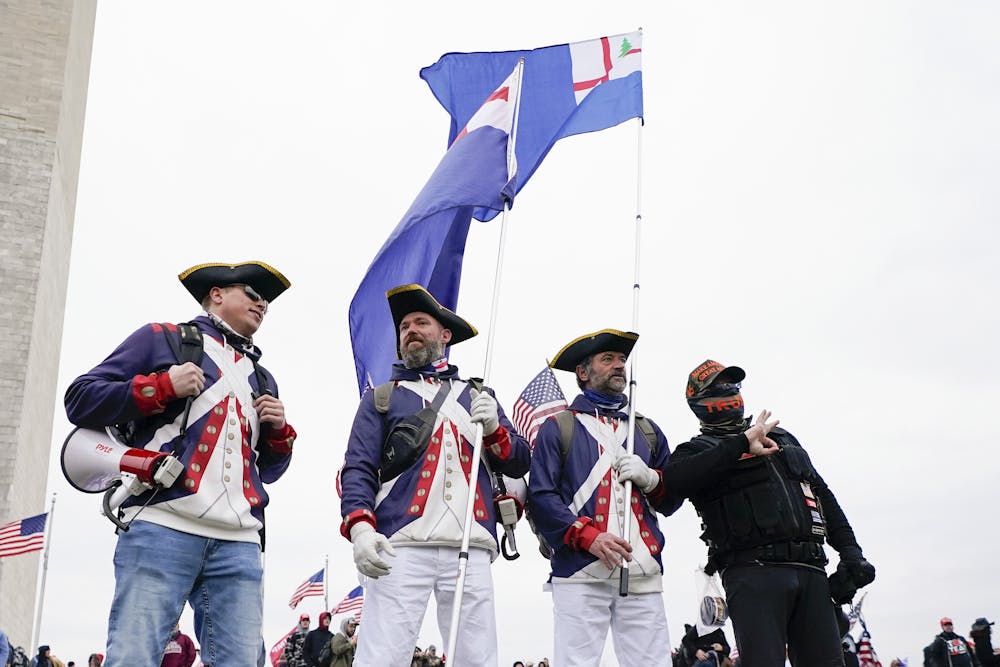
Discursive performance crimes were low-level actions that included textual (placards, signs, graffiti), visual (costumes, hats, T-shirts, tattoos) and auditory (slogans, shouting) performances in four sub-categories:
Shaman — based on the QAnon Shaman — which are performances based on adopting conspiracy theories.
Sloganeers — which included the use of slogans like “Hang Mike Pence” and “#StopTheSteal” — based on violence and disinformation.
Supporters loyal to Donald Trump attend a rally near the White House on Jan. 6, 2021, in Washington.
(AP Photo/Julio Cortez)
Many of these messages expressed specific ideologies, including a deep-state conspiracy, disinformation regarding the allegedly stolen election, and white supremacy, xenophobia and racism. Ideological expression also took place without the commission of crime, and we know discourse is not a crime.
Material crimes
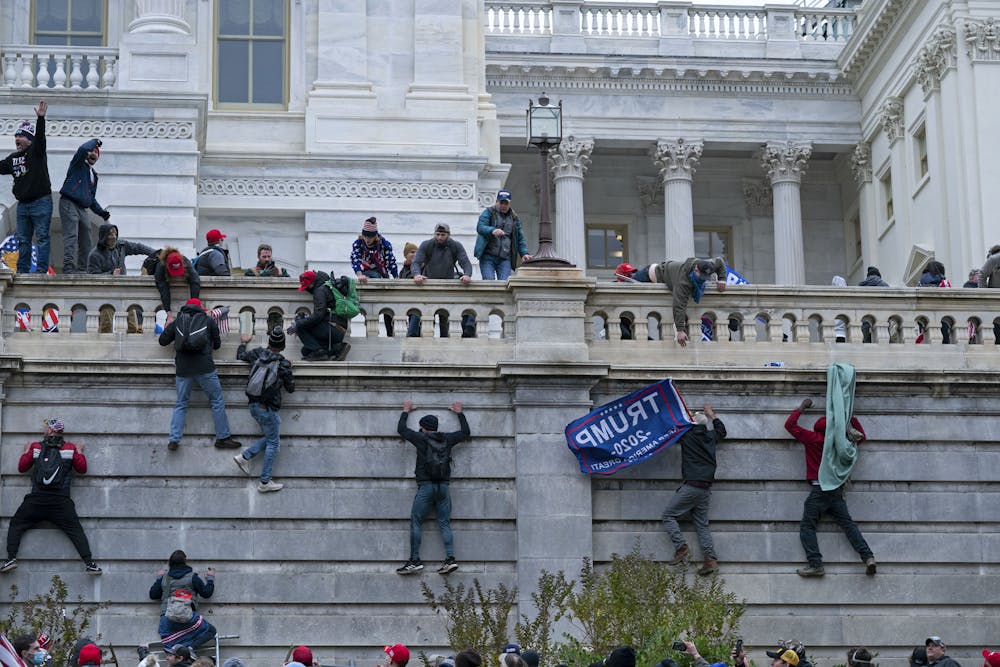
Material performance crimes were unco-ordinated, non-violent, non-instrumental, medium-level actions in three sub-categories:
Occupiers — occupied desks, ate food, read papers, put their feet up, wrote threatening messages.
Thieves — ransacked the Capitol, stole lecterns, signs, laptops and other “trophies.”
These performance crimes yielded little to no strategic advantage, but garnered online fame (or infamy) by posting on social media — posts later used as criminal evidence. Material actions served to support, intentionally or otherwise, political insurrectionists.
Rioters climb the west wall of the the U.S. Capitol in Washington on Jan. 6.
(AP Photo/Jose Luis Magana)
Political crimes
Political performance crimes consisted of co-ordinated high-level actions with political objectives such as capturing and harming lawmakers, and preventing the peaceful transition of power, in two sub-categories:
Street fighters — allegedly led by the white-supremacist, ethno-nationalist gang the Proud Boys, which led the charge against the barricades, smashed Capitol windows and fought with police.
Insurrectionists — allegedly led by militia group the Oath Keepers. They were outfitted in flak jackets, military pants, camo, helmets, bulletproof vests and backpacks, and communicated over walkie-talkie radios and the walkie-talkie app Zello. They moved with intention in military stack formations.
Political motives
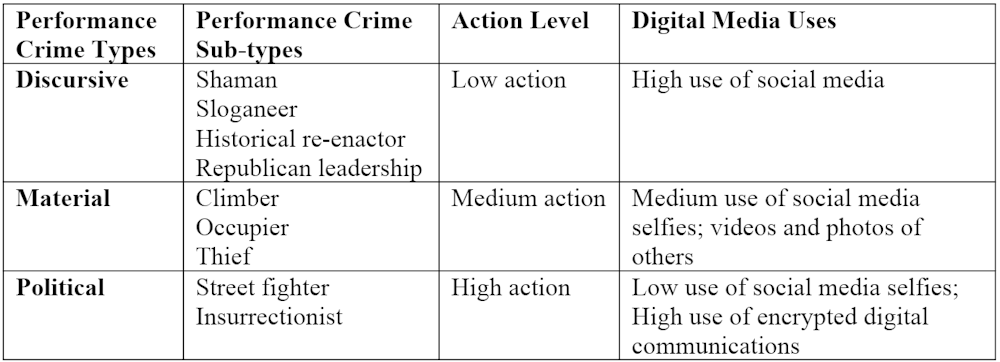
Crossover among types takes place — a self-surveillant subject might carry a sign, occupy a desk and pilfer its contents. However, not all performance crimes were represented in the media equally. Rather, increasing levels of intensity of action most often correlated with decreasing levels of self-surveillance — the more physically intensive an action was, the less likely they were to film themselves engaging in it.
The more political an individual’s objectives, the less likely they were to livestream their actions. Members of the Proud Boys and Oath Keepers, for example, are up on charges of seditious conspiracy but seldom appeared as self-surveillant subjects.
Pragmatically speaking, their hands were too full to livestream as they were tug-of-warring over barricades, moving in stack formation, smashing windows, and so on. But they also astutely chose not to film illegal actions, often exempting themselves from the label of performance crime.
As the level of action taken by insurrectionists increased, their use of digital media decreased.
(Sandra Jeppesen), Author provided
Incomplete and inaccurate
The filming and uploading of performance crimes during the Capitol riots is only one piece of the media puzzle. Actions were also captured from multiple perspectives by action cameras like GoPros, through reverse-camera selfie streaming, surveillance cameras and police body-worn cameras during arguably the most livestreamed mass performance crime in U.S. history.
Another piece of the news puzzle is being debated at the hearings. Did Donald Trump — a high-profile self-surveillant subject — incite violence? Did his words and actions contribute to a performance crime at the highest level?
Real-time news on social media, while promoting performance crimes, cannot be relied on to convey complex news narratives. Despite the amount of information posted online during an event (including by those participating in performance crime), what we see in real-time on social media is incomplete and inaccurate. The hearings, including recent testimony by White House aide Cassidy Hutchinson, remind us that during a political crisis, key actions occur behind closed doors.
This makes social media coverage incomplete. Conversely, social media posts may promote misinformation and disinformation, making coverage inaccurate.
To film oneself committing a crime might seem a guileless act of self-incrimination, however, it is becoming increasingly popular. Take the Jan. 6 insurrection as a case in point.
With 874 people arrested on charges from disorderly conduct to seditious conspiracy, many were apprehended because of video or photos shared online. This is considered performance crime: the performance of criminal activity in which filming and sharing it with an audience is intrinsic to the crime itself.
Performance crime participants may be considered self-surveillant subjects, those who effectively participate in and submit themselves to digital surveillance by uploading photos and videos of their actions. Self-surveillant subjects in the Capitol riots participated in performance crimes I have categorized as discursive, material and political.
A man is charged for his activities during the Jan. 6 Capitol riots after texting a selfie to his church group.
Text-based performances
Discursive performance crimes were low-level actions that included textual (placards, signs, graffiti), visual (costumes, hats, T-shirts, tattoos) and auditory (slogans, shouting) performances in four sub-categories:
Shaman — based on the QAnon Shaman — which are performances based on adopting conspiracy theories.
Sloganeers — which included the use of slogans like “Hang Mike Pence” and “#StopTheSteal” — based on violence and disinformation.
Many of these messages expressed specific ideologies, including a deep-state conspiracy, disinformation regarding the allegedly stolen election, and white supremacy, xenophobia and racism. Ideological expression also took place without the commission of crime, and we know discourse is not a crime.
Material crimes
Material performance crimes were unco-ordinated, non-violent, non-instrumental, medium-level actions in three sub-categories:
Occupiers — occupied desks, ate food, read papers, put their feet up, wrote threatening messages.
Thieves — ransacked the Capitol, stole lecterns, signs, laptops and other “trophies.”
These performance crimes yielded little to no strategic advantage, but garnered online fame (or infamy) by posting on social media — posts later used as criminal evidence. Material actions served to support, intentionally or otherwise, political insurrectionists.
Political crimes
Political performance crimes consisted of co-ordinated high-level actions with political objectives such as capturing and harming lawmakers, and preventing the peaceful transition of power, in two sub-categories:
Street fighters — allegedly led by the white-supremacist, ethno-nationalist gang the Proud Boys, which led the charge against the barricades, smashed Capitol windows and fought with police.
Insurrectionists — allegedly led by militia group the Oath Keepers. They were outfitted in flak jackets, military pants, camo, helmets, bulletproof vests and backpacks, and communicated over walkie-talkie radios and the walkie-talkie app Zello. They moved with intention in military stack formations.
Political motives
Crossover among types takes place — a self-surveillant subject might carry a sign, occupy a desk and pilfer its contents. However, not all performance crimes were represented in the media equally. Rather, increasing levels of intensity of action most often correlated with decreasing levels of self-surveillance — the more physically intensive an action was, the less likely they were to film themselves engaging in it.
The more political an individual’s objectives, the less likely they were to livestream their actions. Members of the Proud Boys and Oath Keepers, for example, are up on charges of seditious conspiracy but seldom appeared as self-surveillant subjects.
Pragmatically speaking, their hands were too full to livestream as they were tug-of-warring over barricades, moving in stack formation, smashing windows, and so on. But they also astutely chose not to film illegal actions, often exempting themselves from the label of performance crime.
As the level of action taken by insurrectionists increased, their use of digital media decreased. (Sandra Jeppesen), Author provided
Incomplete and inaccurate
The filming and uploading of performance crimes during the Capitol riots is only one piece of the media puzzle. Actions were also captured from multiple perspectives by action cameras like GoPros, through reverse-camera selfie streaming, surveillance cameras and police body-worn cameras during arguably the most livestreamed mass performance crime in U.S. history.
Another piece of the news puzzle is being debated at the hearings. Did Donald Trump — a high-profile self-surveillant subject — incite violence? Did his words and actions contribute to a performance crime at the highest level?
Real-time news on social media, while promoting performance crimes, cannot be relied on to convey complex news narratives. Despite the amount of information posted online during an event (including by those participating in performance crime), what we see in real-time on social media is incomplete and inaccurate. The hearings, including recent testimony by White House aide Cassidy Hutchinson, remind us that during a political crisis, key actions occur behind closed doors.
This makes social media coverage incomplete. Conversely, social media posts may promote misinformation and disinformation, making coverage inaccurate.
Rep. Marjorie Taylor Greene (R-GA) revealed this week that the man accused of murdering seven people at a July Fourth parade in Illinois wanted her jailed for an alleged role in the Jan. 6 attacks.
During an interview with OAN, Greene said that Democrats wanted to paint mass shooters as conservatives.
"That's the narrative over and over again," she opined. "But they can't do it with this guy because all of his likes and things he posted on his own social media prove that he was a leftist."
"As a matter of fact, he liked a social media post saying that I should be in jail for Jan. 6!" the lawmaker continued. "Bobby Crimo is not a Trump supporter. He's not a Marjorie Taylor Greene fan, either. He is a radical leftist."
Greene noted that Crimo "liked our Vice President Kamala Harris."
"He followed her," she said. "I don't follow her! I bet you don't follow her. He also liked the CDC. I don't like the CDC's page. I don't follow the CDC! But many leftists do."
She added: "He was as mainstream Democrat as you can get. He was not a Trump supporter and not one of ours."
According to NBC News, alleged shooter Robert “Bobby” E. Crimo III left a trail of social media clues but did not post about politics often. In one post, he appeared at a Trump rally dressed as the Where's Waldo character. In another post, Crimo draped himself in a Trump flag.
Politifact recently gave Greene a "false" rating after she shared a photoshopped image of Crimo.