People of color who work for the Trump administration say they are baffled that he has handled the response to anti-police brutality protests so poorly.
In interviews with Politico, people of color who are still working in the Trump White House are "mystified" about how President Donald Trump has continued to pound the table about "law and order" instead of embracing the cause of reforming the police.
"They had a huge opportunity, and they botched it," one official said. "I don’t know what led to the botching. Maybe he needs more advisers who have a better sense of what is going on in the real world."
Another person of color who once worked for Trump said that the president's response to the protests has been so tone deaf that they may not vote for him in the fall elections.
"Trump is not sharing any sense of empathy at all, because that is not who he is," the official said. "You cannot ask him to magically turn it, on because it is not there."
And one black Trump official tells Politico that they have just been keeping their head down through the whole ordeal.
"I just kind of keep to myself,” they said. “I don’t pay any attention to that stuff."
The Trump campaign was aware of the significance of Juneteenth, and expected "some blowback," but thought few would notice.
June 19 is Juneteenth, the day that Americans, especially Black Americans, celebrate to commemorate the end of slavery.
This month marks the 99th anniversary of the “single worst incident of racial violence in American history,” where dozens if not hundreds of Black Americans were massacred by white people, and where 35 square city blocks, known as "Black Wall Street" were burned to the ground by whites. That happened nearly a century ago, in Tulsa, Oklahoma.
The Trump campaign "was caught off guard by the intensity," of the blowback, the AP reports, "particularly when some linked the selection to the 1921 massacre."
It's unclear why the campaign was caught off guard, given the nation is in the middle of what are now three weeks of nationwide protests about racial injustice and police brutality, spurred by the killing of a Black man who was unarmed and handcuffed, at the hands of a white police officer, while others looked on and did nothing to save him.
“This isn’t just a wink to white supremacists — he’s throwing them a welcome home party,” said Senator Kamala Harris (D-CA), commenting on the date and location choices for the restarting of Trump's MAGA rallies.
The anger many Americans are feeling over the choice of Tulsa on Juneteenth is now compounded by the next campaign date and location choice. President Trump will officially accept the GOP nomination in Jacksonville, Florida, on August 27, a horrific anniversary in American history.
"The president will address his supporters on the 60th anniversary of ‘Ax Handle Saturday,’ when a white mob organized by the Ku Klux Klan attacked mostly black civil rights protesters sitting at the city’s whites-only lunch counters,” in Jacksonville, The New York Times reported.
A 38-year-old man in California has been charged with poisoning at least eight homeless people and videotaping them as they suffered seizure-like symptoms, vomiting and difficulty breathing, authorities said Thursday.
Several of the victims ended up in the hospital in mid-May after ingesting food laced with oleoresin capsicum, "which is twice as strong as the pepper spray used by police," the Orange County District Attorney's office said in a statement.
"These human beings were preyed upon because they are vulnerable," said District Attorney Todd Spitzer. "They were exploited and poisoned as part of a twisted form of entertainment, and their pain was recorded so that it could be relived by their attacker over and over again."
Authorities said William Robert Cable poisoned the victims in Huntington Beach, south of Los Angeles, and watched and filmed them as they writhed in pain.
Several of the victims were given beer to entice them to eat the poisoned food, they added.
Cable, who was arrested on May 22, faces up to 19 years in prison if convicted of the poisoning charges.
Millions of Americans suffered long-term financial pain because of the Great Recession and the crash of September 2008. Now, the coronavirus pandemic is inflicting additional pain on millions of Americans, and UC Berkeley law professor Frank Partnoy — in a sobering article for The Atlantic’s July/August 2020 issue — warns that another banking crisis is a strong possibility.
“After months of living with the coronavirus pandemic,” the 53-year-old Partnoy explains, “American citizens are well aware of the toll it has taken on the economy: broken supply chains, record unemployment, failing small businesses. All of these factors are serious and could mire the United States in a deep, prolonged recession. But there’s another threat to the economy too. It lurks on the balance sheets of the big banks, and it could be cataclysmic. Imagine if, in addition to all the uncertainty surrounding the pandemic, you woke up one morning to find that the financial sector had collapsed.”
Partnoy goes on to explain why he fears that possibility. Banks, according to Partnoy “learned few lessons from” the “calamity” of the “2008 crash” — and “new laws intended to keep them from taking on too much risk have failed to do so. As a result, we could be on the precipice of another crash, one different from 2008 less in kind than in degree. This one could be worse.”
In 2010, Partnoy notes, Congress passed the Dodd-Frank Act “to prevent the next crisis.” But one financial instrument that, according to Partnoy, has become problematic is what is known as a CLO or “collateralized loan obligation” — not to be confused with a CDO or collateralized debt obligation.
“After the housing crisis,” Partnoy notes, “subprime CDOs naturally fell out of favor. Demand shifted to a similar — and similarly risky — instrument, one that even has a similar name: the CLO or collateralized loan obligation. A CLO walks and talks like a CDO, but in place of loans made to home buyers are loans made to businesses — specifically, troubled businesses. CLOs bundle together so-called leveraged loans, the subprime mortgages of the corporate world. These are loans made to companies that have maxed out their borrowing and can no longer sell bonds directly to investors or qualify for a traditional bank loan.”
Partnoy observes that CLOs have been “praised by Federal Reserve Chair Jerome Powell and Treasury Secretary Steven Mnuchin for moving the risk of leveraged loans outside the banking system.” But according to Partnoy, that doesn’t mean that they aren’t risky.
Partnoy wraps up his Atlantic article on a troubling note, warning that the financial problems resulting from the coronavirus pandemic could become even worse if large banks are allowed to take dangerous risks.
“If we do manage to make it through the next year without waking up to a collapse, we must find ways to prevent the big banks from going all in on bets they can’t afford to lose,” Partnoy explains. “Their luck — and ours —will at some point run out.”
Just after midnight on March 13, 2020, Breonna Taylor, an EMT in Louisville, Kentucky, was shot and killed by police officers who raided her home.
The officers had entered her home without warning as part of a drug raid. The suspect they were seeking was not a resident of the home – and no drugs were ever found.
But when they came through the door unexpectedly, and in plain clothes, police officers were met with gunfire from Taylor’s boyfriend, who was startled by the presence of intruders. In only a matter of minutes, Taylor was dead – shot eight times by police officers.
Although the majority of black people killed by police in the United States are young men, black women and girls are also vulnerable to state-sanctioned violence. The #SayHerName campaign has worked to bring greater awareness to this issue.
Breonna Taylor’s story is reminiscent of countless others, and reflects a long-standing pattern: For decades, black women have been targets of police violence and brutality.
And for decades, their stories have been sidelined in public discussions about policing. Many scholars point to misogyny to explain the continued marginalization of black women in mainstream narratives on police violence. As Andrea Ritchie, one of the authors of the groundbreaking #SayHerName report, explains, “Women’s experiences of policing and criminalization and resistance [have] become unworthy of historical study or mention, particularly when those writing our histories are also men.”
Despite, or perhaps because of, their own vulnerability to state-sanctioned violence, black women have been key voices in the struggle to end it.
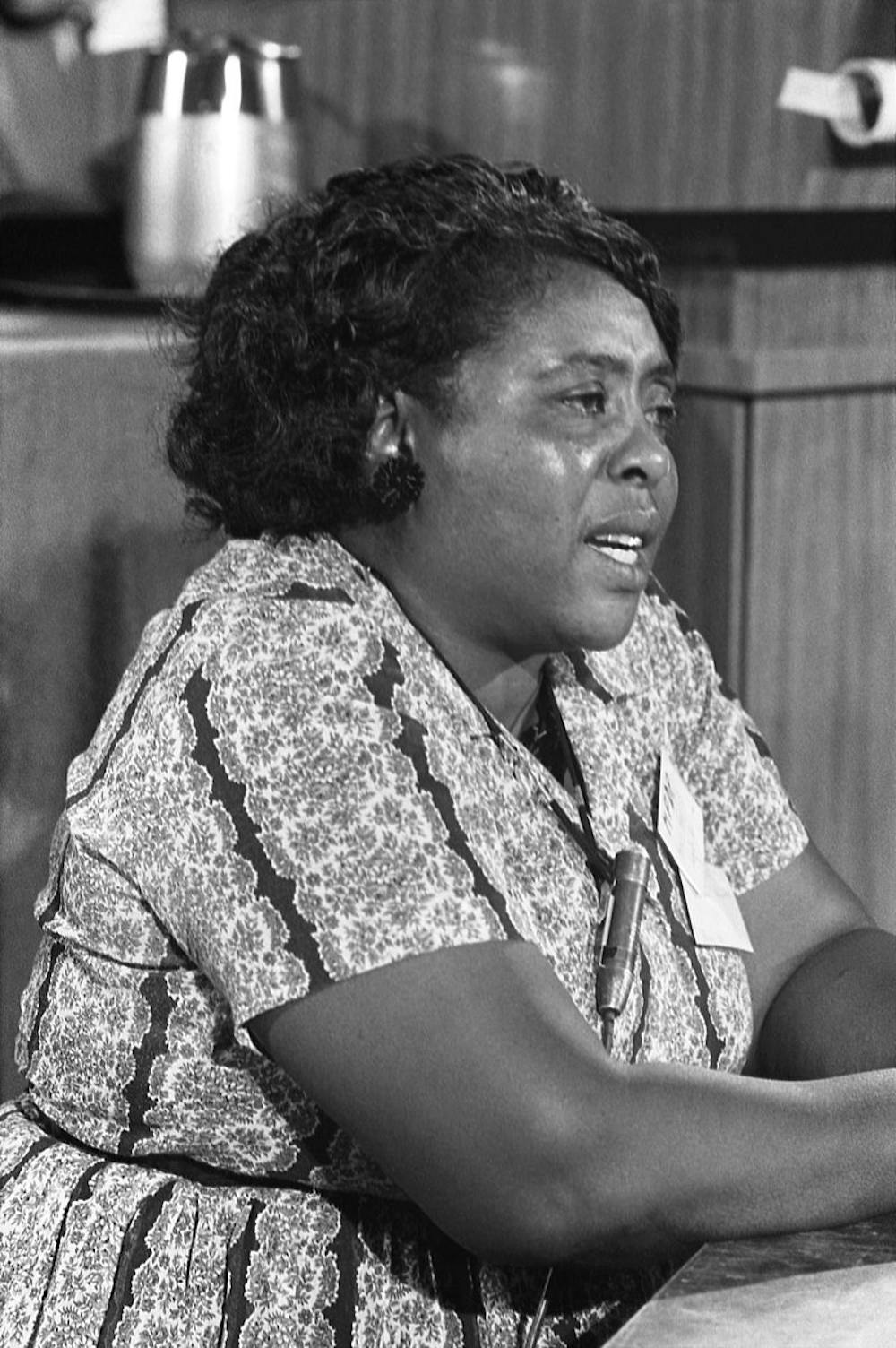
Fannie Lou Hamer confronts police violence
Civil rights leader Fannie Lou Hamer was one of the most vocal activists against state-sanctioned violence.
Born in Ruleville, Mississippi, in 1917, Hamer was a sharecropper who joined the civil rights movement during the early 1960s.
In 1963, Hamer and a group of other activists were traveling back home after attending a voter’s workshop in Charleston, South Carolina. They stopped at a restaurant in Winona, Mississippi, to grab a bite to eat.
The restaurant owners made it clear that black people were not welcome. Hamer returned to the bus, but then reemerged when she noticed officers shoving her friends into police cars. An officer immediately seized Hamer and began kicking her.
Later at the police station, white officers continued to beat Hamer. As she later recalled, “They beat me till my body was hard, till I couldn’t bend my fingers or get up when they told me to. That’s how I got this blood clot in my left eye – the sight’s nearly gone now. And my kidney was injured from the blows they gave me in the back.”
In doing so, Hamer brought attention to the problem of police violence. Her efforts would pave the way for many other black women activists who boldly confronted police violence and brutality by telling their stories – and the stories of their loved ones.
Both cases drew widespread media coverage and public outcry from black leaders, who demanded tangible changes in policing.
United by their similar experiences, Mary Bumpers and Veronica Perry joined forces to combat police brutality in New York City – an epicenter of police violence and anti-brutality organizing. Transforming their grief into political action, both women politicized their roles as mothers and daughters to challenge police violence. They organized local demonstrations and pushed for legislation that would help to curb police violence in the city.
On Sept. 24, 1985, they were keynote speakers at the Memorial Baptist Church in Harlem. Both women delivered rousing speeches before an audience of community members and religious leaders.
“We will not stand for the KKK in blue uniforms … we will not stand for it,” Veronica Perry insisted.
Her comments emphasized black activists’ recognition that the fight for black rights was interconnected with the struggle against racist violence – whether at the hands of a lynch mob of ordinary citizens or at the hands of a police officer.
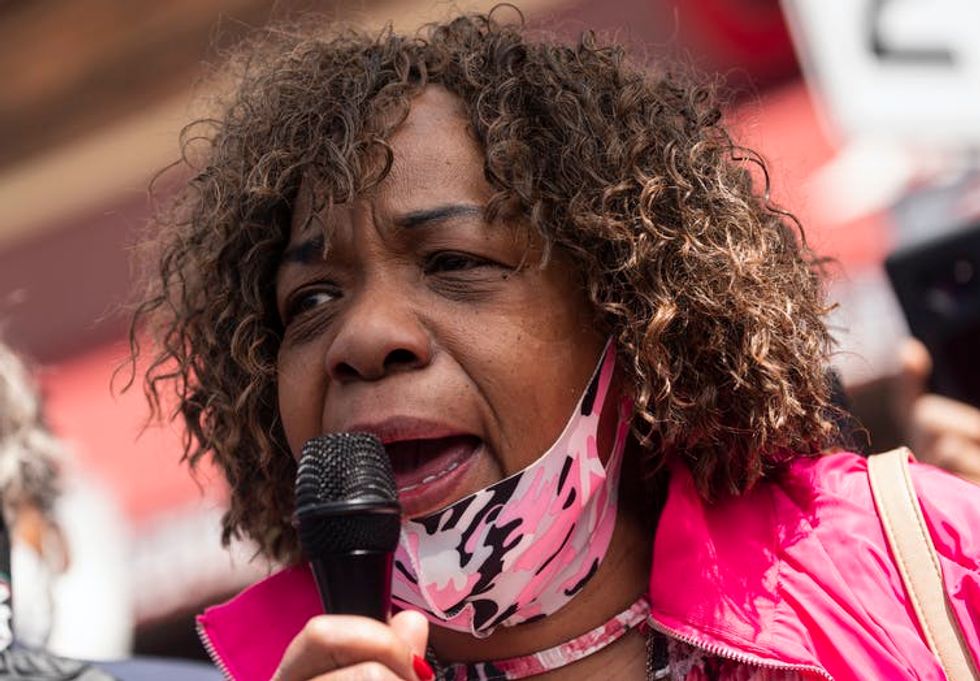
Gwen Carr, the mother of Eric Garner, spoke after George Floyd’s death in Minneapolis.
In October 1986, Mary Bumpurs and Veronica Perry appeared together at a memorial service at the House of the Lord Church in Brooklyn. They were joined by several other black women, including Carrie Stewart, the mother of graffiti artist Michael Stewart, who died in police custody in 1983.
Also joining them was Annie Brannon, whose 15-year-old son Randolph Evans was killed by New York police in 1976.
At the service, they lit candles in memory of their loved ones and called on community members to take seriously the escalating police violence in the city and across the nation. “We as a people have to stand together,” Mary Bumpurs explained. “It takes each of us banding together,” Veronica Perry added.
Today many remember the Eleanor Bumpurs and Edmund Perry cases. Fewer might recall these two women’s grassroots organizing during the 1980s.
Their efforts, and the earlier work of Fannie Lou Hamer in Mississippi, offer a glimpse of the significant role black women play in challenging police violence.
These women’s political work continues today through the “Mothers of the Movement,” a group of black mothers whose sons and daughters have been killed while in police custody.
This group, which includes Sybrina Fulton, the mother of Trayvon Martin, and Gwen Carr, the mother of Eric Garner, are working tirelessly to push for legislation that would fundamentally change American policing.
In recent years, Fulton, along with Democratic Georgia Congresswoman Lucy McBath, the mother of Jordan Davis, and Lesley McSpadden, the mother of Michael Brown, have run for public office. In the wake of recent protests, these women are calling for greater police accountability and joining the chorus of voices demanding the end of police killings of black people in the United States.
According to Axios, Bolton's book will argue that there was "Trump misconduct with other countries" besides Ukraine, although the publication's source did not go into specifics about which countries are involved.
In addition to its revelations about Trump's foreign policy, the book will accuse Trump of violating the Constitution in his efforts to block publication of his former national security adviser's book.
In the prologue, Bolton writes that Trump directed "the seizure and withholding of my advisers' personal and other unclassified documents" while also making "outright threats of censorship."
"His reaction thus ranged from the mean-spirited to the constitutionally impermissible," Bolton concludes.
Sources close to Trump tell Axios that they are particularly worried about Bolton's book because he is such a detailed note taker who kept scores of yellow notepads filled with records and observations.
"It scares me to death," the source said. "I’ve gotten very little sleep... They’re going to fire up an already fired-up base, and that concerns me for November."
An Atlanta-based GOP operative, meanwhile, said that the long lines give "Democrats a rallying cry by painting GOP elected officials as backwoods racists to large swaths of independent-minded suburban voters."
However, some GOP operatives tell the Examiner that it's still better for the party if "hurdles" remain up in Dem-heavy districts.
"Republicans concede voting rights could deliver extra votes for Democrats and help Biden overcome a lack of enthusiasm," the publication writes. "But some GOP insiders said hurdles to voting in urban Democratic municipalities, if they exist, might just as easily benefit Republicans."
MSNBC's Joe Scarborough stopped short of calling President Donald Trump a fascist, but he said the clues were adding up.
The president bragged to megachurch-goers that National Guard troops cut through protesters "like a knife through butter," and the "Morning Joe" host said that fit into an alarming pattern Trump has displayed since his campaign.
"You know, I remember back in December of 2015 when Donald Trump was talking about Muslim bans and Muslim registry, I asked is this what Germany looked like in 1933," Scarborough said. "You always have to be careful, of course, using analogies that line this president up with anybody, so I won't say that the president of the United States saying that it was a beautiful thing, police cutting through marchers like a knife cutting butter, I won't say that's fascist."
"I will leave that to our viewers to go back in history and see what fascist leaders have said about if anybody said anything similar to it was a beautiful thing like knife cutting through butter," he added. "I'll say this, if you can't find examples of fascist leaders talking about violence against protesters that way, please, your homework assignment for the weekend if you so choose to take it is to find an American president that's ever talked like this."
Melania Trump remained back in New York City after her husband's inauguration, which at the time she explained was related to their son's school year.
But a new book reveals the first lady also used her delayed arrival at the White House as leverage to renegotiate her prenuptial agreement with President Donald Trump, reported the Washington Post.
Melania Trump was angry over reports about Trump's sexual indiscretions and extramarial affairs, and she wanted time to cool off and "amend her financial agreement with Trump," wrote Post reporter Mary Jordan in her new book, “The Art of Her Deal: The Untold Story of Melania Trump.”
President Donald Trump is moving forward with plans for a campaign rally in Oklahoma, and MSNBC's Joe Scarborough mocked him for asking supporters to waive liability for any coronavirus cases that spread among attendees.
The sign-up page for tickets to the Tulsa rally informs supporters that they "voluntarily assume all risks related to exposure to COVID-19" and agree not to hold the campaign liable if they're infected by the potentially deadly virus.
"Do you want to go to a rally?" the "Morning Joe" host began. "Would you like to go a rally right now? I want to crowd in with a lot of people, yeah, inside. I want to do that. If you want to go to a Trump rally, you know, Donald Trump, he's so cool, he goes to -- he goes to a plant in Maine where they're making swabs and and he doesn't wear a mask because he thinks that's cool. Of course, they have to destroy all the work they're doing for testing because he didn't wear it, and you remember [White House chief of staff] Mark Meadows a couple days ago looking at the press going, 'You look funny in your masks.' [Politico reporter] Jake Sherman said, 'Yeah, because we don't want to die.' It's this fake macho B.S. they're trying to pull off."
Scarborough then slammed Trump for caring more about lawsuit money than his supporters' health.
"But here's the deal, Donald Trump, in the immortal words of Ross Perot, when the rubber meets the road, when it has to do with Donald Trump's money, suddenly he believes in science," he said. "I've seen the light, I've seen the light. Praise the Lord, I've seen the light. The message on the campaign website for re-elect Donald Trump, commander in chief, without a mask, says this: 'If you want to register for his rally in Tulsa by clicking below, you are acknowledging an inherent risk of exposure to COVID-19 exists in any public place where people are present by attending the rally. You and your guest voluntarily assume all risks related to exposure to COVID-19 and you agree not to hold -- you agree not to hold -- you agree not to hold Donald J. Trump for President Inc. or the stadium liable for any illness or injury.'"
"There is another way I could have written this," he added. "I tried to help them out with a succinct tweet, and it goes something like this: 'Come to our rally. P.S., it could kill you, but that's your problem.'"
"Immunity from lawsuits encourages irresponsible and reckless behavior, and undermines public health, as the Trump campaign is now shamefully making clear."
To register for a spot at President Donald Trump's first campaign rally since the Covid-19 pandemic shuttered much of the United States in March, prospective attendees must first agree not to sue either the Trump campaign or the venue if they contract coronavirus during the event—a requirement critics say is an attempt by the president's team to evade responsibility for moving ahead with a hazardous indoor gathering.
"By clicking register below, you are acknowledging that an inherent risk of exposure to Covid-19 exists in any public place where people are present," reads a paragraph at the bottom of the registration form for Trump's planned rally in Tulsa, Oklahoma on Juneteenth. "By attending the Rally, you and any guests voluntarily assume all risks related to exposure to Covid-19 and agree not to hold Donald J. Trump for President, Inc.; BOK Center; ASM Global; or any of their affiliates, directors, officers, employees, agents, contractors, or volunteers liable for any illness or injury."
"The Trump campaign may have shied away from such a move if it could be held accountable for the resulting illness and potential deaths that are likely to follow."
—Robert Weissman, Public Citizen
Oklahoma, which began reopening its economy last month, has recorded more than 7,600 coronavirus cases and at least 357 deaths. The president's Tulsa rally is slated to take place inside the BOK Center, which boasts a seat capacity of nearly 19,200.
As the Associated Pressreported, "arena marketing director Meghan Blood said Thursday that she didn't know yet about any plans for social distancing or other coronavirus precautions for Trump's rally, which would be one of the larger public gatherings in the U.S. at this stage of the outbreak."
The Trump campaign said the president will also soon hold rallies in Florida, North Carolina, and Arizona—three states that are currently seeing a surge in new Covid-19 infections.
Catherine Sharkey, a professor at New York University School of Law, toldCNN Thursday that liability waivers are likely to become commonplace in the U.S. as states continue the process reopening their economies.
"They only give limited protections, so they never would protect against, for example, gross negligence or recklessness," said Sharkey. "One could argue that holding a large public gathering that will draw people together in a context in which they're not able to do social distancing or follow the directive of the CDC, et cetera. One could argue that is grossly negligent."
Robert Weissman, president of consumer advocacy group Public Citizen, warned in a statement late Thursday that indoor campaign rallies "are extremely likely to spread the coronavirus, particularly if Trump discourages attendees from wearing masks either explicitly or by example."
"The Trump campaign may have shied away from such a move if it could be held accountable for the resulting illness and potential deaths that are likely to follow," said Weissman. "Instead, it aims to escape liability and any measure of accountability by forcing attendees to waive their rights through contract terms that they are unlikely even to notice."
"Immunity from lawsuits encourages irresponsible and reckless behavior, and undermines public health, as the Trump campaign is now shamefully making clear," Weissman added. "Congress must learn from the bad Trump campaign example and protect the rights of workers, patients, and consumers. That means no immunity for businesses and entities that engage in unreasonable conduct that endangers people by exposing them to the coronavirus."
Political scientist Miranda Yaver tweeted that the president knows "his campaign rallies have significant potential to be super-spreader events, especially as many states see increases in coronavirus cases and hospitalizations."
"He doesn't care, so long as he's not liable," Yaver wrote. "Classic Trump."
Fox News host Laura Ingraham — who has been called a "Neo-Nazi fan favorite" by Rep. Alexandria Ocasio-Cortez, D-N.Y.; a "white supremacist" by Rep. Joaquin Castro, D-Texas; and a "racist" and a "monster" by her own brother — kicked off her primetime show Wednesday by warning viewers that the social justice movement sweeping the nation in the wake of George Floyd's death was a "propaganda war" waged by liberals bent on dismantling U.S. history and culture.
While Ingraham's monologue, which mostly appeared to recycle conservative talking points, did not touch on the renewed movement in communities across the country to remove statues honoring heroes of the Confederacy, she lamented that this new "war" has had a deleterious effect on the "work product" of various industries.
America's liberals have "purged almost all conservatives from academia, the entertainment industry and journalism," the host said. "And one by one, those sectors ultimately fell victim to oppressive groupthink, which had a terrible effect on their work product and credibility."
"The punishment for deviating from the sentiment du jour grew harsher over time," she added.
As evidence that liberals were only hurting themselves, Ingraham pointed to Kevin Hart's withdrawal from hosting the Oscars and footage of students saying "f**k you" to right-wing provocateur and convicted felon Dinesh D'Souza in a Michigan State University lecture hall in 2018.
Ingraham was at one point engaged to D'Souza. In 2014, when he was sentenced for campaign finance fraud, she penned a letter to the judge overseeing the case.
"Dinesh is simply one of the finest human beings I have ever met. His generosity of spirit, philanthropy, keen sense of compassion and devotion to country are what I hope my own children exhibit when they mature into adults," she wrote after D'Souza had pleaded guilty to soliciting campaign donations from others and then reimbursing them, allowing him to skirt federal maximum contribution laws.
Ingraham, on Wednesday, then landed on her thesis: "What we are witnessing is a relentless propaganda war against the old teachings about America. It's an effort to smear our history and our patriotic spirit."
She then sampled some history, dubbing the protesters now demonstrating against police violence "the new Bolsheviks" — the Russian Revolution-era communist group led by Vladimir Lenin — before invoking conservative intellectual giants of yore, such as Phyllis Schlafly, who "warned about the poisonous effects of the cultural monopolies."
Other select chestnuts included familiar complaints about Huckleberry Finn, which Ingraham claimed cannot be read anymore "without hearing that Mark Twain was just a hopeless racist." Various groups have banned Huckleberry Finn since 1885, the year it was published, often citing its rampant use of the N-word.
The host the leapt ahead 135 years to the unrest shaking America today, echoing network colleague Tucker Carlson's warnings that Black Lives Matter would invite "Third World rule."
Protesters have brought art and books to the zone, as well as held concerts and movie nights there.
Ingraham lamented that corporate concessions such as HBO temporarily pulling "Gone with The Wind" and LEGO's temporary cessation of "marketing little plastic police figures" will not win the day.
"Giving into threats only leads to more threats," Ingraham, whose incendiary race-baiting has repeatedly cost her advertisers, said.
"More controls, less freedom," she concluded. "That's what's coming."
President Donald Trump was so impressed with the National Guard in Minneapolis dispersing protestors he again tried to steal credit from the Governor of Minnesota for deploying them.
"But we are very proud of the fact that I called, I said, 'I'm sorry, we have to have them go in.' And they went in. And it was like a knife cutting butter. Right through," the President told a group of mostly white megachurch goers Thursday afternoon at a campaign-style rally event Thursday in Dallas.
"I'll never forget – you saw the scene, on that road wherever it may be, in the city. Minneapolis. They were lined up, they just walked straight," Trump said.
"Yes. There was some tear gas and probably some other things," Trump admitted.
Watch:
Trump is in Dallas holding a taxpayer-funded discussion the White House is calling by the campaign's slogan: "Roundtable on Transition to Greatness: Restoring, Rebuilding, and Renewing." Tonight he will attend a private fundraiser where he is expected to pull in $10 million.