Sen. Marco Rubio (R-FL) came under an avalanche of criticism on Monday after he tried to find a silver lining about reports of students getting infected with COVID-19 while at school.
The Florida senator's tweet came in reaction to news of a school in Georgia that is being shut down for the next two days after nine students came down with novel coronavirus infections in just the first week back from class.
"Any setting in which people interact will lead to infections," he wrote. "The good news is these infected students are at very low risk of complications."
Rubio then said that schools should work on "lowering risk of student infections," while "more importantly lowering risk of students infecting staff or high risk family members."
Rubio's tweet drew a quick backlash, as his followers pointed out that protecting vulnerable staff members and parents is impossible when the virus is running completely unchecked throughout the country.
Law enforcement officers in Santa Clarita, California were seen on video pointing weapons at Black teens who were allegedly being threatened by a homeless man.
The video was posted by Instagram user Tammilaray.
"I wanted to share what happened to my son yesterday in SCV when he was with a couple of friends sitting at a bus stop headed home," the Instagram user explained. "He was attacked by a gentleman (homeless guy) who approached them and first asked them if they had any crack then tried to take their things."
According to the report, the manager of the nearby Buffalo Wild Wings called the cops to get help for the teens.
"'One' caller called the police and reported two black guys are attacking a homeless guy," Tammilaray said. "This is how the police responded. This is something my son and his friends will never forget. I’m still wonder how will I ever help my son recover from this traumatic experience. Please pray for my family. Please Share to protect our kids!!!"
The Los Angeles County Sheriff's Department told TMZ that they received a call about two adult males hitting another man with a skateboard. The department said the two teens were released and no arrests were made. "The Dept doesn't know what happened to the homeless man," TMZ added.
President Donald Trump announced Sunday night that Democrats were calling him begging for a deal on the stimulus after he signed a series of executive orders he claimed would take place of a legislative deal on a coronavirus stimulus package. But on Monday morning, Democrats said they weren't sure who called because it wasn't them.
MSNBC's Capitol Hill reporter Garrett Haake revealed that both Sen. Chuck Schumer (D-NY) and House Speaker Nancy Pelosi (D-CA) said that they haven't spoken to the president in a very long time. For Pelosi it has been over a year, since the last government shutdown where she humiliated him over a budget battle. Trump ultimately was forced to cave.
Trump seemed to accidentally reveal the truth in a Monday morning tweet in which he claimed again that Democrats were calling him, but he ended his tweet saying, "They know my phone number!" It was an apparent plea for them to call him.
If the executive orders were sufficient, as Trump claimed, then he wouldn't need a further "deal" with Democrats.
According to an analysis at Marketwatch, Donald Trump should not count on riding the same wave of voters who propelled him to a surprising White House win in 2016, with new polling showing they have become disenchanted with him and left the fold.
Cautioning that polls are just a snapshot in time, Chris Jackson claimed that, were the election to be held today, Trump would witness a massive shift of independent voters choosing presumptive Democratic nominee Joe Biden.
Pointing out that a more than a substantial number of unaffiliated voters are in play in every election, and many don't make up the minds until just before they vote, the report states that voting is firming up early due to voters' unfavorable opinion of the president.
Also working against the president is a demographic composition of the voters this go-around, particularly among the undecideds.
"A total of 1,114 Americans age 18 and up from the continental U.S., Alaska and Hawaii were interviewed online in English and asked: 'Overall, do you approve or disapprove of the way Donald Trump is handling his job as president?'" the report states. "A closer look at this group reveals that their composition is slightly different than in 2016. This year, undecided voters are more likely to be female, less likely to have a college degree, more likely to be younger, and are more likely to be a person of color."
"Looking at their sentiment, undecided voters appear to be highly dissatisfied with the state of the U.S. currently. Two-thirds of them believe the country to be on the wrong track and a similar amount disapprove of the president, " Jackson explained. "The majority identify as independent or non-political. If we assume anyone who believes the country is on the right track and/or approves of the president and/or identifies as a Republican, we find that only one-third of undecided voters give signals that they would be inclined to vote for Trump. The remaining two-thirds would be potential Biden voters."
That, he notes, is highly problematic for the president.
"If we combine this implied support with our regular Reuters/Ipsos tracking survey data, we find that Biden's lead in the polling remains robust," he continued. "In fact, his lead grows from a solid six-point advantage with registered voters to a 'wavelike' 12-point advantage. This is almost the exact opposite of what was observed in 2016 when analysis of undecided voters suggested Clinton’s lead was much smaller than stated in the poll topline."
Stating that the president -- who is being dogged by the coronavirus pandemic and a collapsing economy -- would have to do something drastic to change his prospects, Jackson said Trump is unlikely to reel in enough voters outside of his base to be re-elected, writing: "Trump does not have a hidden bloc of support that will miraculously appear and alter his standing in the days before the election."
President Donald Trump on Monday lashed out at Sen. Ben Sasses (R-NE), who over the weekend criticized the president's executive orders regarding the payroll tax and enhanced unemployment benefits.
"RINO Ben Sasse, who needed my support and endorsement in order to get the Republican nomination for Senate from the GREAT State of Nebraska, has, now that he’s got it (Thank you President T), gone rogue, again," the president wrote. "This foolishness plays right into the hands of the Radical Left Dems!"
Sasse over the weekend slammed the president's executive orders as "unconstitutional slop" and compared them to the executive orders issued by former President Barack Obama that many Republicans used to criticize.
In fact, Trump himself at the time regularly attacked Obama for issuing executive orders that he deemed "power grabs."
A massive explosion happened in Baltimore, Maryland Monday morning leaving at least five people trapped, including children.
Fox Baltimore reported that several houses were impacted. One person heard over the police scanner that there were "borderline mass casualty." Thus far, however, only one person was pronounced dead at the scene.
There are no facts about the cause of the explosion at this time, but firefighters are on the scene to attempt to rescue those trapped in the rubble. At least three homes exploded, according to witnesses, prompting speculation that it could have been a massive gas leak, but those reports were unconfirmed.
On Monday, Politico reported that Senate Homeland Security Chairman Ron Johnson (R-WI), as part of his investigation into the origins of the Russia probe, has issued a subpoena for FBI Director Christopher Wray.
"The subpoena, which POLITICO reviewed, demands documents but not testimony," reported Betsy Woodruff Swan. "Specifically, it asks for 'all documents related to the Crossfire Hurricane investigation' — the FBI’s counterintelligence probe into Russian interference in the 2016 U.S. election. That probe scrutinized Americans close to then-candidate Trump for their links to Kremlin officials. Mueller took over the probe in May 2017."
"Johnson also released a lengthy letter detailing the origins of his probe and criticizing the reaction it has garnered from media reports and Democrats," continued the report. "Democrats, Johnson wrote, 'have initiated a coordinated disinformation campaign and effort to personally attack' himself and Finance Committee chairman Sen. Chuck Grassley (R-Iowa), whose office has worked with."
Johnson's probe, launched to validate partisan claims from President Donald Trump and his allies that the FBI abused its power in pursuing his possible ties to Russia, has drawn concern not just from Democrats but from Republicans worried it will backfire. The investigation has hit some snags, with the CIA refusing to brief senators on the matter.
San Diego County GOP Party Chairman Tony Krvaric has railed against what he claims is the rampant fraud associated with mail-in voting. In a May 3 tweet, he said that vote-by-mail is "fraught with danger." But according to a report from Voice of San Diego, Krvaric has voted by mail in 22 consecutive elections dating back to 2004.
Krvaric says his record doesn't matter because he made sure his voting was secure.
“The voter file is notoriously poor with incomplete or inaccurate information,” he said. “The problem is not my ballot, which I know to expect and usually drop off at the polling place but have mailed in a few times but would make sure to track that my ballot was received.”
According to former Republican political consultant Tom Shepard, voting by mail is "a hell of a lot more secure than filing taxes, or other things we do by mail."
“The lengths they go through – I mean they manually scan every signature and match it to the voter file," Shepard said. "That’s why it takes so long to count the last absentees. It’s a darn full-proof process. For there to be mass fraud in that process, I don’t think it would be possible.”
A Washington Post analysis found voter fraud to be exceedingly rare, with only 372 possible cases of double voting or voting on behalf of deceased people out of 14.6 million votes cast in three vote-by-mail states in 2016 and 2018.
"Can't stress this enough— if the USPS is sabotaged, this will amount to the greatest voter suppression campaign in history."
In the wake of what was dubbed a "Friday Night Massacre" at the U.S. Postal Service—compounded by news that first-class postage rates, as opposed to cheaper bulk rates, would be charged for processing mail-in ballots in November—calls overnight and into Saturday have gone out for people across the U.S. to rise up in a coordinated fashion to end what many observers warn is a blatant effort by the Trump administration and the GOP to sabotage the federal mail delivery service ahead of this year's elections.
While Republicans in the Senate and the White House negotiating team have both refused to accept Democratic demands to include massive funding for election protections in the next round of Covid-19 relief as a way to have safe and accessible voting for all amid the pandemic, the latest news about what Postmaster General Louis DeJoy, a longtime GOP donor and Trump supporter, has been doing since appointed earlier this summer is prompting outrage, accountability, and calls for immediate action.
"This is how they destroy our democracy," warned progressive activist Ady Barkan while pointing to a report by The American Prospect's David Dayen which noted the looming postage hike on mail-in absentee ballots.
The Postal Service has informed states that they'll need to pay first-class 55-cent postage to mail ballots to voters, rather than the normal 20-cent bulk rate. That nearly triples the per-ballot cost at a time when tens of millions more will be delivered. The rate change would have to go through the Postal Regulatory Commission and, undoubtedly, litigation. But the time frame for that is incredibly short, as ballots go out very soon.
A side benefit of this money grab is that states and cities may decide they don’t have the money to mail absentee ballots, and will make them harder to get. Which is exactly the worst-case scenario everyone fears.
The American Postal Workers Union (APWU), which represents over 220,000 mail carriers and retirees, on Saturday said it was necessary for all constituents worried about the attacks on the USPS or the integrity of mail-in voting this fall to immediately contact their representatives in the U.S. Senate:
Other outside defenders of the Postal Service said that while agitating members of Congress was vital, the scale of the threat calls for action beyond that.
"Grind the government to a fucking halt if we have to," declared liberal commentator Brian Tyler Cohen late Friday. "I can't stress this enough— if the USPS is sabotaged, this will amount to the greatest voter suppression campaign in history. The election will effectively become void... AND THAT IS WHAT TRUMP WANTS—THAT IS HIS POINT HERE."
As veteran consumer advocate Ralph Nader said last month, "Trump's henchman Louis DeJoy took control of USPS last month and is already slowing down first class mail service to undermine Benjamin Franklin's institution. People should hold demonstrations around their local post offices."
In a video posted to the APWU's Facebook page, a longtime USPS employee in Minneapolis identified only by his first name Kevin, called on people nationwide to "come together and save our Post Office" from the attacks coming Trump's White House and DeJoy.
With vote-by-mail so crucial for ballot access this November, outspoken defenders of the Postal Service are calling it a national "five-alarm fire" and a crisis that cannot be overstated.
"The U.S. Postal Service is facing unprecedented challenges and political threats even while it is an essential lifeline for millions of Americans, especially those isolated by the COVID-19 pandemic," the People for the American Way stated this week as they launched a new video celebrating the USPS and calling for its protection.
Former Republican presidential candidate Rick Santorum on Monday blamed former President Barack Obama after President Donald Trump took executive actions instead of negotiating a COVID-19 relief bill.
During an appearance on CNN's New Day program, host John Berman pointed out that Santorum had slammed Obama for the use of executive actions in 2014.
"How do you feel about it now when it's a Republican president?" Berman wondered.
"I would say, number one, some of the things the president is suggesting are proper use of executive action, like suspending the payroll tax temporarily," Santorum replied. "A couple of the executive actions are clearly fine. There's a couple that are not and I would say that President Obama has set the precedent, and that's the problem."
"But I'm giving you an opportunity to not be a hypocrite," Berman interrupted. "I just want to know, do you approve of the executive action?"
"No, I don't," Santorum insisted.
"Why don't you?" the CNN host pressed. "Why don't you approve of the action that President Trump -- this president -- took?"
"The action you just spoke of -- creating a new unemployment system -- is something that is under the purview of Congress and not for the president to be able to do," Santorum opined. "And just like when Barack Obama funded health insurance companies illegally, in my opinion, unconstitutionally, both are under the purview of Congress to appropriate that money. He can't just unilaterally do that."
Santorum went on to say that at least one Republican senator had condemned Trump's use of executive actions.
"You didn't see that at all on the Democratic side when President Obama did it," he added. "And he was the first to do it."
In the history of voter suppression in the United States – including attempts to stop Black and Latino people from voting – Republican tactics in the 1981 New Jersey gubernatorial race are worth highlighting.
That November, voters in several cities saw posters at polling places printed in bright red letters. “WARNING,” they read. “This area is being patrolled by the National Ballot Security Task Force.”
And voters soon encountered the patrols themselves. About 200 were deployed statewide, many of them uniformed and carrying guns.
In Trenton, patrol members asked a Black voter for her registration card and turned her away when she didn’t produce it. Latino voters were similarly prevented from voting in Vineland, while in Newark some voters were physically chased from the polls by patrolmen, one of whom warned a poll worker not to stay at her post after dark. Similar scenes played out in at least two other cities, Camden and Atlantic City.
Weeks later, after a recount, Republican Thomas Kean won the election by fewer than 1,800 votes.
Democrats, however, soon won a significant victory. With local civil rights activists, they discovered that the “ballot security” operation was a joint project of the state and national Republican committees. They filed suit in December 1981, charging Republicans with “efforts to intimidate, threaten and coerce duly qualified black and Hispanic voters.”
In November 1982, the case was settled when the Republican committees signed a federal consent decree – a court order applicable to activities anywhere in the U.S. – agreeing not to use race in selecting targets for ballot security activities and to refrain from deploying armed poll watchers.
The 2020 presidential election will be the first in nearly 40 years conducted without the protections afforded by that decree, which expired in 2018 after Democrats failed to convince a judge to renew it.
As a professor who teaches and writes about New Jersey history, I’m alarmed by the expiration because I know that Republicans in 1981 relied not only on armed poll watchers but also on a history of white vigilantism and intimidation in the Garden State. These issues resonate today in the midst of the Black Lives Matter movement and continued GOP attempts to suppress the 2020 votein numerous states.
Former U.S. Rep. John Lewis with House Democrats before passing the Voting Rights Advancement Act to eliminate potential state and local voter suppression laws, Dec. 29, 2019. The Senate has not taken up the bill.
Considered an early referendum on Ronald Reagan’s presidency, New Jersey’s 1981 gubernatorial race held special meaning for Republicans nationwide. Kean – with campaign manager Roger Stone at the helm – promised corporate tax cuts and relied heavily on Reagan’s endorsement.
To secure victory, state and national Republican party officials devised a project they claimed would prevent Democratic cheating at the polls.
In the summer of 1981, the Republican National Committee sent an operative named John A. Kelly to New Jersey to run the ballot security effort. Kelly had first been hired by the Republican National Committee in 1980 to work in the Reagan campaign, and he served as one of the RNC’s liaisons to the Reagan White House.
In August 1981, under the guise of the National Ballot Security Taskforce, Kelly sent about 200,000 letters marked “return to sender” to voters in heavily Black and Latino districts. Those whose letters were returned had their names added to a list of voters to be challenged at the polls on Election Day, a tactic known as voter caging.
In the Newark area, Kelly produced a list of 20,000 voters whom he deemed potentially fraudulent. He then hired local operatives to organize patrols, ostensibly to keep such fraud at bay. To run the Newark operation, he hired Anthony Imperiale.
Newark’s white vigilante
Imperiale, in turn, hired off-duty police officers and employees of his private business, the Imperiale Security Police, to patrol voting sites in the city.
The gun-toting, barrel-chested former Marine had first adopted the security role during Newark’s 1967 uprising – five days of protests and a deadly occupation of the city by police and the National Guard following the police beating of a Black cab driver. During the uprising, Imperiale organized patrols of his predominantly white neighborhood to keep “the riots” out.
Soon, Imperiale became a hero of white backlash politics. His opposition to police reform earned him widespread support from law enforcement. And his fight against Black housing development in Newark’s North Ward delighted many of his neighbors. By the end of the 1970s, Hollywood was making a movie based on his activities.
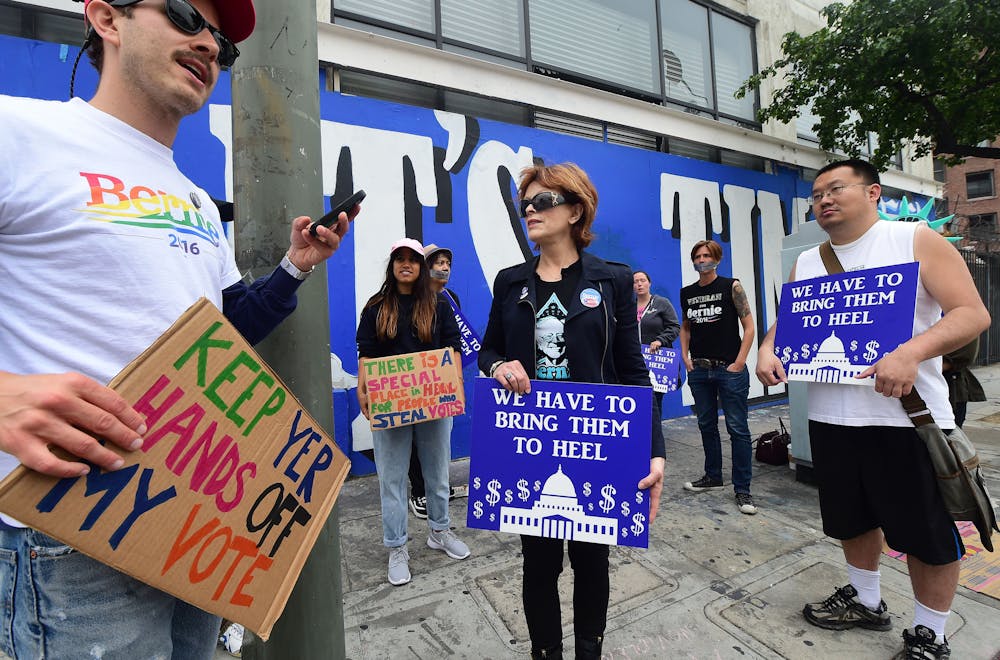
Actress Frances Fisher arrives to speak at a downtown rally in Los Angeles, California on May 19, 2016, to bring attention to voter suppression.
After serving as an independent in both houses of the state legislature, Imperiale became a Republican in 1979. Two years later, he campaigned with Kean. Once in office, the new governor named Imperiale director of a new one-man state Office of Community Safety – an appointment often interpreted as reward for Imperiale’s leadership of the ballot efforts in Newark, but stymied when Democrats refused to fund the position.
Rather, the state and national Democratic committees brought suit against the Republican National Committee to ensure it couldn’t again use such methods anywhere. For nearly 40 years – through amendments and challenges – the resulting consent decree helped curtailvoter suppression tactics.
Since the decree’s expiration in 2018, Republicans have ramped up their recruitment of poll watchers for the 2020 presidential election. Last November, Trump campaign lawyer Justin Clark – calling the decree’s absence “a huge, huge, huge, huge deal” for the party – promised a larger, better funded and “more aggressive” program of Election Day operations.
The Trump campaign is claiming, as Republicans did in 1981, that Democrats “will be up to their old dirty tricks” and has vowed to “cover every polling place in the country” with workers to ensure an honest election and reelect the president.
This November, Republican tactics in 1981 are worth remembering. They demonstrate that the safeguarding of polling places from supposedly fraudulent voters and of public places from Black bodies share not only a logic. They also share a history.
Although the Republican-sponsored Tax Cuts and Jobs Act of 2017 did precious little for the middle class, President Donald Trump has been claiming that former Vice President Joe Biden — the presumptive Democratic presidential nominee — is pushing for a middle class tax hike. This claim, journalist Hans Nichols stresses in an August 10 article for Axios, is right out of President Ronald Reagan’s 1984 playbook. But so far, according to Nichols, Biden is not taking Trump’s bait.
“President Trump is trying to lure Joe Biden into a Walter Mondale trap, attempting to force the Democratic nominee to embrace middle-class tax increases as part of his election strategy,” Nichols notes.
In his 1984 reelection campaign, Reagan slammed Democratic presidential nominee Mondale (who had served as vice president under President Jimmy Carter) as someone who was anxious to raise taxes on the middle class. Reagan was reelected by a landslide that year, defeating Mondale by 18% in the popular vote and winning 525 votes in the Electoral College.
Trump, over the weekend, called for a payroll tax suspension.
“With his Saturday evening executive action to unilaterally rewrite the tax code,” Nichols reports, “Trump again is demonstrating the lengths to which he’ll go to change the conversation — and try to make the election a choice between him and Biden and not a referendum on him. In Biden’s response, he didn’t take the bait. Instead, he used the White House effort to suspend payroll taxes as a way to double down on his appeal to seniors and cast himself as the defender of Social Security.”
Biden, Nichols notes, described Trump’s plan as a “first shot in a new, reckless war on Social Security.”
According to Nichols, Biden has “stayed in touch with Mondale over the years” and has “studied Mondale’s papers to learn from history.”
Nichols observes, “Biden isn’t opposed to raising taxes on the wealthy, he told Wall Street donors as much in June. But he’s never said he’d raise middle-class taxes.”
In a column for the conservative Bulwark, author Richard North Patterson claims we are watching the waning days of "Mad King Trump" as he blunders from interview to interview spewing nonsense as his advisers try to prop up an administration in a death spiral.
Getting right to the point, Patterson said Trump evokes the image of a "mad king of some Ruritanian backwater, spewing splenetic ravings while his shrinking cadre of sycophants struggles to steer their foundering ship of state."
To make his case, he noted a recent interview the president participated in with Fox News host Chris Wallace where he bragged about passing a test designed to monitor signs of dementia, with Patterson pointing out, "instead of entering his second childhood, Trump seems never to have left his first."
Describing the Fox News interview, the author said the president came off across as "pathetic," wallowing in self-pity and completely disassociated from the reality on the ground where people are dying from COVID-19 as his own health advisers are urging increased efforts to stem the spread of the pandemic.
"Instead of listening to science, Trump looks for affirmation from the fever swamp of right-wing media, recycling falsehoods, bogus conspiracies, and patent quackery," he wrote before noting a report from the Washington Post that stated, "People close to Trump, many speaking on the condition of anonymity to share candid discussions and impressions, say the president’s inability to wholly address the crisis is due to his almost pathological unwillingness to admit error; a positive feedback loop of overly rosy assessments and data from advisers and Fox News; and a penchant for magical thinking that prevented him from fully engaging with the pandemic."
Noting Trump's attacks on presumptive Democratic presidential nominee Joe Biden, Patterson said the president is engaging in a "war on reality" in a desperate attempt to remain in office.
"Such incoherent vituperation captures Trump’s central problem: Compared with Trump himself, Biden is Mr. Rogers. Trump’s ad hominem lunacy isn’t working, and his time is running out: Early voting in Pennsylvania, North Carolina, and Wisconsin starts in mid-September, and Trump’s campaign seems to be writing off Michigan," he explained. "In desperation, Trump has declared war on the ultimate reality which separates democracies from monarchies: that, come November 3, voters will render judgment on his presidency. Hence his preemptive claims of voter fraud spawned another hallucination—postponing the election itself."