On Wednesday, writing for The Washington Post, columnist Amber Phillips highlighted how former Attorney General Jeff Sessions' "humiliating" failure to be renominated for his old Senate seat in Alabama is a cautionary tale for other Republicans — and a stark illustration of why so many are afraid to even appear to disagree with President Donald Trump.
"Sessions was the first senator to endorse Trump, choosing him over other candidates like his Senate colleague Ted Cruz (R-Tex.)," wrote Phillips. "Trump was just a few months into his campaign when Sessions stood with him onstage, giving the candidate a boost of legitimacy from Washington. When Trump won the White House, Sessions was rewarded by being chosen to be Trump’s attorney general. And Sessions in return tried to relentlessly hammer home the two men’s tough-on-immigration rhetoric and policies."
"But the relationship went wrong over the question of loyalty, or rather the president’s perception of loyalty," wrote Phillips. "Trump has been humiliating Sessions for years, actually, even while Sessions was still his attorney general. The president seemed to view the prominent Cabinet position as one designed to protect him rather than to be the nation’s top law enforcement officer. Perhaps Trump was helped along by the fact that his attorney general was such a close political ally. Or perhaps Trump views key aspects of government as a means to the end of supporting him — a pattern we’ve seen since."
Sessions was ultimately fired at the end of 2018 after being frozen out of Trump's inner circle for months, and went on to lose to former Auburn football coach Tommy Tuberville when he ran to get his Senate seat back.
"Republicans are trying to hang onto their Senate majority, and the last thing they need is a Sessions-like battle with the president who deems some of them not loyal enough," conclude Phillips. "That’s a lesson many of them have already learned, but Sessions’ humiliating defeat drives it home."
However, the president isn't taking into account the fact that tens of millions of Americans also enthusiastically hate him.
In an analysis posted at FiveThirtyEight, University of California Irvine political science professor Michael Tesler notes that enthusiastic anti-Trump voters at the moment are more numerous than enthusiastic pro-Trump voters.
"While Biden voters may not be all that excited about voting for Biden, they’re very enthusiastic about voting against Trump," he writes. "And that gives Biden a pretty strong edge, because Trump supporters don’t despise Biden the way they despised Hillary Clinton in 2016."
He then points to recent survey data showing that more than 80 percent of Biden voters say they have a "very unfavorable" view of Trump, whereas just 54 percent of Trump voters feel the same way about Biden.
This contrast gets even more stark when looking at net number of people who find the candidates either very favorable or very unfavorable, Tesler explains.
"What’s especially notable here is that Biden’s net enthusiasm rating is near zero, which is similar to most major-party presidential candidates’ ratings from 1980 to 2012," he argues. "Trump’s current score of around -20, on the other hand, has only one historical comparison other than his own campaign four years ago: Hillary Clinton in 2016."
Axios reports that new data from the National Federation of Independent Business and investment bank UBS show that small businesses appear to be in dire straits even as big businesses such as Amazon benefit from the collapse of competitors.
A recent survey conducted by NFIB found that "23 percent of small businesses... would be able to operate under current economic conditions for no more than six months," while "another 21 percent said no more than a year."
Holly Wade, NFIB's director of research, tells Axios that the survey data present "a bleak picture."
Separately, UBS global equity strategist Keith Parker tells Axios that a recent survey of small businesses' chief financial officers has found that their expectations for earnings "have essentially collapsed."
Mohamed Kande, the U.S. and global advisory leader at PricewaterhouseCoopers, predicts that all of this will result into massive industry mergers with just a few large players left standing.
"What happens when you have changes like that is you start to see a wave of consolidation," he said. "It's hard for small companies to survive because they don’t have the balance sheets, they don’t have the capital to sustain a crisis for a long time."
On Wednesday, writing for The Daily Beast, ex-GOP strategist and Never Trump conservative Rick Wilson tore into "Drunk Uncle" Trump's latest press conference tirade.
"Like an addled necromancer with the heavy charnel stench of a dead campaign on him, Trump spent over an hour chanting the old incantations from an eldritch grimoire (The Dark Booke of Bannon, perhaps) only to find that nothing was working," wrote Wilson. "Even his most devoted followers were eyeing the exits and wondering when some apprentice would step forward to lead him off gently off the stage for a rest and a posset of unicorn blood."
Trump spent a large portion of the press conference attacking former Vice President Joe Biden and suggesting he would destroy the American way of life, which led some to suspect he had forced some White House staffers to violate the Hatch Act.
"For the tiny minority of Trumphadis who still imagine there is some rational, considered version of Donald Trump lurking inside that hair helmet, what they saw Tuesday was a desperate candidate flailing, madly spewing agitprop that even a Tucker Carlson producer would stare at in awe of its madness," wrote Wilson. "Trump runs the entire campaign operation from his impulses and instincts. They can hire 5,000 people for his campaign effort, and not one of them can persuade or change him ... Tuesday’s presser felt like Donald Trump seizing the reins of the campaign from Brad and Jared and baby daddy Jason Miller and getting back to the red-meat white-power themes he loved so well in 2016."
"Trump was struggling Tuesday to reconnect to the grunting populism of his 2016 success. In it, he was never held to account no matter how much footsie he played with the alt-right and its media outlets of record," concluded Wilson. "Now, the feeling that the magic isn’t working and that that spell has finally failed isn’t wishful thinking on the part of the Never Trump movement. It’s a president, a presidency, and a campaign in steep decline. You hate to see it."
President Donald Trump's ongoing efforts to roll back regulations designed to protect the environment, workers, and public health likely played a significant role in the spread of Covid-19 in the United States.
That's according to a new report released Tuesday by New York University School of Law's Institute for Policy Integrity (IPI), a nonpartisan policy think tank.
The 45-page report titled "Weakening Our Defenses" (pdf) details how Trump's far-reaching deregulatory push has exacerbated several major risk factors for contracting and spreading Covid-19, such as high levels of air pollution, hazardous working conditions, and lack of adequate health insurance.
"President Trump's deregulatory agenda has affected all those factors, and, therefore, the disproportionate racial and economic justice impacts of deregulation are now most likely compounding in deadly ways in the wake of the Covid-19 pandemic," the report says.
"Even before the pandemic," the report continues, "those regulatory decisions collectively were already causing dire consequences for public health and safety, the environment, and economic conditions—but we now know that those regulatory decisions have likely also increased our collective susceptibility to Covid-19."
The report cites the Trump administration's rollback of restrictions on nearly 2,000 forms of hazardous air pollution in 2018, weakening of the Clean Power Plan, and gutting of vehicle fuel efficiency standards in 2020 as examples of environmental deregulatory actions that left the U.S. more vulnerable to Covid-19. The U.S. currently has the most confirmed coronavirus cases and deaths in the world.
"These rollbacks have put all of us—especially low-income communities, Black people, and people of color, and essential workers—at higher risk of contracting and dying from Covid-19," said Gina McCarthy, former Environmental Protection Agency administrator and current president of the Natural Resources Defense Council.
The report also points to the Trump administration's weakening of workplace safety standards at meatpacking plants, which have become major Covid-19 hotspots. According to the Centers for Disease Control and Prevention, more than 16,200 meat and poultry processing workers have contracted Covid-19 at 239 facilities in the U.S.
"In October 2019, the Trump administration's Department of Agriculture finalized a rule to 'modernize' swine slaughter inspections," IPI's report says. "The new program, which pig processing plants may opt into, reduces the number of food safety inspectors in plants and removes caps on pig slaughter line speeds."
By forcing workers to perform their jobs in close proximity to one another, the report notes, the prioritization of speed over safety forces "likely puts meat processing workers at greater risk for Covid-19."
The Trump administration's efforts to undermine the Affordable Care and limit Medicaid eligibility by approving state-level work requirements also may have contributed to the spread of Covid-19, according to the new report.
"Though some of these state requirements have since been invalidated by the courts, other state programs could yet be implemented, and even the temporary loss of coverage in some states could be significant—particularly during a pandemic," the report says.
Dr. Kathleen Rest, executive director of the Union of Concerned Scientists, said in a statement that the Trump administration's "failure to listen to and act on the best available science is irresponsible and dangerous."
"From day one, the Trump administration has attempted to roll back not only existing public health protections, but the scientific basis on which all public health protections are based," said Rest. "That's short-sighted and foolish at the best of times, but they have continued to dismantle safeguards even as the country faces the threat of Covid-19, one of the biggest public health crises in our history."
Trump trade adviser Peter Navarro is now being rebuked by White House Director of Strategic Communications Alyssa Farah for his attack on Dr. Anthony Fauci.
Hours after USA Today published an opinion piece from Navarro in which he claimed the nation's top infectious disease expert has been almost entirely wrong about the novel coronavirus pandemic, Farah sent out a tweet saying that Navarro's piece did not go through any kind of proper White House channels.
"The Peter Navarro op-ed didn’t go through normal White House clearance processes and is the opinion of Peter alone," she wrote. "Donald Trump values the expertise of the medical professionals advising his Administration."
Even by the standards of the national pandemic spike, Arizona has a serious coronavirus problem.
On Monday morning the state's health department reported 1,357 new coronavirus cases, including eight additional deaths. It now has more cases per capita than any other state besides New Jersey, whose outbreak peaked months ago. Moreover, the rate at which new cases have been reported has surpassed the rate at which testing has been increased, which means the existing data almost certainly does not reflect the true extent of the outbreak.
Further complicating matters, Gov. Doug Ducey, a Republican, only authorized local governments to implement mask requirements on June 17 — and public health officials say it will take several weeks for the impact of those requirements to be evident. Ducey has also been criticized for personally setting a bad example after a photograph was published showing him at a social event practicing neither distancing nor mask-wearing. (Ducey's office disputes the timeline involving when the photograph was taken.)
Arizona has also had a series of high-profile coronavirus cases. Last month a teacher in the state died after contracting the coronavirus while she was forced to share a classroom with two other teachers, both of whom also contracted the disease. On Monday a group of school board members and medical professionals signed an open letter to Ducey urging him to delay opening schools until at least October, citing concerns about the safety of both educators and students. (Officials in Phoenix, the state's largest city, has made clear public schools will be online-only as the fall term begins.)
Ducey was also called out in an impassioned obituary written by Kristin Urquiza, whose father, Mark Anthony Urquiza, died from COVID-19 last month.
"Mark, like so many others, should not have died from COVID-19," Urquiza wrote. "His death is due to the carelessness of the politicians who continue to jeopardize the health of brown bodies through a clear lack of leadership, refusal to acknowledge the severity of this crisis, and inability and unwillingness to give clear and decisive direction on how to minimize risk."
So what exactly has gone wrong in Arizona — and what can be done to make it right?
"It is impossible to say whether [Ducey] is ignoring advice, is unaware of it, or doesn't believe it," Dr. Elizabeth Jacobs, a professor of epidemiology and biostatistics at the University of Arizona, told Salon by email. "There have been numerous editorials published that have strongly recommended intensive actions, such as a statewide mandate on masking and improved testing speeds. The latest actions by the governor aim to increase testing capacity by the end of August. With considerations such as reopening schools and universities under discussion, this will not be soon enough. It is distressing that we do not have adequate testing in the state even now."
When asked about specific mistakes made by Arizona's government, Jacobs pointed to overly ambitious economic reopening that was too rapid, the lack of a statewide mandate on masking and incompetent or inadequate testing, which she described as "the biggest concern I have personally right now."
"We need rapid testing available to everyone, with testing sites equally distributed in all neighborhoods, regardless of socioeconomic status," Jacobs explained. "We need tests that are sensitive and specific, with rapid turnaround. We need supports in place for those who may be most vulnerable to COVID-19, such as our Native American Nations and among our Latinx population. We also need to ensure that legislation to protect individuals from evictions is renewed during this emergent epidemic, and that we provide financial support for those who are being hit hardest by social distancing." Jacobs also called for "sensible and reasonable recommendations" for school reopening and said that Arizonans need to know that authority figures "care about them and will be here to support them."
A recent poll suggests that Jacobs' views are held by a large number of her fellow Arizonans. A poll by the COVID-19 consortium found that Ducey has the lowest ranking among all American governors for his handling of the coronavirus crisis, and in fact is the only governor to rank below President Trump. (Ducey has a 32 percent approval rating compared to Trump's 34 percent approval rating.)
As of Sunday Arizona has reported 2,245 deaths a total of 122,467 cases. In an open letter to Ducey, the mayors of Flagstaff, Phoenix, Tempe, Tolleson and Tucson said that "our economy will not recover until we are able to slow the spread and rebuild consumer confidence. The longer we wait to act, the longer and more severe the blow to our economy will be, the longer it will take to safely send our children back to school, and more lives will be needlessly lost."
A recent article in Vox echoed some of these observations. As German Lopez wrote, Arizona's coronavirus spike "is the result, experts say, of Arizona's missteps at three crucial points in the pandemic. The state reacted too slowly to the coronavirus pandemic in March. As cases began to level off nationwide, officials moved too quickly to reopen in early and mid-May. As cases rose in the state in late May and then June, its leaders once again moved too slowly."
As Will Humble, executive director of the Arizona Public Health Association, told Vox, the state reopened too aggressively. "It was a free-for-all by May 15," Humble said, later adding that the state effectively "went from phase 0 to phase 3."
Unfortunately the errors made by Arizona's leaders are likely to be have long-lasting consequences regardless of how the state tries to make up for things now.
"Even if I put in 100 percent face mask use and everybody complied with it in Arizona right now, there would still be weeks of pain," Cyrus Shahpar, a director at the global health advocacy group Resolve to Save Lives, told Vox. "There are people out there spreading disease, and it takes time [to pick them up as cases], from exposure to symptom onset to testing to getting the testing results."
A North Carolina woman who became infamous for multiple racist incidents caught on video has died after being struck by a fire truck.
Rachel Dawn Ruit suffered fatal injuries after she was struck Monday by an emergency vehicle, just days after her arrest for a racist attack on a teenage girl and Muslim woman, reported WLOS-TV.
The 41-year-old Ruit was arrested July 4 after allegedly ripping off a woman’s hijab during a Black Lives Matter demonstration and grabbing a teenager in the groin, telling her she needed to be “put down.” She also was accused of threatening to rape the teen.
A man who witnessed Ruit being struck by the fire truck recognized her from videos of previous racial harassment.
“I just witnessed the same lady from that video accidentally step out into traffic on Patton Avenue, going towards downtown Asheville, as she was walking with traffic coming from behind her,” said witness Jonathan Rowell. “The Asheville Fire Department truck that you see in the background is the vehicle that she stepped out in front of.”
The U.S. is pinning its hopes on a COVID-19 coronavirus vaccine, but will a vaccine alone be enough to stop the pandemic and allow life to return to normal?
The answer depends on a how “good” the vaccine ends up being.
In a study published July 15 in the American Journal of Preventive Medicine, my colleagues and I used a computer simulation of every person in the country to show how effective a vaccine would have to be and how many people would have to get vaccinated to end the pandemic. We found that a coronavirus vaccine’s effectiveness may have to be higher than 70% or even 80% before Americans can safely stop relying social distancing. By comparison, the measles vaccine has an efficacy of 95%-98%, and the flu vaccine is 20%-60%.
That doesn’t mean a vaccine that offers less protection would be useless, but it would mean social distancing in some form may still be necessary.
However, it is important to remember that a vaccine is like many other products: What matters is not just that the product is available but also how effective it is. Take clothing for example. If you are going to a formal dinner, underwear alone may partially cover you but probably not well enough for the occasion. This doesn’t mean underwear is useless.
Similarly, different vaccines may offer different levels of protection. Scientists talk about this as the vaccine’s efficacy or effectiveness. If 100 people who haven’t been exposed to the virus are given a vaccine that has an efficacy of 80%, that means that on average 80 of them would not get infected.
The difference between efficacy and effectiveness is that the former applies when vaccination is given under controlled circumstances, like a clinical trial, and the latter is under “real-world” conditions. Typically, a vaccine’s effectiveness tends to be lower than its efficacy.
Computer simulations show what could happen
Since COVID-19 coronavirus vaccines are still under development, now is the time to set vaccine efficacy levels to aim for, as well as to manage expectations. Running computer simulations is really the only way to ethically do this.
For the study, our PHICOR team at the City University of New York Graduate School of Public Health and Health Policy, working with scientists from the National School of Tropical Medicine at the Baylor College of Medicine, developed a computer simulation model of the entire United States and its population interacting with each other. Using that model, we were able to introduce the COVID-19 virus into this virtual population in different ways and have it spread from person to person in various pandemic scenarios. Each simulated person who gets infected has probabilities of being hospitalized, placed on a ventilator or dying based on the severity of the problems just as in the real world.
Experiments using this simulated population can represent the different vaccines and what is likely to happen if different proportions of the population are vaccinated at different times during the pandemic. The results show how vaccines with different levels of efficacy would affect the pandemic and can be used to estimate the impact on things such as number of people who get infected, health outcomes and costs. In this case, we assumed that only one vaccination would be required.
What will it take to stop the pandemic?
Typically, in an epidemic or pandemic, as more people are exposed to the virus, the number of new infections per day steadily increases until it reaches a peak and begins to drop. Of course, how long this takes depends upon how the virus and the response to it may evolve over time.
To stop the pandemic, the number of new infections per day needs to drop to zero, or at least to a very low number, as quickly as possible.
If the COVID-19 pandemic was just beginning and the population infected was close to 0%, the simulations show that vaccine efficacy would have to be at least 60% to stop the coronavirus if the entire population was vaccinated. Given the number of susceptible people who couldn’t be vaccinated because of age or health problems and the number who would refuse to be vaccinated, that’s probably impossible.
If only 75% of the population gets vaccinated, the vaccine efficacy would have to be around 70%. If only 60% of people get vaccinated, the threshold goes even higher, to around 80%. It’s all about making sure the virus can’t find more people to infect.
Those numbers assume that a person infected with the virus infects 2.5 other people on average. If the virus is more contagious, the vaccine has to be more efficient.
Now, the further along the pandemic is, the less the height of the peak can be reduced. It’s like climbing a mountain – you are already at a certain height. Plus, it is harder to shut a pandemic down when there are more infectious people running around.
So, when 5% of the population has already been infected with the virus, the best that you can do is reduce the peak by around 85%. The difference between 0% and 5% can add up to millions of infections. So far, about 1% of the U.S. population has been confirmed to have been infected, but officials estimate the actual percentage is much higher.
How many people get vaccinated is crucial
Based on these findings, a vaccine with an efficacy as low as 60% could still stop the pandemic and allow society to return to normal. However, most if not all of the population would have to be vaccinated.
With fewer people protected, a vaccine would have to have an efficacy of at least 80% to be able to stop the pandemic by itself, meaning social distancing could be completely relaxed. This can provide a target to aim for when developing COVID-19 coronavirus vaccines.
Again, all of this doesn’t mean that a vaccine with a lower efficacy would not be useful. It would mean that social distancing and mask-wearing likely would have to continue until the pandemic runs its course or a vaccine that is actually “good enough” arrives.
As states struggle to get the COVID-19 balance right – between eased restrictions and rising infection rates – it falls to individuals to abide by mask-wearing rules and to maintain six feet of distance between themselves and others when out and about.
Some people dutifully endure the hardships of coronavirus lockdown, while others can’t be bothered to keep their distance. Why?
As a cognitive researcher, I’m interested in how what psychologists call the “Big Five” personality traits influence the ways individuals deal with social distancing rules in daily life. Who is more likely to mask up every time they leave their home? And who is more likely to flout these evolving behavioral expectations?
Personal space, territorial invasion
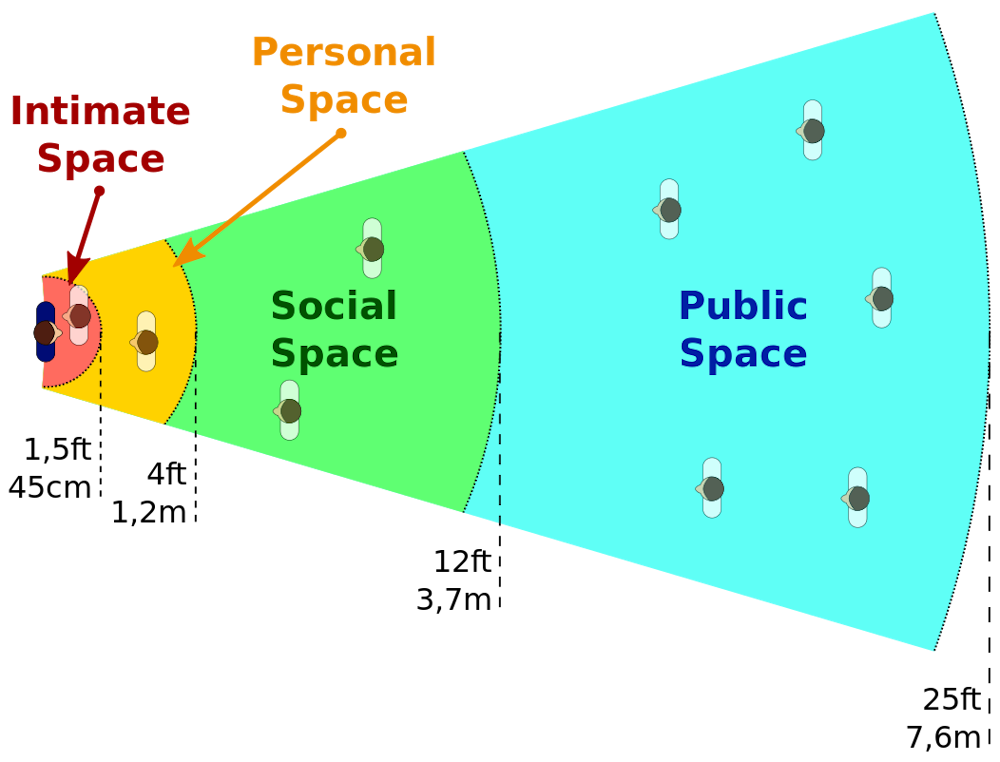
How comfortable you are being near to other people has a big cultural component. Anthropologist Edward T. Hall made a study of what he called proxemics, measuring personal space expectations around the world.
Pandemic response means the personal space bubble is now bigger than the previous norm.
Touching or whispering happens in the closest zone. From about 1.5 to 4 feet away is the distance reserved for communicating with friends. Now public health recommendations have extended that zone to 6 feet or more, the distance that had been normal for interactions with those you don’t know well.
When people violate proximity norms, it can feel like they’re invading your territory. And nowadays, the stakes are higher than just your personal comfort – these distance guidelines are meant to protect you from infectious germs.
Subconsciously, everyone knows the traditional spatial zones. The “wait here” foot emblems now found at a store’s checkout line are necessary to help rewrite the cognitive script for where you stand until it becomes a mindless habit. You are forced to “unlearn” subconscious behavior; old dogs must learn new tricks.
Strangers who invade your social distance are being aggressive if they’re aware of what they’re doing. But if it’s done mindlessly or subconsciously, then personality traits are helping drive the behavior.
For more than four decades, psychology researchers have divvied people up by personality types based on an individual’s combination of five key traits. They’re used to predict how people make purchases, behave at work, even long-term life outcomes like marriage stability and career achievement. Paul Costa and Robert McRae popularized the acronym OCEAN, for openness, conscientiousness, extroversion, agreeableness and neuroticism.
Everyone varies from high to low on each of the five personality traits.
An open individual is inclined to be curious, imaginative, creative, original, artistic and flexible. Openness reflects a tendency to think in abstract, complex ways. People high in openness tend to be adventurous and intellectual and enjoy the arts, while those on the opposite end of the spectrum tend to be practical, conventional and focused on the concrete. The more open your personality is, the better you might cope with uncertainty over a long, sustained period – as in the case of a global pandemic.
Conscientiousness is the tendency to be habitually careful, reliable, hard-working, well-organized and purposeful. A conscientious person controls, regulates and directs their impulses. They would likely be early adopters of mask-wearing, even without direction to do so. This trait makes someone less willing to violate territorial space and social distancing guidelines.
Extroversion is characterized by being outgoing and drawing energy from interacting with others, compared to introverts who get their energy from within themselves. Behavioral neuroscience research has revealed two subtypes of this trait.
Agentic extroversion is about being comfortable in the limelight and taking a leadership position. These people are less likely to feel a strong bond with others and have more interest in going for rewards in social or workplace contexts.
On the other hand, affiliative extroverts don’t seek out leadership roles as much and have close social bonds with a lot of people from which they gather happiness and meaning.
Both types of extroverts would likely enjoy virtual networking during isolation, while probably struggling with isolation if sheltering alone.
Agreeableness reflects compliance. It is the opposite pole of antagonism and reflects a tendency to be good-natured, acquiescent, courteous, helpful and trusting. People high in this trait would probably go along with mask-wearing right away and be more likely to follow social distancing guidelines as soon as they’re announced without grumbling about the rules.
Neuroticism is characterized by impulsivity and a tendency to experience negative emotions including anxiety, worry, fear, anger, depression or sadness, hostility, self-consciousness and loneliness. This trait is associated with wishful thinking and disengagement in order to escape feelings of distress. Presumably people high on neuroticism would tend to react to the pandemic with avoidance and denial.
The dark triad of personality traits
Personalities can have their dark sides, too.
Narcissism involves loving oneself obsessively; it goes along with grandiosity and vanity.
Machiavellianism is about manipulating others; it’s characterized by cynicism and long-term, calculating strategies.
Finally there’s psychopathy, meaning a lack of empathy. Psychopathic people are usually impulsive and have cold interpersonal relations. Individuals at the higher end of the continuum are deceptive, aggressive, sexually promiscuous and coercive.
All of these dark triad traits, as psychologists group them, would likely be associated with more social distancing violations.
Personality traits influence who’s fine with masks and who isn’t.
Everyone varies on all of those personality traits from high to low. It’s possible to deduce a personality profile for someone more likely to rampantly violate social distancing guidelines.
Pulling from meta-analyses of how personality affects pro-social behaviors, I’ve come up with this formulation. I have in mind coronavirus-mitigating behaviors in the U.S., but it could be tested cross-culturally and in other contexts.
Social distancing violator = Low openness + Low conscientiousness + Low agreeableness + High neuroticism + High Machiavellianism + High narcissism + High psychopathy + Error
My model predicts that a person who scores lower in openness, conscientiousness and agreeableness would be more likely to violate social distancing guidelines. Same for someone higher in neuroticism, Machiavellianism, narcissism and psychopathy.
The error term in the equation is a bit of a fudge factor; it represents all the variation in social distancing that is not explained by the personality traits. For example, political ideology influences social distancing compliance, with Republicans less likely to adhere to social distancing orders.
Psychology researchers are starting to collect data during the pandemic that supports this model. In one study, for instance, Pavel Blagov found that people with lower levels of agreeableness and conscientiousness were less likely to endorse health recommendations related to social distancing and hygiene during the coronavirus pandemic.
Personality is not fixed; it can evolve over one’s lifespan. As the coronavirus crisis drags on, I’ll be interested to see how adherence to social distancing guidelines changes over time – and wondering how much personality traits are changing too.
While dissecting Trump's latest remarks about the state of the economy, Camerota pointed out that there was something deeply illogical about what the president is pitching to voters.
Specifically, she said that the president is touting the state of the economy just as major cities across the country are beginning to shut down again.
"I heard the talking points going haywire," she said of Trump's answers. "I heard something malfunctioning."
CNN contributor Bakari Sellers then chimed in to say that incoherent talking points are the only thing Trump has left now that his administration has overseen a humanitarian catastrophe.
"We have a president who doesn't have the necessary level of compassion, empathy, or understanding to tackle this issue," he explained. "There are 130,000 people who have died because of this administration's incompetence, their utter incompetence, and he can't wrap his head around that."
He then pointed to several Trump-loving governors in states such as Georgia and Florida to illustrate that the problem went far beyond just Trump.
"The Republican Party has become a party that's enveloped itself in incompetence," he said.
The Lincoln Project released a new ad contrasting President Donald Trump's egregiously wrong predictions about the coronavirus pandemic with Dr. Anthony Fauci's warnings.
The White House has been attacking the infectious disease expert as the president's approval ratings sink, and the anti-Trump conservative group pushed back.
"In a time when truth is under assault, [Fauci] has always been straight with us," the ad says. "While Trump lied."
"Now Donald Trump is attacking Dr. Fauci," the ad continues. "Why? Because Trump failed America."
President Donald Trump is hearing mixed messages inside his own administration about focusing on the coronavirus pandemic.
The president and his campaign want to hold rallies in spite of the deadly virus, and his chief of staff Mark Meadows and son-in-law Jared Kushner are urging him to move on past COVID-19 and talk about what he'd do in a second term, but some administration officials have begged him to focus on the pandemic, reported Politico.
“If you solve the virus problem, almost everything else will solve itself,” said one senior administration official.
A solid majority of Republicans are increasingly concerned about the deadly virus, and more than a quarter of voters say the pandemic, and not the economy, is the top factor in deciding their choice in the election.
But the president and his campaign are desperate to get back in front of large crowds at rallies, although state and local officials have cautioned against that and Trump supporters themselves have proven reluctant to potentially expose themselves to the virus at those events.
“President Trump was a machine in 2016 and he wants to be that same candidate this cycle. Unfortunately, coronavirus has interfered with our plans to contrast his tremendous stamina with Sleepy Joe’s,” said a person involved with the president’s re-election.