Vice President Mike Pence traveled to Louisiana Tuesday to meet with Democratic Governor John Bel Edwards and the state’s two Republican Senators to share his message about the importance of opening all schools in the fall. Not on the tarmac in Baton Rouge when Air Force Two landed at 11:13 AM was the Bayou State’s Tea Party Republican Attorney General Jeff Landry, who tested positive for coronavirus before he was slated to greet the vice president.
“Out of an overabundance of caution with the Vice President coming to our state, I was tested for Cornavirus,” Landry told the state’s Dept. of Justice employees via email, Louisiana’s The Advocate reports. “Though experiencing no symptoms, I tested positive for COVID-19.”
Attorney General Landry has opposed measures to protect the people of Louisiana from the deadly virus, and the statistics show his efforts are not working.
While Louisiana is only 25th out of America’s 50 states in population, it ranks 12th in coronavirus cases, with 82,051. Worse, coronavirus is exploding across the state. In per capita cases the state ranks third.
Louisiana ranked eighth on Monday in new cases, with 2,224.
And in total deaths Louisiana ranks tenth, with 3,428.
Gov. John Bel Edwards, who lost an aide to the coronavirus, has tried to reduce the infection rate, but his efforts have been undermined by the Attorney General.
Last month Landry declared Governor Edwards’ order to ban live indoor music in response to the coronavirus pandemic was unconstitutional.
In May, GOP lawmakers turned to Landry to help them craft legislation “squashing” Governor Edwards’ stay-at-home order, The Advocate also reported.
Also in May Landry “urged” the Governor to re-open barber shops and salons, saying there are “thousands of licensed cosmetologists in our State; many are independent contractors who have no other source of income and are struggling to make ends meet.”
In late April he “encouraged” Gov. Edwards to allow churches, which have been major spreading sites, to re-open.
Previously, Landry promoted President Donald Trump’s fraudulent claims by “securing” “8,000 packs of azithromycin and 75,000 tablets of hydroxychloroquine sulfate … in addition to the 400,000 tablets of hydroxychloroquine directly donated by Amneal Pharmaceuticals last week.”
NEW YORK — Surveillance video released Tuesday of the vandal who defaced the massive Black Lives Matter mural in front of Manhattan’s Trump Tower shows he dumped an entire can of red paint before fleeing. Police are asking the public’s help identifying the culprit and tracking him down. The man, wearing a black baseball hat with white lettering, sunglasses and a surgical mask, approached the mural on Fifth Avenue near West 57th Street in Midtown about 12:15 p.m. Monday, pulled an open can of red paint from a paper bag and emptied the can onto the “V” in LIVES, the video shows. He emptied the can’...
The ACLU is demanding the appointment of a special prosecutor to investigate a violent police assault last month on peaceful Black Lives Matter demonstrators near the White House—a crackdown reportedly ordered by Attorney General William Barr.
"The suspect can't be the investigator," the ACLU the tweeted. "We need a full investigation independent of Barr."
The group sent a letter (pdf) Tuesday morning urging Barr and other Justice Department officials involved in the law enforcement crackdown to recuse themselves from any investigation into the June 1 incident, which came amid nationwide demonstrations over the police killing of George Floyd.
"On that day, at approximately 6:25 pm, federal and other government forces attacked peaceful protesters and journalists covering the event without warning and unprovoked, used tear gas, flash bang grenades, and rubber bullets to drive the crowd out of the public park they lawfully occupied," the letter reads.
"These actions were an unconstitutional violation of protesters' right to speak, assemble, and petition the government under the First Amendment and to remain free of unreasonable seizure under the Fourth Amendment," the letter continues. "You must take all necessary steps to ensure that you and others involved in the ordering and carrying out of the use of force have no role in the appointment or supervision of the special counsel."
Barr last month denied ordering law enforcement officials to push back the security perimeter outside the White House to clear the way for President Donald Trump's walk to St. John's Church for a photo-op.
But anonymous Justice Department officials and White House Press Secretary Kayleigh McEnany told the media that Barr personally made the order that resulted in the violent crackdown on peaceful demonstrators.
"When A.G. Barr came to the White House—I think it was early afternoon—he noticed that it hadn't been cleared, gave the order for it to be cleared, and that action took place," McEnany said during a June 3 press briefing.
Kate Ruane, ACLU senior legislative counsel, said in a statement Tuesday that "Barr and other administration officials appear to have criminally conspired to violently attack lawful demonstrators and all signs indicate they have since been engaged in a concerted cover up effort."
"History books will certainly remember Bill Barr for the crimes of the Trump administration, but a full, independent investigation now is necessary to hold him and any other officials who may be responsible for this chilling incident accountable today," said Ruane.
Ben Garrison, a Trump-loving conservative political cartoonist, has filed a lawsuit against the Anti-Defamation League for labeling some of his work as anti-Semitic.
At issue is a cartoon that Garrison drew in 2017 that depicted former Trump national security adviser H.R. McMaster as puppet whose strings were being pulled by George Soros and an even larger hand that was labeled, "Rothschilds."
The lawsuit then claims that Garrison cannot be anti-Semitic because conspiracy theories about Soros and the Rothschilds are real.
"Prior to publication of the ADL Article, ADL knew that the Rothschilds controlled Soros and that Soros controlled McMaster," the lawsuit states. "ADL also knew that Garrison’s cartoon was not anti-Semitic and knew that Garrison was not anti-Semitic."
The lawsuit also complains that the Trump White House rescinded an invitation for him to visit after the ADL accused him of anti-Semitism -- and in part because of this, he "seeks money damages for the insult, embarrassment, humiliation, mental suffering, anguish, injury to his name and professional reputation, and loss of business caused by the ADL’s defamation."
President Donald Trump desperately wants to turn the page on the coronavirus pandemic that's killed more than 138,000 in the U.S. and threatens to sink his re-election -- but even his staunchest allies won't let him move on.
A growing number of Trump's reliable allies are undermining White House talking points on the deadly pandemic that's rapidly spreading across the South and West, and Republicans are joining the calls for more testing and other measures the president opposes, reported Politico.
"What he can do, what the president can do, and what his administration can do is make sure [tests] aren't an issue," said "Fox & Friends" host Brian Kilmeade. "I mean, it's been four or five months. It should not be an issue."
Former White House chief of staff Mick Mulvaney complained Monday in an op-ed that delays for testing results encountered by his family were "simply inexcusable," and Florida Gov. Ron DeSantis has changed his tone as the virus overruns his state's hospitals.
“I know many Floridians are filled with apprehension as they wonder, you know, what does this mean," DeSantis said Monday, one day after the state recorded 15,000 new cases. "What do these trends mean for our health, for our families, and for our jobs? How long is this going to go on for? What’s going to happen with things like kids being in school?”
“I hear you," he added, "and I along with our federal partners, our local leaders, and our great medical community, we’re working nonstop to be able to respond to this crisis."
Many prominent Republicans have expressed skepticism about attending the GOP convention next month in Jacksonville, Florida, and conservative elected officials and activists are concerned about the White House push to reopen schools on time.
“We don’t want a reemergence," said Rep. Chris Smith (R-NJ). "We don’t want young people getting sick or bringing it home to their parents, or the teachers, some of whom are upwards in their age risk who could also be at further risk of contracting the disease."
“Yes, I want kids to go back to school," Smith added, "but if, and only if, and I say that with capital letters, it is safe."
The Republican National Convention in Jacksonville, Florida is a little over one month away, and one of Florida's GOP senators seems to support canceling.
Sen. Marco Rubio (R-FL) launched a "coronavirus" section of his official U.S. Senate account where he advocated people wearing masks, staying socially distant, and people gathering in groups of no more than 10.
"Practice social distancing. Avoid gatherings of 10 or more people, and steer clear of bars, restaurants, and other areas where large numbers of people congregate," his site says.
That seems to fly in the face of the GOP's decision to continue holding a Republican convention even if it is dangerous.
Florida has been hitting records of coronavirus cases over 15,000 and 16,000 per day and hospitalizations have also increased as well. An increase in cases generally predicts an increase in deaths and Florida has slowly been growing more deadly. Last week, the state hit a record for COVID-19 deaths at 120 in just one day. That was surpassed Tuesday with 132 new deaths in a single day.
To make matters worse, testing is becoming a problem.
"The state received significantly less tests Monday (67,160) than it did the two days prior (255,231 combined). Of the total tests received, 18.31% were positive. This includes people tested multiple times," WFLA reported.
Rubio said over the weekend that the cost of not reopening schools in August is "extraordinary," even if there is a giant surge in cases.
He acknowledged that there are risks of death if schools reopen, but not going to school is a bigger deal.
Sen. Lindsey Graham (R-SC) this week defended the federal government's top infectious disease expert after President Donald Trump and the White House put out statements defaming him.
The Republican senator praised Fauci as "one of the smartest people I know."
"Has he been right all the time? No," Graham said. "We don't have a Dr. Fauci problem. We need to be focusing on doing things to get us where we need to go. So, I have all the respect in the world for Dr. Fauci."
Graham added: "I think any effort to undermine him is not going to be productive, quite frankly."
A Michigan man has been shot and killed by an Eaton County deputy on Tuesday after he stabbed an elderly man who confronted him in a store for not wearing a mask, the Detroit Free Press reports.
Sean Ernest Ruis, 43, was confronted by a 77-year-old male customer for not wearing a mask inside the store. The argument continued outside in the parking lot, where Ruis stabbed the man and then fled on foot. The victim, whose name has not been released, is reportedly in stable condition.
Later that morning, Ruis was pulled over by an Eaton County deputy. Ruis then exited his vehicle carrying a knife and ignored the deputy’s warnings to drop it, police said, ultimately prompting the deputy to open fire. Ruis later died at the hospital.
The incident took place just two days after Michigan Gov. Gretchen Whitmer ordered that masks must be worn inside Michigan businesses.
A New York couple pointed guns at protesters marching past their house during a Black Lives Matter rally, and activists want them to be charged.
Protesters were nearing the end of their parade route when a white man came out of his home shouting obscenities in an apparent attempt to incite the group, and then yelled to his wife to get his gun, reported WNYT-TV.
Hudson Mayor Kamal Johnson, who took part in the march, said the woman came back outside and started waving the gun around.
State police were already at the scene to watch over the demonstration, and Johnson said troopers followed the woman into her home and returned with a gun.
The man and woman were placed inside a patrol car, but Johnson wondered why they weren't handcuffed.
Johnson asked an officer why the couple wasn't being charged, but he said the officer refused to answer and did not say whether the gun was illegal.
Some activists have pressed charges against the couple, whose names have no been released.
“We had several, several protesters who pressed charges for the menacing that they went through," said activist Lukee Forbes. "We also had several videos and pictures delivered to the police officers, and yet they tell us that they’re still doing an investigation."
The incident remains under investigation, according to police.
A columnist for an Australian newspaper has been watching the United States' response to the novel coronavirus with a mix of shock and horror -- and he now believes "we are witnessing the fall of a great power."
"Look at the U.S. now," he writes. "Its president is so psychiatrically disordered with narcissism that he is incapable of dealing with the COVID-19 crisis in a coherent, empathetic way. Everything he says and does is through a prism of himself. He has now turned his whole re-election campaign into one of race hate, law and order and a bizarre invention of a threat from 'left-wing fascists.'"
However, Hull cautions Americans that merely getting rid of Trump this fall will not instantly fix what ails the nation.
"The underlying weakness in present U.S. democracy is that partisanship has become so extreme that the nation is incapable of dealing with the major issues that face it," he writes. "COVID-19 has illustrated that starkly, with every word and act predicated on party allegiance. Meanwhile, other problems like race, police violence, gun control, inequality, the health system, climate change and energy policy go unattended."
This is a headline I hoped to not see again after the number of coronavirus infections had finally started to decline in the Northeast and Pacific Northwest. However, the pandemic has now shifted to the South and the West – with Arizona, Florida, California and Texas as hot spots.
At the same time, cases, hospitalizations and the percentage of positive tests in Northeastern states have declined. New York Gov. Andrew Cuomo recently declared, “We now have the lowest transmission rate in the United States of America.” In fact, there are now more daily hospitalizations in Arizona than in New York, Pennsylvania and the entire Northeast combined.
What explains the difference?
My physician colleagues and I have learned a lot since a mysterious respiratory virus first appeared in mainland China over six months ago. We can now rattle off stats about the coronavirus as if we were sports commentators. It spreads through droplets and aerosols. It binds to ACE-2 receptors in the lungs. It can last on certain surfaces up to 72 hours. It can cause loss of taste and smell.
We could go on and on if you pressed us, but the most important thing we have learned is how it spreads and how to slow it down. A critical piece of that – and a key difference between the Northeast today and many of the areas where coronavirus is spreading now – is people’s behavior.
Hard-hit states quickly learned value of masks
As a respiratory virus, SARS-CoV-2 is transmitted mainly through droplets that leave the mouth and nose as a person talks, sneezes, coughs or exhales. It thrives in environments where there are lots of people in enclosed spaces – especially if they are laughing, talking, singing or otherwise coming into close contact. It thrives physically in the same settings where we thrive socially.
This is why the early hard-hit areas were able to crush the curve by closing businesses and implementing stay-at-home orders. Without significant close human interaction, the coronavirus couldn’t spread.
While other states are now seeing hospitals fill with COVID-19 patients, most of the Northeast is maintaining control of community spread as its economies reopen. The difference reflects, at least in part, each state’s behavior expectations and the willingness of residents to keep up safety precautions like wearing masks, avoiding large crowds, maintaining social distance of at least six feet and staying isolated when they are ill or may have been exposed to the virus.
Rhode Island is an example. When the state began allowing businesses to reopen in early May, Gov. Gina Raimondo said success would depend on how people behaved – if they continued social distancing and wearing masks. Rhode Island is small, but it sits in the middle of the busy New York-Boston corridor. It was one of the first states to close businesses and schools, and one of the first to require people to wear face masks in public places. To locate the virus and stop its spread, it launched partnerships to make testing widely available and developed a contact tracing program with regular check-ins through a phone app. It also required travelers to self-quarantine for 14 days.
“We have to embrace new ways of living our lives,” Raimondo said in May.
In many parts of the Northeast, the months of illnesses, deaths and the struggle to turn the COVID-19 tide are still fresh in people’s minds. The progress isn’t uniform, however. New York City’s mayor has expressed concern about an uptick in positive cases among people in their 20s.
The problems of a political divide
Elsewhere in the country, the current surge in COVID-19 cases began to pick up after Memorial Day weekend, when people in several states that hadn’t seen the same toll from the pandemic let their guard down. Video and pictures showed parties, barbecues, crowded beaches and political rallies – all with very little social distancing or mask-wearing – giving more fuel for the coronavirus to spread.
Despite the overwhelming evidence for what we should be doing, following the advice of public health experts has also, sadly, become politicized. Depending on the news sources people listen to, they might hear warnings from health officials being taken seriously or being dismissed by pundits and politicians.
A recent national poll shows that Democrats report consistently wearing a mask 68% of the time, while Republicans reported doing the same only 34% of the time. The national conversation has devolved into a false dichotomy: Either you’re on the side of prioritizing safety or you’re on the side of personal freedom and opening the economy.
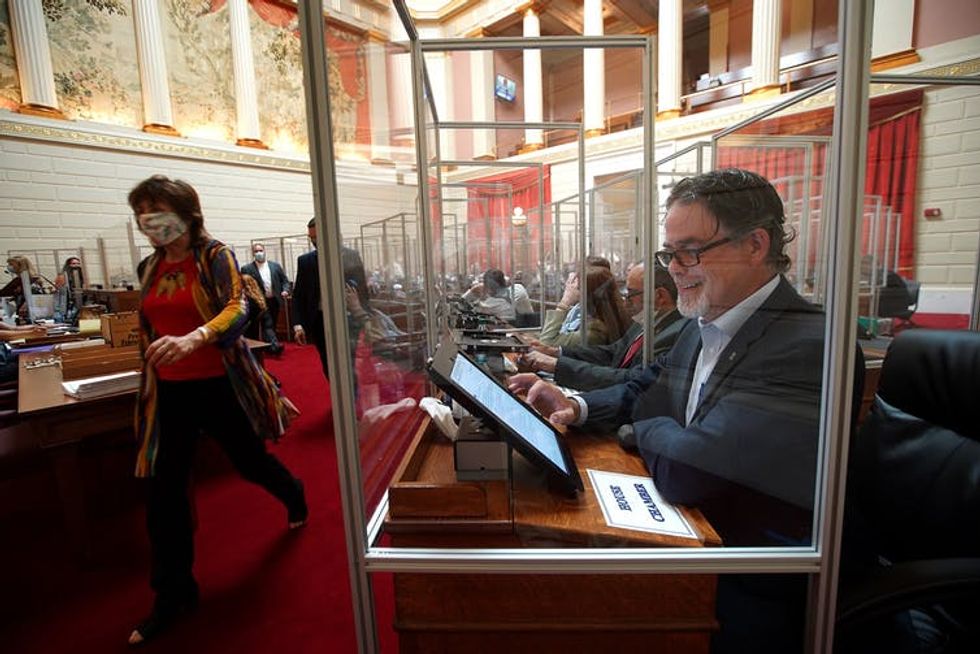
When the Rhode Island General Assembly returned on June 17, 2020, plexiglass separated the desks as a coronavirus precaution. Republican Rep. Michael Chippendale was among members without a mask on.
In reality, the two should be partners, as these preventative measures are the best tools we have to reach our common goals of reopening businesses and schools safely. It’s the same reason we stop at stoplights and go through metal detectors at the airport – we make a small sacrifice for the greater public good.
For the foreseeable future, Americans will have to collectively agree to live life a little differently. Until we can all agree on this, the coronavirus will continue to have the upper hand, and our health and wealth will suffer.
Last week it was revealed that nearly one-third of Americans couldn't pay their mortgages or their rent. It's the third month in a row with over 30 percent of American renters and homeowners showing that they're in trouble, despite the stimulus check from Washington.
Tuesday, the Wall Street Journal wrote that the largest bank in the United States, JP Morgan Chase, put aside $10 billion, anticipating that the numbers of home loan defaults are going to get far worse.
"The pandemic also took a toll on two other big U.S. lenders," said the Journal. "Wells Fargo & Co. posted its first quarterly loss in more than a decade and socked away $9.57 billion to prepare for a wave of loan defaults. Citigroup Inc.’s second-quarter profit fell 73%, weighed down by the $7.9 billion the bank set aside for an expected increase in soured loans."
JP Morgan Chase CEO Jamie Dimon explained that the 2020 economic crisis “is not a normal recession.”
"The recessionary part of this you’re going to see down the road," he said.
Whatever stimulus, unemployment and help the Congress can deliver are what is keeping things stable for now.
"JPMorgan’s outlook for the economy has darkened since the bank reported first-quarter earnings, and its increased loan-loss provisions reflect that view," said the Journal. "The bank put aside extra to prepare for unemployment to remain above 10 percent through the first half of next year, said Chief Financial Officer Jennifer Piepszak."
Their models are predicting a wave of mortgage defaults coming up in the next year, particularly if the economy continues to take a hit as the virus resurges and has a second or third wave.
"The biggest portion of the quarter’s provision—$5.83 billion—came from the consumer bank, while $2 billion came from the corporate and investment bank and another $2.43 billion came from the commercial bank," said the Journal. "In the consumer and small-business banking operations, revenue fell 9 percent and the provisions it set aside for loan losses sent it to a $176 million loss. Spending volume on the bank’s credit cards fell 23 percent."
It isn't a promising prediction of the future of the American economy.
For those seeking to tackle climate change and get a fast food fix, Burger King has the answer -- a Whopper from cows that fart and burp less.
The fast-food giant announced Tuesday that select restaurants in five US cities -- New York, Miami, Portland, Los Angeles and Austin, Texas -- would be serving Whoppers made from "reduced methane emissions" beef.
The chain says that adding just 100 grams of lemongrass leaves to a cow's diet late in life could reduce their output of methane, a greenhouse gas responsible for global warming.
Initial study results revealed an up to 33 percent reduction in methane emissions from cows on the new diet in the last three to four months of their lives, Burger King said.
"At Burger King, we believe that delicious, affordable, and convenient meals can also be sustainable," said global chief marketing officer Fernando Machado.
But the company, which worked with two scientists on the project, said it hopes to inspire other groups to make similar moves by making their findings public.
"If the whole industry, from farmers, meat suppliers, and other brands join us, we can increase scale and collectively help reduce methane emissions that affect climate change," Machado said.
Burger King had already moved to respond to changing tastes of environmentally conscious customers who limit their meat intake by offering a vegetarian Whopper last year.