Fears continue to grow about the spread of COVID-19 coronavirus in the United States.
Rep. Alexandria Ocasio-Cortez (D-NY) warned of one particular way the virus could spread in America. Before becoming the youngest woman ever elected to Congress, Ocasio-Cortez was a hospitality industry worker.
"I can’t tell you how many times the people who handle your food -- who are already overworked and underpaid -- show up sick to work because our country refuses to guarantee healthcare or paid sick leave," the former bartender noted.
The solution, AOC said, is passing Medicare for All, the single-payer health care proposal that has been a major topic during the 2020 presidential debate.
New coronavirus cases surged outside of China on Tuesday, leaving an Iranian deputy minister among the stricken and triggering mass disruption as a top health official warned the world is not prepared for containing the epidemic.
Even as the number of fresh cases declines at the epicentre of the disease in China, there has been a sudden increase in parts of Asia, Europe and the Middle East.
Towns and cities in different parts of the world have been sealed off in an attempt to stop the contagion, while hotels in the Canary Island and Austria were locked down on Tuesday because of suspected cases.
AFP / JEAN-PHILIPPE KSIAZEK Security personnel after sealing an area at the Lyon Perrache train and bus station in France, after the blocking of a bus arriving from Milan, Italy and suspected of carrying the new coronavirus
In Iran, which has reported 15 deaths out of nearly 100 infections, even the country's deputy health minister Iraj Harirchi said he had contracted the virus.
At the World Health Organization (WHO) headquarters in Geneva, Bruce Aylward, who headed an international expert mission to China, hailed measures taken there but told reporters that other nations were "simply not ready" for reining in the outbreak.
"You have to be ready to manage this at a larger scale... and it has to be done fast," Aylward said.
- Travel and trade routes -
The virus has killed more than 2,600 people and infected over 77,000 others in China. In the rest of the world, there have been more than 40 deaths and 2,700 cases.
The disease has now reached dozens of countries, with Austria, Croatia and Switzerland the latest additions on Tuesday.
Iranian Presidency/AFP / - Iran's deputy health minister Iraj Harirchi said that he was among nearly 100 infected by the COVID-19 illness in his country
The epidemic's disruption has also grown, with stock markets tumbling around the world, restrictions imposed on travellers and sporting events cancelled.
The WHO, the UN health agency, has called for countries to "prepare for a potential pandemic" -- a term used to describe an epidemic that spreads throughout the world.
Poor countries are particularly at risk, the WHO has warned.
- Gulf cuts links to Iran -
In the Middle East, Iran has emerged as a major hotspot.
The death toll -- the deadliest outside China -- rose to 15 on Tuesday when three more people succumbed to the disease, officially known as COVID-19.
The country has been scrambling to contain the epidemic since last week when it announced its first two deaths in Qom, a centre for Islamic studies and pilgrims that attracts scholars from abroad.
FARS NEWS AGENCY/AFP / MEHDI MARIZAD Iran has been scrambling to contain the epidemic -- a worker is pictured disinfecting the Masumeh shrine in Qom
US Secretary of State Mike Pompeo, whose country came to the brink of war with Iran earlier this year, said Washington is deeply concerned Tehran "may have suppressed vital details" about the outbreak there.
Gulf countries announced new measures to cut links with Iran in an attempt to stop the spread.
The United Arab Emirates suspended passenger and cargo flights to Iran, while Bahrain closed schools and nurseries for two weeks. This came after the Gulf states of Kuwait and Bahrain announced additional cases.
- Games off -
South Korean President Moon Jae-in warned that the outbreak was "very grave". His country's death toll rose to 10 and the number of confirmed infections approached 1,000 -- the largest total outside China.
AFP / Jung Yeon-je People buy face masks at a retail store in the southeastern city of Daegu, South Korea
Scores of events, including K-pop concerts, have been cancelled or postponed in the world's 12th-largest economy.
Parliament closed for cleaning on Tuesday after confirmation that a person with the coronavirus had attended a meeting there last week.
More than 80 percent of the infections have been in and around Daegu, South Korea's fourth-largest city.
AFP / Miguel MEDINA With police manning checkpoints to enforce a blockade, Italian Prime Minister Giuseppe Conte has said that residents could face weeks of lockdown
In Japan, a fourth former passenger of the coronavirus-stricken Diamond Princess cruise ship died, a health ministry official said.
Nearly 700 people from the quarantined ship have tested positive for the illness so far. Infections have also spiked in Japan, with at least 164 cases including one death.
AFP / Laurence CHU Spread of the coronavirus
Italy -- which has reported 10 deaths and more than 300 cases -- has locked down 11 towns. Prime Minister Giuseppe Conte has said the measures could last weeks.
A young man who returned to Croatia from Italy became the first case in the Balkans region.
Upcoming football matches in Italy's Serie A and the Europa League will be played to empty stadiums.
A major rugby match could also be affected. Ireland's government recommended cancellation of next month's Six Nations clash against Italy in Dublin.
In Venice, production of the latest "Mission: Impossible" film starring Tom Cruise was stopped.
And in the United States, which has 57 cases, health authorities significantly escalated the level of threat being conveyed to the public, saying they ultimately expect the new coronavirus to spread more widely there.
"It's not so much a question of if this will happen anymore, but rather more a question of exactly when," said Nancy Messonnier, a senior official with the Centers for Disease Control and Prevention, urging local governments, businesses and schools to develop plans.
Wall Street stocks sank deeper into the red, following a slide in European markets.
"Bit by bit, US investors are seeing the prospects for global growth diminish," said Gregori Volokhine of Meeschaert Financial Services.
Swiss food giant Nestle postponed all business trips until mid-March because of the virus.
- China returning to business -
In China, though, the epidemic appears to be slowing -- and the country is gingerly returning to business.
More cars are on the streets of Beijing, factories are resuming work, Apple is reopening several stores, and some regions are relaxing traffic restrictions.
But schools remain closed, the capital has a mandatory 14-day quarantine for returning residents, and authorities are keeping about 56 million people in Hubei Province -- the hub of the outbreak -- under lockdown.
Photo: A Chinese security guard wears protective clothing outside a restaurant in Beijing
COVID-19 coronavirus is already impacting the 2020 Democratic presidential nomination contest.
"US citizens living in China have been told they won’t be able to cast their votes in person for the Democratic primary next month and will instead need to vote online, according to Democrats Abroad, the group in charge of overseeing voting overseas," BuzzFeed News reported Tuesday.
The virus has sickened over 80,000 people and claimed 2,700 lives.
"And as the coronavirus outbreak has spread to 38 countries, triggering concerns about a global pandemic, CDC officials warned on Tuesday that they expect the virus to spread to the US, and told US businesses and schools to prepare," BuzzFeed noted. "The news raises questions about whether the coronavirus outbreak could interrupt the lead-up to the biggest national event of the year: the 2020 election."
There are also worries about coronavirus impacting this summer's national conventions.
"When asked about whether they had any contingency plans for this year’s Democratic National Convention in Milwaukee in July, which is run by the DNC and typically features thousands of delegates and party members, they declined to comment. (The Republican National Committee did not respond to similar questions about planning for their August convention in Charlotte)," BuzzFeed noted.
The DNC did comment on the closing of polling places in Shanghai and Beijing.
"Our number one concern is to ensure all eligible voters are able to make their voices heard without jeopardizing anyone's health and safety,” DNC spokesperson Maya Hixson said. “Democrats Abroad has robust systems in place so that members can still exercise their right to vote, and we are working with them as the situation develops."
Iran's deputy health minister confirmed on Tuesday that he has tested positive for the new coronavirus, amid a major outbreak in the Islamic republic.
Iraj Harirchi coughed occasionally and wiped sweat from his brow repeatedly during a news conference in Tehran on Monday with government spokesman Ali Rabiei.
At the time, he denied a lawmaker's claim that 50 people had died from the virus in the Shiite shrine city of Qom, saying he would resign if the number proved accurate.
In a video broadcast on state television, the deputy minister put on a brave face as he admitted he was infected.
"I too have been infected with coronavirus," Harirchi said in the video apparently shot by himself.
"I had a fever as of last night and my preliminary test was positive around midnight," he said.
"I've isolated myself in a place since. A few minutes ago, I was told that my test was final, and now I am starting medication.
'Virus does not discriminate'
"I wanted to tell you that... we will definitely be victorious against this virus in the next few weeks," Harirchi declared.
But he warned Iranians to be careful as the "virus does not discriminate" and infects anyone, regardless of their standing.
Following news of Harirchi's infection, government spokesman Rabiei, who stood by his side on Monday, appeared at another news conference on Tuesday with the country's industries minister and other officials.
A prominent Iranian reformist politician, Mahmoud Sadeghi, also announced he had tested positive for the virus.
"My coronavirus test was positive. I send this message but I don't have much hope of staying alive," Sadeghi said in a tweet.
He used the occasion to call on the judiciary to provide prison leave time to those detained over political and security charges so that "they can go through this epidemic with their families".
Iran confirmed three more deaths and 34 new infections on Tuesday, taking the country's overall death toll to 15 and infection tally to 95.
The Islamic republic has been hit by the deadliest coronavirus outbreak by far outside China, the epidemic's epicentre.
Quarantine an 'old method'
According to the health ministry, most of the deaths and infections outside Qom are among people who have recently visited the holy city.
The ministry's spokesman Kianoush Jahanpour said 16 of the new cases were confirmed in Qom, while nine were in Tehran, and two each in Alborz, Gilan and Mazandaran.
The virus appeared to be spreading to new parts of Iran, as one new case was also reported in the provinces of Fars and Khorasan Razavi, as well as Qeshm island.
Despite being the epicentre of the outbreak in Iran, Qom has yet to be quarantined.
Health Minister Saeed Namaki defended the decision on Tuesday and said that quarantine was an "old method".
"We still do not agree with quarantining cities since we believe the people are cultured enough to refrain from travelling from infected cities to other places," semi-official news agency ISNA quoted him as saying.
WATCH:
Photo: Iranian health minister Iraj Haririchi (Screen Capture)
Top samba "schools" in Brazil's Carnival capital Rio de Janeiro paraded for a second night on Monday, peppering the annual sizzling fusion of music, dance and costume with jabs at the country's president, Jair Bolsonaro.
The last six of the city's 13 top samba schools took to the "sambodromo", or Sambadrome, with hundreds of colorfully dressed and some scantily clad dancers and musicians parading behind huge, elaborate floats designed around a broad theme.
Monday's parades, which ran well into the early hours of Tuesday, touched on many themes, among them Bolsonaro, who has cut a controversial and divisive figure since being sworn into office in January last year.
Brazilian actor and comedian Marcelo Adnet starred in the Sao Clemente school's parade dressed up as Bolsonaro, mockingly doing push ups, saluting, and firing an imaginary gun with his fingers, all of which the ex-army captain has done in public during his presidency.
The Sao Clemente float also displayed placards with the words "It's OK?!", a popular Bolsonaro phrase, and "It was Leonardo di Caprio", a reference to Bolsonaro blaming the Hollywood actor for the Amazon rainforest fires last year.
Since Bolsonaro took office in January 2019, Brazilians have been sharply divided, with supporters crediting him for a rapid drop in violent crime and an improving economy, while critics have denounced his racism, sexism and stance on the environment.
On Sunday the famed Mangueira samba school took aim at the national rise in right-wing religious fervor and surge in police violence, in Rio in particular, in Bolsonaro's first 14 months.
Mangueira's song included a line about "No messiah with a gun in his hand", a reference to Bolsonaro, whose middle name is 'Messias' and who advocates more widespread gun ownership.
The costumes, floats and choreography of Rio's samba school may change, but they are always sparkling and spectacular, often taking all year and over $2 million to put together.
Each year the top 13 samba schools parade through the Sambadrome in front of up to 90,000 locals, tourists and VIPs partying in the steep, concrete stands and hospitality suites that line the 700-meter (2,300-ft) venue.
The judges' verdicts are announced on national television on Ash Wednesday.
The 90,000-capacity Sambadrome was designed by revered architect Oscar Niemeyer and constructed in 1984.
Juliette Kayyem, the former U.S. Assistant Secretary of Homeland Security for Intergovernmental Affairs for President Barack Obama, warned last year that President Donald Trump's obsession with the U.S./Mexico border would ultimately make American's less safe because he was taking his eye off the ball in other ways.
Speaking to The Atlantic in April 2019, Kayyem explained that Trump's relentless focus on immigration was a myopic understanding of how Homeland Security works.
“What you’re seeing is the second pivot, where Trump views it solely as a border-enforcement agency,” said Kayyem. “It means that all these other things—climate change, terrorism, election security—all of those things become irrelevant next to the border enforcement and wall. We’re like we were after 9/11, when all we focused on was stopping 19 guys from getting on four airplanes.”
As the coronavirus makes landfall in the United States, Kayyem's prediction is coming to fruition. The virus has a death rate of 2 percent, according to the National Institute of Health, where the flu has a 0.1 percent fatality rate.
In a Twitter thread, Kayyem is now urging people not to panic. She also predicted that the White House would likely trade between freaking out or tuning out any reality of the virus. The White House has had at least two months to prepare for the contagion and a possible pandemic. They chose to trust China would contain it.
"That bought time, not bad, but that's not a strategy," she said.
After grilling acting Department of Homeland Security Secretary Chad Wolf through the morning, Kennedy and other Republicans had lunch with Attorney General Bill Barr. When Fox News reporter Chad Pergram asked the Louisiana senator about the coronavirus, Kennedy lamented that he can't get a straight answer out of Trump's team.
"GOP LA Sen Kennedy on coronavirus. Says he's 'getting different answers from different officials' on how long to prep a vaccine. Says he was told before they were 5 months away. Were told this morning it was a year and a half."
The Center for Disease Control is already saying that Americans should prepare for disruption in their daily lives. They told Americans to expect things "such as closing schools, canceling mass gatherings and requiring employees work from home," to stave off the disease.
Coronavirus has a 2 percent fatality rate. To put that in context, the flu has a 0.1 percent fatality rate, with 16,000 people who died and 280,000 people hospitalized during the 2019-2020 flu season, ABC News reported.
Sen. Patrick Leahy (R-VT) attacked the White House, saying that they were a day late and a dollar short. The White House wants over $1 billion, but won't say who is in charge of the work for
They want over a billion dollars..& they won't say who's in charge of doing anything..it lacks any real thought of planning it seems to be more for a press release that they're doing something.
President Donald Trumpkicked off his first official visit to India by addressing a rally of more than 100,000 people on Feb. 24 in Indian Prime Minister Narendra Modi’s home state of Gujarat.
Trump promised the thousands of cheering Indians who greeted him “an incredible trade deal” and “the most feared military equipment on the planet.”
Accompanied by first lady Melania Trump, he then toured Sabarmati ashram, where Mahatma Gandhi lived for 13 years. Afterwards, Trump visited the Taj Mahal, a 17th-century mausoleum built by an Indian emperor for his beloved wife.
Trump and Modi have built a personal rapport. The U.S. president’s 36-hour visit to India – named “Namaste Trump” – is seen as India returning the favor for “Howdy Modi” – a rally in Texas in fall 2019, where the two leaders appeared together.
I am a scholar who studies U.S. foreign policy toward India. In the past, U.S. administrations concerned with boosting trade with India have celebrated the two countries’ shared commitment to democracy and human rights. Under the Trump administration, I argue, the relationship is in danger of becoming purely transactional.
Departing from the past
Over the past several decades, American presidents, regardless of political affiliation, have reaffirmed the shared values that have bound the two states.
In 1977, President Jimmy Carter visited India shortly after Prime Minister Indira Gandhi lost an election. Gandhi had declared a state of emergency in India, ruthlessly curtailing civil rights and personal liberties. Carter opposed providing U.S. nuclear fuel to India because India had conducted a nuclear test in 1974, arguing that it had violated the spirit of a prior agreement.
Nevertheless Carter went out of his way to laud India for its ability to restore democratic practices, following the state of emergency. Several decades later, a president of a wholly different ideological leaning, George W. Bush, adopted a markedly similar stance when hosting Prime Minister Manmohan Singh for a state visit in Washington.
When introducing his visitor to his wife Laura Bush, the U.S. president famously celebrated the absence of religious extremism in India, calling it “a democracy which does not have a single al-Qaeda member in a population of 150 million Muslims.”
U.S. President George W. Bush and Indian Prime Minister Manmohan Singh, with first lady Laura Bush and Singh’s wife, Gursharan Kaur.
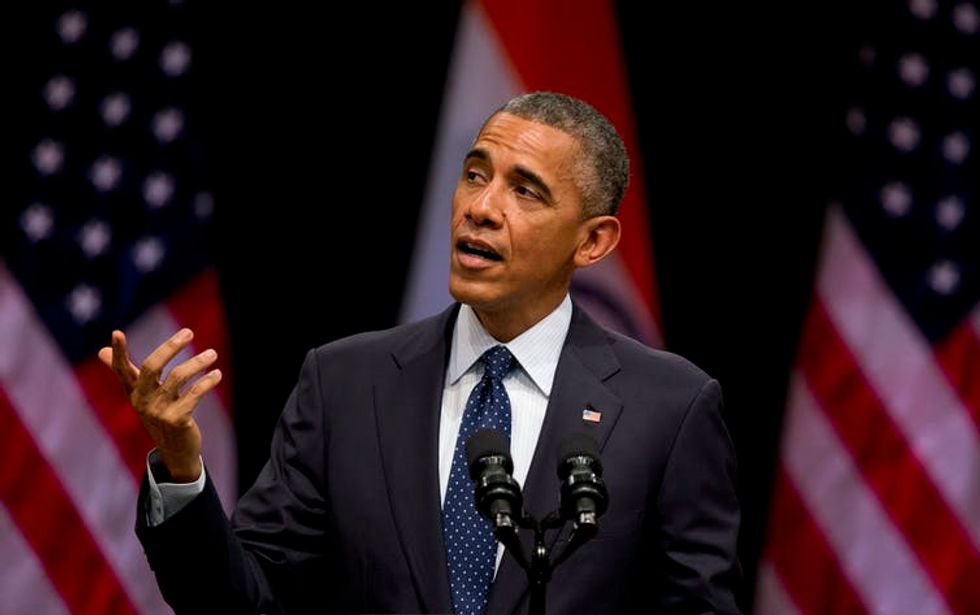
After President Barack Obama’s second visit to India in 2015, he criticized India’s failure to uphold human rights during Prime Minister Modi’s first term in office.
“Every person has the right to practice his religion or not to practice it if they choose so without persecution,” Obama stated in a speech in Mumbai shortly before his departure from India on Jan. 27, 2015.
President Barack Obama during his second visit to India in 2015.
Trump’s visit diverges from this past of U.S. presidents alternately celebrating and critiquing democracy in India. Trump seems to be focused on material issues – primarily India’s increasing spending on U.S. military supplies.
In recent years, defense and military sales relationship with India have been burgeoning, growing some 557% between 2013 and 2017 over the previous five-year period and now reaching almost US$20 billion. In early February of this year India announced it would purchase $2.4 billion in Sikorsky naval helicopters from the U.S.
These military acquisitions, in considerable part, stem from India’s growing apprehensions about China. These fears stem from China’s military capabilities arrayed along much of India’s Himalayan border and the failure to resolve a border dispute.
Indeed Trump has adopted a hard line stance toward India when it comes to business transactions. On the eve of his departure to New Delhi, Trump ended India’s preferential trade status as a developing country. The move could impose as much as $260 million in new duties and is meant to induce India to open up its markets to a range of American manufactured and agricultural products.
A requiem for human rights?
Missing from Trump’s visit is any allusion whatsoever to recent disturbing political developments in India.
In early August 2019, India ended the special status of the portion of the state of Kashmir, under India’s control. It also placed a number of prominent politicians under house arrest, blocked telephone and internet services and dramatically bolstered its military presence in the region.
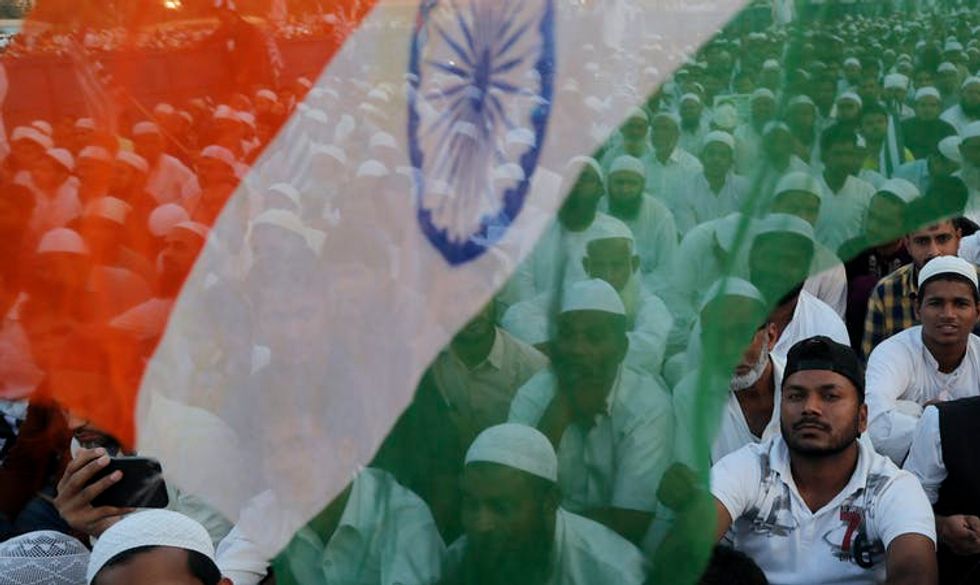
In December 2019, India passed the Citizenship Amendment Act, a law that allows the immigration of a range of minorities to India from Afghanistan, Bangladesh and Pakistan but bars Muslim migrants. Protests that erupted across the country in opposition to the new law have been brutally repressed by police.
Indian Muslims participate in a protest against a new citizenship law.
India is also drafting a National Register of Citizens, an effort to document all voting-age Indians that could in effect disenfranchise millions of poor minorities because of their inability to produce appropriate papers.
All of these policy initiatives have been undertaken since Prime Minister Modi was re-elected in April 2019. Several members of U.S. Congress, most notably U.S. Rep. Pramila Jayapal of Seattle, have been outspoken about India’s human rights challenges. But Trump has stayed silent – and he seems unlikely to break that silence on his first-ever official visit to India.
As I see it, Trump’s message is clear: As long as India opens up its markets to American products, and is willing to make common cause with the United States on some foreign policy issues, the shared commitment to democratic values and civil rights of minorities can be set aside.
As the coronavirus outbreak approaches global pandemic status, the financial markets started the week in the hole. In the case of the U.S. Stock Exchange, all of the gains for the year were erased in one day. But the cause isn't isolated to the deaths caused by the virus.
Axios reported Tuesday that the market tumble that President Donald Trump's precious economic bubble might be bursting.
Asset fund managers said coming into 2020 that the stock market would be less predictable, but would likely rise about 5 percent from the 2019 close.
"The most cited target was for the S&P 500 to end the year at 3300, a mark it had surpassed by Feb. 5," Axios said.
Investors bought into the idea that after Trump's trade war was resolved, everything would be fine.
"Despite warnings from economists that the U.S-China trade war could cause a global economic recession, investors have been buying rather than selling," Axios reported in May 2019. But the Trump tariffs made a huge impact, regardless of his reassurance. Stock traders, meanwhile, bought into the stability and claimed all was well, whether it will be or not.
At the National Association for Business Economics conference in Washington Monday, economists examined the idea of the coronavirus outbreak would cause a dramatic response to markets.
"Cleveland Fed President Loretta Mester just smiled and shook her head when I asked her about the market's nosedive during a cocktail reception last night," wrote Axios.
"It’s one day of a very strong reaction in the market," she said. "The Fed has to be forward-looking, and we have to just wait and see how things develop."
So, if the markets expected a slight dip from the threat of the virus, why was the so-called "dip" so significant? The opening bell was mere hours ago, but already the market is continuing its downward spiral, losing 200 points as of 10:30 a.m. EST.
On Tuesday, President Donald Trump took the stage in India for a solo press conference, during which he attacked two Supreme Court justices, lashed out at reporters, claimed that Democrats "loved" film producer and convicted sexual predator Harvey Weinstein, and lied about his motivations for replacing the Director of National Intelligence.
Commenters on social media slammed the president's chaotic and inflammatory remarks.
President Donald Trump's purge of disloyal staffers has Ukrainians concerned that Russia will ramp up its aggression.
Oleksandr Danylyuk, the former chairman of Ukraine's National Security and Defense Council, fears Russia will exploit a post-impeachment opening to ramp up its political influence operations against his country in their ongoing war, reported The Daily Beast.
In particular, Danylyuk is concerned that Trump's personal lawyer Rudy Giuliani is putting Ukraine at risk by strengthening administration ties to corrupt, Kremlin-linked politicians in Kyiv.
“Russia is getting more ambitious," Danylyuk told the website. "They are already taking an aggressive position. Putin knows what he wants and he does not need to seek approval for his actions inside Russia let alone outside of Russia."
Danylyuk worries that qualified experts on Ukraine-Russia relations have been driven out of the administration and replaced by inexperienced Trump loyalists -- if they were replaced at all.
“There are not enough people in the administration -- in the U.S. administration -- to focus on Ukraine and Russia issues," he said. "A lot of people left. It will not be easy to find several counterparts. I would expect sometime after the presidential elections the U.S. will have to compensate for that. They will have to find a very strong team to deal with this.”
Egypt’s ousted former president Hosni Mubarak has died at the age of 91, state television said on Tuesday, weeks after undergoing surgery.
The former Egyptian strongman was under house arrest since he was ousted on February 11, 2011 after three decades in power. Mubarak suffered from health problems following his ouster and arrest, and his medical state was the cause of several often contradictory reports. Earlier this week, his son, Alaa Mubarak tweeted that his son was still in an intensive care unit (ICU) weeks after undergoing surgery.
Until the day he stepped down, Mubarak kept an absolute grip on power with routine security crackdowns and human rights violations against opposition members, particularly the Muslim Brotherhood movement.
The last years of his presidential term were marked by growing opposition to his rule among Egyptians. In 30 years, conditions for Egypt’s working class failed to improve; in 2010, 44 percent of the population lived on less than two dollars a day. Accusations of fraud in the November 2010 legislative further damaged Mubarak’s public image.
By early 2001, Mubarak was unable to withstand 18 days of unprecedented protests in the Arab nation, during which hundreds of thousands of Egyptians took to the streets in the capital, Cairo, calling for his departure. Despite the violent crackdown on the demonstration, the protesters took over Cairo’s Tahrir Square -- which became the centre of the anti-regime movement -- until Mubarak stepped down.
A rapid political rise
Mubarak had studied to be a fighter pilot and after earning his degree in 1950, he rose through the military ranks until he was named Egypt’s Air Forces commander in 1972. Under his leadership, Egypt’s Air Force contributed significantly to the country’s early victories over Israel during the Kippur War in 1973. Mubarak was promoted to general shortly thereafter.
Mubarak was eyeing a diplomatic post as his next professional step when then president Anwar el Sadat decided otherwise, naming him vice president in 1975. “Mubarak was the ideal right-hand man: disciplined, hardworking, loyal, and without great ambition or charisma,” journalist Hicham Kassem wrote for French daily newspaper Le Monde in 2005. “Former US Secretary of State Henry Kissinger, who met him around that time, thought he had a minor staff job because he was so low-profile.”
For six years, Mubarak accompanied Sadat to meetings with foreign heads of state, both Arab and Western. Often, when Sadat was away, it was Mubarak who presided over cabinet meetings. One week after Sadat was assassinated by radical Islamists in 1981, Mubarak became president. He was 53 years old.
In terms of diplomacy, Mubarak was considered by many to be an accomplished head of state, as he was able to increase Egypt’s presence on the international stage. “One of Mubarak’s fundamental manoeuvres was succeeding in rallying Arab countries to the Americans in 1990 during the first Gulf war,” said Jean-Noel Ferrié, a political scientist and author of a book on Egypt. “It was a masterful move.”
Though Egypt did not recover the status of leader of the Arab world that it enjoyed under Gamal Abdel Nasser (who was president from 1952 to 1970), under Mubarak it nevertheless regained a role as a key player in the region. Most notably, Egypt began playing a crucial role in issues related to the Israeli-Palestinian conflict; Mubarak took on the role of mediator in indirect negotiations between the two sides as of 2005.
But the trust that Arab countries once placed in Mubarak ultimately faded. During Israel’s raid of the Gaza Strip between December 27, 2008, and January 18, 2009, Egypt refused to completely open the Rafah Crossing, which lies along the Egypt-Gaza border. Some 1,400 Palestinians were killed during the operation. “Mubarak continued Sadat’s policies of deferring to the US and Israel,” noted Ferrié. “Today, Egypt no longer has the aura it had before. On the regional stage, it has let Iran and Turkey take its place.”
Moving toward authoritarian rule
At the beginning of his term, Mubarak’s domestic policies seemed to be more flexible than those of his predecessor. He notably ordered the release of 1,500 members of the Muslim Brotherhood who had been imprisoned under Sadat. The move backfired when the Islamic organisation, allied with the Wafd opposition party, won four parliamentary seats in 1984. Fearing the emergence of a widespread Islamist movement in Egypt, Mubarak tightened his grip, imposing a repressive crackdown on the Muslim Brotherhood from 1990 to 1997. During this period, 68 Islamists were executed and 15,000 imprisoned.
Over the course of his term, Mubarak’s power was bolstered by an extensive police force and a political system dominated by his own party. The result was an opposition that was all but silenced. Mubarak was the only candidate in the presidential elections of 1987, 1993, and 1999, in which he got more than 95 percent of the votes. In 2005, however, faced with the growing dissatisfaction of the Egyptian people, he ordered the modification of the constitution so that multi-party elections could be held. The overture proved to be a façade -- for the election of that year, Mubarak’s party handpicked the candidates to go up against Mubarak, who, unsurprisingly, came away with 88 percent of the votes.
Mubarak’s authoritarian tendencies ultimately provoked his fall from power. In June 2012, the former Egyptian strongman was judged complicit in fatal acts of violence committed against protesters in Tahrir Square, which resulted in the deaths of around 846 civilians in January and February 2011. He was sentenced to life in prison for failing to prevent the killings. His lawyers appealed the verdict and a higher court later cleared them in 2014.
The acquittal stunned many Egyptians, thousands of whom poured into central Cairo to show their anger against the court. In March 2017, the ailing former military chief and president was released from prison.
Along with sons Alaa and Gamal, Mubarak was placed in temporary detention on April 13. He was also being investigated for corruption charges.
The last marshal of the Soviet Union Dmitry Yazov, who was a key player in the political turmoil that precipitated the collapse of the USSR, died in Moscow on Tuesday aged 95.
Yazov, who was then the Soviet Union's highest ranking military official, played a central role in the 1991 attempted coup against Mikhail Gorbachev and in the bloody repression of pro-independence uprisings in Lithuania.
Yet he remained a revered figure in Russia and was awarded military decorations by both Russian President Vladimir Putin and Defence Minister Sergei Shoigu.
"He was and will remain a legend," Shoigu said in a statement quoted by Russian news agencies, describing Yazov as "a brave, decisive fighter, wise, and a responsible commander."
The defence ministry said Yazov died following a "serious and prolonged illness".
Defence minister of the Soviet Union between 1987 and 1991, Yazov participated in the August 1991 coup attempt against Gorbachev.
The coup failed and its leaders were arrested three days later but the attempted overthrow heralded the collapse of the Soviet Union, which was finally dissolved in December 1991.
Yazov was released from prison in 1993 and granted amnesty in 1994.
His death leaves just one leader of the failed coup still alive, Oleg Baklanov, a member of the Communist Party's central committee.
Last year, Lithuania convicted Yazov in absentia along with more than 60 former Soviet officers for war crimes during a 1991 anti-Soviet uprising. Fourteen people were killed and hundreds injured in a crackdown on protests.
- Oversaw crackdowns -
"It took very long but he finally was given a proper verdict when he was charged and convicted," Lithuania's first post-Communist leader Vytautas Landsbergis told AFP on Tuesday.
Russia's foreign ministry slammed the 10-year jail term handed down by Lithuanian judges and accused the Baltic country of "falsifying obvious facts".
Yazov was also defence minster during crackdowns on pro-independence demonstrations in Azerbaijan in January 1990, which saw Soviet troops firing into crowds of protesters in Baku, killing hundreds.
Born in the Omsk region of Siberia in 1924, Yazov was a veteran of World War II and was injured twice. He wrote a number of books on military strategy and history.
On February 4, Shoigu awarded Yazov the "For Merit to the Fatherland" award for his work with veterans.
He was also decorated by Putin with the Order of Honor in 2004 and again on his 90th birthday with the Order Alexander Nevsky.
"We are proud to have you with us... and hope that you will continue to support us, to support young soldiers in their service to the fatherland," Putin said.




 AFP / JEAN-PHILIPPE KSIAZEK
  Iranian Presidency/AFP / -
  FARS NEWS AGENCY/AFP / MEHDI MARIZAD
  AFP / Jung Yeon-je
  AFP / Miguel MEDINA
  AFP / Laurence CHU