On Monday's edition of CNN's "OutFront," former Gov. John Kasich (R-OH) explained why he is bucking his party to speak in support of Joe Biden for president at the Democratic convention.
"The reason I didn't support Trump the last time is, I was afraid that he would be a divider and not a unifier," said Kasich. "Unfortunately, as I've watched him over the last three and a half years now, he's continued to do that. I don't think the country does well when we're divided. And so I had to search my conscience ... I believe we need a new direction. We just can't keep going the way that we're going."
"I am a conservative," Kasich added. "I believe Biden can bring us together ... I think he can restore civility and I don't think he'll go hard left. I think he is a pretty tough guy. So I'm comfortable with the fact that he would be our leader. And I expect he'll have Republicans that will be part of anything he does going forward. That's the way — that is his nature and has been history. And he is a man of deep faith, and a man that has suffered some tremendous grief that has shaped his character. All some of the things I will talk about in my speech."
"I'm clued into a lot of people of faith. A number of them ... are very happy that I'm making this decision," he added. "I consider myself to be a man of faith. A flawed man of faith, for sure, but aren't we all? ... A lot of people scratch their heads about why some of these very conservative evangelicals support Trump. It seems not to be consistent with the things that they believe in as promoted in the Old and New Testament."
At Monday's White House coronavirus briefing, President Donald Trump had barely started speaking — mainly discussing absentee ballot applications in Virginia and economic performance in the wake of his executive orders — when he received an unknown message from the Secret Service and cut everything short.
"What?" the president could be heard saying from the podium. After receiving the message, he promptly walked out with several aides, leaving behind a room full of confused reporters.
The president later returned and announced there had been an altercation just outside the White House grounds, that ended with a suspect shot by Secret Service agents.
One of the things that observers noticed with President Donald Trump’s campaign ads is that he’s no longer featured, instead only being included in the disclaimer that is legally mandated -- while there’s certainly no mention of the coronavirus.
During an MSNBC panel discussion Monday, stand-in host Chris Jansing noted that it has become clear that the Trump campaign still doesn't know how to message ads about the virus. Meanwhile, polls are showing former Vice President Joe Biden pulling ahead of Trump in key swing states like Pennsylvania and Michigan.
Jansing asked commentator Jason Johnson why Trump's campaign doesn't have all the grateful governors the president says are thanking him appearing in ads.
"Well, because he screwed it up, Chris," said Johnson. "He's doing such a terrible job that he can't even put -- look, here's the irony of this advertising campaign, okay? Donald Trump, who slaps his name on everything, he puts a T on every tower, puts his name on steaks, on diplomas, now he doesn't want to put his own face on his own commercials. That's how much his brand has been damaged throughout the course of his presidency over the last four years."
Johnson laughed that Trump has now moved to hide himself. It's a strange move after spending months claiming Biden was hiding in his basement.
"The last time we saw this is when Republicans didn't want to bring George Bush around during the 2008 convention," Johnson recalled. "Donald Trump is a toxic brand. Amongst his supporters, they love him, but he's so polarizing that he's now a galvanizing force for Democrats. At some point, you're going to have to show what you've accomplished. You can't just attack the other side and right now Donald Trump doesn't have much to show what he's accomplished."
Columnist A.B. Stoddard described it as more of the same of Trump's absence when it comes to the virus itself by denying and dismissing the existence of COVID-19 from the start.
The midwest is currently being hit by a devastating derecho.
Over 450,000 homes and businesses are without power in Nebraska and Iowa, The Weather Channel reported Monday.
"Residents in the Midwest felt the wrath of a derecho which left widespread damage and hundreds of thousands in the dark Monday afternoon," the network reported. "The severe storms marched eastward across Nebraska and Iowa, bringing wind gusts as high as 100 mph that easily downed large trees and caused some structural damage."
As the fast-moving storm heads east, it is threatening Chicago.
"A damaging derecho, or long-lasting, significant windstorm, was approaching the greater Chicago area Monday afternoon with widespread damaging winds and likely power outages," The Washington Postreported. "The National Weather Service Storm Prediction Center issued a rare 'particularly dangerous situation' severe thunderstorm watch for eastern Iowa, northern Illinois, extreme northwest Indiana, and southern Wisconsin, where 'scattered significant gusts to 100 mph' were 'likely.'”
Postings on social media showed the damage the storm has already inflicted -- and warnings of what may be yet to come:
White House Press Secretary Kayleigh McEnany insisted on Monday that President Donald Trump's executive actions are "a lot different" from executive actions taken by former President Barack Obama.
During her daily White House briefing, one reporter noted that Trump had taken executive actions on financial relief for COVID-19 despite his criticism of then-President Obama for taking executive actions prior to 2016.
"How are the president's actions this weekend any different from President Obama?" the reporter wondered.
"They are a lot different," McEnany replied. "When you consider the fact that President Barack Obama utilized executive orders to push forward policy that he denied that he had the right to push forward 23 times on DACA."
"I've already listed and enumerated the various legal authorities on the part of the president," she said, pointing to Trump's signature on the Cares Act, which did not give the president authority to create additional executive actions.
Law enforcement officers in Santa Clarita, California were seen on video pointing weapons at Black teens who were allegedly being threatened by a homeless man.
The video was posted by Instagram user Tammilaray.
"I wanted to share what happened to my son yesterday in SCV when he was with a couple of friends sitting at a bus stop headed home," the Instagram user explained. "He was attacked by a gentleman (homeless guy) who approached them and first asked them if they had any crack then tried to take their things."
According to the report, the manager of the nearby Buffalo Wild Wings called the cops to get help for the teens.
"'One' caller called the police and reported two black guys are attacking a homeless guy," Tammilaray said. "This is how the police responded. This is something my son and his friends will never forget. I’m still wonder how will I ever help my son recover from this traumatic experience. Please pray for my family. Please Share to protect our kids!!!"
The Los Angeles County Sheriff's Department told TMZ that they received a call about two adult males hitting another man with a skateboard. The department said the two teens were released and no arrests were made. "The Dept doesn't know what happened to the homeless man," TMZ added.
President Donald Trump announced Sunday night that Democrats were calling him begging for a deal on the stimulus after he signed a series of executive orders he claimed would take place of a legislative deal on a coronavirus stimulus package. But on Monday morning, Democrats said they weren't sure who called because it wasn't them.
MSNBC's Capitol Hill reporter Garrett Haake revealed that both Sen. Chuck Schumer (D-NY) and House Speaker Nancy Pelosi (D-CA) said that they haven't spoken to the president in a very long time. For Pelosi it has been over a year, since the last government shutdown where she humiliated him over a budget battle. Trump ultimately was forced to cave.
Trump seemed to accidentally reveal the truth in a Monday morning tweet in which he claimed again that Democrats were calling him, but he ended his tweet saying, "They know my phone number!" It was an apparent plea for them to call him.
If the executive orders were sufficient, as Trump claimed, then he wouldn't need a further "deal" with Democrats.
A massive explosion happened in Baltimore, Maryland Monday morning leaving at least five people trapped, including children.
Fox Baltimore reported that several houses were impacted. One person heard over the police scanner that there were "borderline mass casualty." Thus far, however, only one person was pronounced dead at the scene.
There are no facts about the cause of the explosion at this time, but firefighters are on the scene to attempt to rescue those trapped in the rubble. At least three homes exploded, according to witnesses, prompting speculation that it could have been a massive gas leak, but those reports were unconfirmed.
Former Republican presidential candidate Rick Santorum on Monday blamed former President Barack Obama after President Donald Trump took executive actions instead of negotiating a COVID-19 relief bill.
During an appearance on CNN's New Day program, host John Berman pointed out that Santorum had slammed Obama for the use of executive actions in 2014.
"How do you feel about it now when it's a Republican president?" Berman wondered.
"I would say, number one, some of the things the president is suggesting are proper use of executive action, like suspending the payroll tax temporarily," Santorum replied. "A couple of the executive actions are clearly fine. There's a couple that are not and I would say that President Obama has set the precedent, and that's the problem."
"But I'm giving you an opportunity to not be a hypocrite," Berman interrupted. "I just want to know, do you approve of the executive action?"
"No, I don't," Santorum insisted.
"Why don't you?" the CNN host pressed. "Why don't you approve of the action that President Trump -- this president -- took?"
"The action you just spoke of -- creating a new unemployment system -- is something that is under the purview of Congress and not for the president to be able to do," Santorum opined. "And just like when Barack Obama funded health insurance companies illegally, in my opinion, unconstitutionally, both are under the purview of Congress to appropriate that money. He can't just unilaterally do that."
Santorum went on to say that at least one Republican senator had condemned Trump's use of executive actions.
"You didn't see that at all on the Democratic side when President Obama did it," he added. "And he was the first to do it."
In the history of voter suppression in the United States – including attempts to stop Black and Latino people from voting – Republican tactics in the 1981 New Jersey gubernatorial race are worth highlighting.
That November, voters in several cities saw posters at polling places printed in bright red letters. “WARNING,” they read. “This area is being patrolled by the National Ballot Security Task Force.”
And voters soon encountered the patrols themselves. About 200 were deployed statewide, many of them uniformed and carrying guns.
In Trenton, patrol members asked a Black voter for her registration card and turned her away when she didn’t produce it. Latino voters were similarly prevented from voting in Vineland, while in Newark some voters were physically chased from the polls by patrolmen, one of whom warned a poll worker not to stay at her post after dark. Similar scenes played out in at least two other cities, Camden and Atlantic City.
Weeks later, after a recount, Republican Thomas Kean won the election by fewer than 1,800 votes.
Democrats, however, soon won a significant victory. With local civil rights activists, they discovered that the “ballot security” operation was a joint project of the state and national Republican committees. They filed suit in December 1981, charging Republicans with “efforts to intimidate, threaten and coerce duly qualified black and Hispanic voters.”
In November 1982, the case was settled when the Republican committees signed a federal consent decree – a court order applicable to activities anywhere in the U.S. – agreeing not to use race in selecting targets for ballot security activities and to refrain from deploying armed poll watchers.
The 2020 presidential election will be the first in nearly 40 years conducted without the protections afforded by that decree, which expired in 2018 after Democrats failed to convince a judge to renew it.
As a professor who teaches and writes about New Jersey history, I’m alarmed by the expiration because I know that Republicans in 1981 relied not only on armed poll watchers but also on a history of white vigilantism and intimidation in the Garden State. These issues resonate today in the midst of the Black Lives Matter movement and continued GOP attempts to suppress the 2020 votein numerous states.
Former U.S. Rep. John Lewis with House Democrats before passing the Voting Rights Advancement Act to eliminate potential state and local voter suppression laws, Dec. 29, 2019. The Senate has not taken up the bill.
Considered an early referendum on Ronald Reagan’s presidency, New Jersey’s 1981 gubernatorial race held special meaning for Republicans nationwide. Kean – with campaign manager Roger Stone at the helm – promised corporate tax cuts and relied heavily on Reagan’s endorsement.
To secure victory, state and national Republican party officials devised a project they claimed would prevent Democratic cheating at the polls.
In the summer of 1981, the Republican National Committee sent an operative named John A. Kelly to New Jersey to run the ballot security effort. Kelly had first been hired by the Republican National Committee in 1980 to work in the Reagan campaign, and he served as one of the RNC’s liaisons to the Reagan White House.
In August 1981, under the guise of the National Ballot Security Taskforce, Kelly sent about 200,000 letters marked “return to sender” to voters in heavily Black and Latino districts. Those whose letters were returned had their names added to a list of voters to be challenged at the polls on Election Day, a tactic known as voter caging.
In the Newark area, Kelly produced a list of 20,000 voters whom he deemed potentially fraudulent. He then hired local operatives to organize patrols, ostensibly to keep such fraud at bay. To run the Newark operation, he hired Anthony Imperiale.
Newark’s white vigilante
Imperiale, in turn, hired off-duty police officers and employees of his private business, the Imperiale Security Police, to patrol voting sites in the city.
The gun-toting, barrel-chested former Marine had first adopted the security role during Newark’s 1967 uprising – five days of protests and a deadly occupation of the city by police and the National Guard following the police beating of a Black cab driver. During the uprising, Imperiale organized patrols of his predominantly white neighborhood to keep “the riots” out.
Soon, Imperiale became a hero of white backlash politics. His opposition to police reform earned him widespread support from law enforcement. And his fight against Black housing development in Newark’s North Ward delighted many of his neighbors. By the end of the 1970s, Hollywood was making a movie based on his activities.
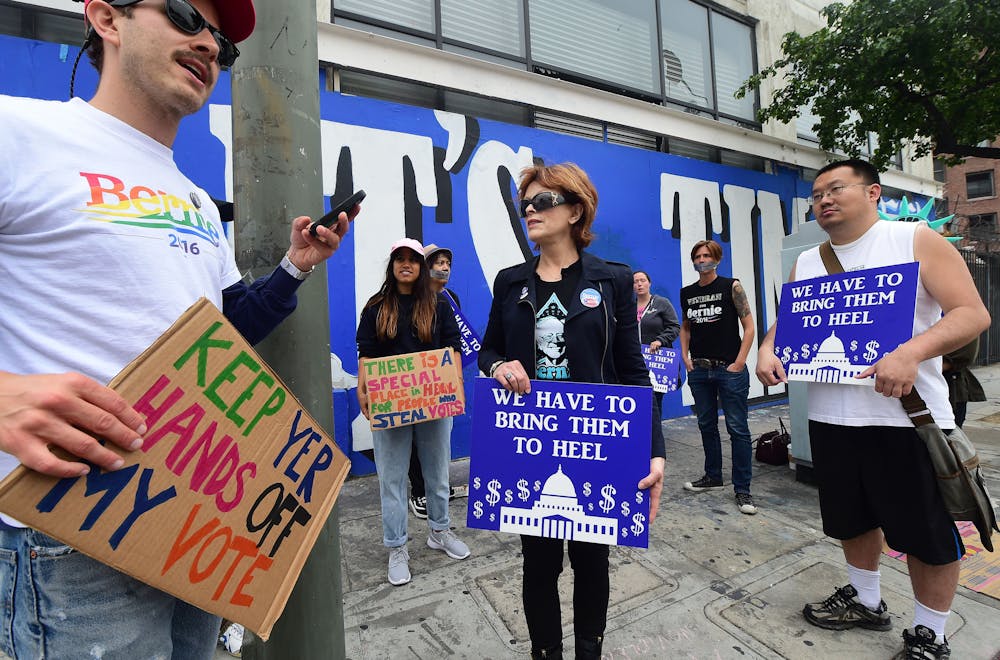
Actress Frances Fisher arrives to speak at a downtown rally in Los Angeles, California on May 19, 2016, to bring attention to voter suppression.
After serving as an independent in both houses of the state legislature, Imperiale became a Republican in 1979. Two years later, he campaigned with Kean. Once in office, the new governor named Imperiale director of a new one-man state Office of Community Safety – an appointment often interpreted as reward for Imperiale’s leadership of the ballot efforts in Newark, but stymied when Democrats refused to fund the position.
Rather, the state and national Democratic committees brought suit against the Republican National Committee to ensure it couldn’t again use such methods anywhere. For nearly 40 years – through amendments and challenges – the resulting consent decree helped curtailvoter suppression tactics.
Since the decree’s expiration in 2018, Republicans have ramped up their recruitment of poll watchers for the 2020 presidential election. Last November, Trump campaign lawyer Justin Clark – calling the decree’s absence “a huge, huge, huge, huge deal” for the party – promised a larger, better funded and “more aggressive” program of Election Day operations.
The Trump campaign is claiming, as Republicans did in 1981, that Democrats “will be up to their old dirty tricks” and has vowed to “cover every polling place in the country” with workers to ensure an honest election and reelect the president.
This November, Republican tactics in 1981 are worth remembering. They demonstrate that the safeguarding of polling places from supposedly fraudulent voters and of public places from Black bodies share not only a logic. They also share a history.
Appearing on MSNBC's " Morning Joe," Associated Press White House correspondent Jonathan Lemire explained Donald Trump's chances of being re-elected have reached the point where, if he loses the electoral votes of one more, he will be out of luck and out of office.
Speaking with co-host Joe Scarborough, Lemire was asked where Trump stands in the battleground states he so desperately needs.
"Both campaigns agree that there are six battleground states to decide this election: Pennsylvania, Wisconsin, Michigan, Arizona, North Carolina, Florida," he began. "Now the president has to play defense and has had to spend resources and had to go the past week to places like Ohio, Texas -- Georgia is another one where he has to play defense. We don't see, outside of perhaps New Hampshire, a place where Democrats have to do the same now that the Trump campaign has ceded Michigan."
"So they can afford to lose one more ... they can lose Wisconsin, Pennsylvania, but they have to win the rest of them," he added. "If they lose two the ball game is over, they can't get 270 electoral votes. They are concerned about where they stand in some of the states. Arizona in particular has been a place of worry for the president's team of late. That's a state hit hard by the coronavirus pandemic. It's not a coincidence that the president had the governor of Arizona here at the White House for an event last week where he talked about things getting better, played up how the federal government has stepped up for Arizona that was with an eye towards November. They can't win at all, and there's no path to victory without Florida -- they're trailing there but feel reasonably confident about Florida and North Carolina too. but it's the states: Pennsylvania and Wisconsin where they know they're down and need to reverse fortunes as quickly."
In particular, Rampell argued that the president's order to temporarily suspend payroll taxes with no guarantee of permanent relief will be a massive headache for businesses to navigate.
"This is going to be a nightmare," she said. "Remember, this is a payroll tax deferral, not a tax cut. That means that these taxes will ultimately need to be paid after 2020. And the real question is, who's left holding the bag?"
She said that it would be particularly difficult for businesses to decide whether they should withhold taxes from employee paychecks, as there's no guarantee that Congress will pass legislation forgiving them from having to pay back taxes when the payroll tax holiday ends.
"The alternatives are, employees will have to pay these tax bills that they were not anticipating some time next year when we may well still be in the middle of some kind of economic recession," she said. "This is money they haven't budgeted for or has been withheld from their paychecks. But most likely, based on the tax attorneys that I've consulted, what will happen is employers, their bosses will have to make good on those taxes."
A South Carolina woman this week was caught on video going on a wild rant about Jesus and communism after a police officer pulled her over because her anti-vaccination signs were completely obscuring her car's rear window.
The video shows that the woman was driving a car that was covered in signs that protested not just economic shutdowns, but also simply testing people for COVID-19.
After the officer pulled her over, she demanded to see his badge number and started yelling at him.
The officer tried to calm her down and told her there was no reason to be upset.
"Oh, no reason to get upset just because we're in communist Greenville, South Carolina?!" she yelled back. "I am not being disorderly! I have freedom of speech! You're being disorderly!"
The officer gave the woman his badge number, after which she complained that she was being given a citation for driving a car with an obstructed view thanks to the anti-vaxxer signs on the rear of the vehicle.
"Jesus is more powerful than you!" she yelled at the officer. "I'm on my last leg! Citation [for] $87 or my license [gets] suspended?! I'll see you in court... and I'll pray for you in the meantime!"