President Donald Trump on Monday criticized a move to change the name of the National Football League's franchise in Washington, D.C.
Trump made the remarks after the Washington team announced it was reviewing the controversial "Redskins" name.
"They name teams out of STRENGTH, not weakness," Trump wrote, "but now the Washington Redskins & Cleveland Indians, two fabled sports franchises, look like they are going to be changing their names in order to be politically correct. Indians, like Elizabeth Warren, must be very angry right now!"
Former NFL player Colin Kaepernick will partner with Disney for a series of programs "from the perspective of black and brown communities" including a docuseries on his own life, the company said Monday.
The deal with Kaepernick -- who launched kneeling protests during US national anthems to protest against police brutality and racial injustice -- will span Disney platforms including ESPN, Hulu and Pixar.
It will feature scripted and unscripted shows, including "an exclusive docuseries chronicling Kaepernick's journey" with unseen footage from the past five years, a Disney statement said.
Kaepernick has not played in the NFL since the 2016 season after starting his protest movement.
But the May death of unarmed black man George Floyd in police custody in Minnesota sparked global protests over police brutality and brought the Black Lives Matter movement into higher profile as Kaepernick had sought.
In the statement, Kaepernick said he aimed to "elevate Black and Brown directors, creators, storytellers, and producers, and to inspire the youth with compelling and authentic perspectives."
The Walt Disney Company announced the multi-project deal to "explore race, social injustice and the quest for equity" with Kaepernick's production company Ra Vision Media.
"Colin's experience gives him a unique perspective on the intersection of sports, culture and race," said Disney executive chairman Bob Iger.
The deal follows a separate, scripted six-part drama announced by Netflix last week, which will focus on Kaepernick's high school years and be narrated by the former NFL star.
Kaepernick played six seasons for San Francisco, leading the 49ers to the 2013 Super Bowl, where they lost to Baltimore. After a coaching change for the team, Kaepernick opted out of his contract in March 2017 but has remained unsigned since then.
In September 2017, US President Donald Trump intensified the controversy over the kneeling protest, calling anyone kneeling during the anthem "sons of bitches."
A California megachurch pastor allowed his youngest son to continue volunteer work with children despite confessing a sexual attraction to minors, until he was outed by his older brother.
The younger son of Rev. John Ortberg, pastor of Menlo Church, confessed the unwanted thoughts to his father in summer 2018, but his father assured him that he'd never acted on his attraction and allowed him to continue volunteer work coaching an Ultimate Frisbee team for high school students, reported Religion News Service.
Ortberg prayed for his son and offered a referral for counseling, but did not notify the church's elder board.
The elder board remained in the dark until the pastor's other son, Daniel Lavery, sent an email to church leaders in November 2019 and then publicly broke with his parents.
Lavery did not reveal his reason for the split until June, saying church elders had not conducted the “robust, thorough inquiry” they had promised, and then outed his younger brother John “Johnny” Ortberg III.
The pastor took a leave of absence after the allegations were first made and was reprimanded by the San Francisco-area church, and had returned to the pulpit after a brief restoration process.
The relationship between Lavery and his brother became strained after Lavery came out as transgender in 2018, and he hoped to reconcile by inviting their sister to a siblings meeting in fall 2019.
Lavery said the meeting started out well, but his brother admitted that he had told their parents and sister about his attraction to children.
“It was then I learned the reason my brother had been avoiding me was not only because of my transition, but it was because everyone else in the family knew that he was a pedophile," Lavery said, "and I didn’t."
Lavery was concerned that his brother continued working with children and called himself a "virtuous pedophile" because he never acted on that attraction, and felt that his father was placing innocent children in danger.
“I became convinced that my parents do not have my brother’s best interests at heart,” Lavery said.
White House Press Secretary Kayleigh McEnany on Monday insisted that President Donald Trump has not expressed support for the Confederate flag even though he complained about NASCAR banning the symbol.
At a White House briefing, McEnany was asked about Trump's tweet claiming NASCAR's ratings had faltered because it banned the Confederate flag.
"Why is the president so supportive of flying the Confederate flag?" NBC's Peter Alexander wondered.
"I think you're mischaracterizing the tweet," McEnany replied. "The tweet was aimed at pointing out that the FBI report of the alleged hate crime at NASCAR concluded that the garage door pull which had been there since last fall was obviously not targeted at a specific individual because, in fact, it was a garage pull."
Alexander pointed out that his question had been about the president's support for the Confederate flag.
"The president never said that," McEnany shot back. "Again, you're taking his tweet completely out of context."
"The president said that NASCAR saw bad ratings because they took down the Confederate flag," Alexander observed. "Does he believe NASCAR should fly the Confederate flag and why don't they fly it here?"
"The flag was mentioned in the broader context that he rejects that NASCAR men and women who go to these sporting events are racist," McEnany opined. "When in fact, as it turns out, what we saw with the FBI report in the alleged incident of a hate crime, it was a complete indictment of the media's rush to judgment."
ABC's Jonathan Karl followed up by asking McEnany to clarify if the president believes NASCAR made a mistake by banning the Confederate flag.
"He said he was not making a judgement one way or the other," McEnany asserted. "The intent of the tweet was to stand up for the men and women of NASCAR and the fans."
A video showing a woman making racist comments on Saturday at a protest in Elizabethton, Tennessee, has garnered hundreds of thousands of views on social media. According to the Johnson City Press, the woman has been identified as Sonya Holt, and she can be seen in the video yelling “white lives matter" and “white lives are better” and making homophobic remarks to protesters.
At one point in the video, Holt tells a Black woman that she is “just a poor little Black girl with a messed up mind.”
A spokesperson at the company where Holt was previously employed said she no longer works there as of Monday morning.
"[Holt's] remarks were one of the most visual instances of verbal salvos hurled at Black Lives Matter protestors during Saturday’s demonstration, with several referring to protestors as 'monkeys,' and another man, seen on the same video as Holt, told protestors 'we should have kept you (expletive) as slaves.'" the Johnson City Press reports.
Harrington claimed that the idea is an assault on the Declaration of Independence, which says that all "men" are created equal.
"It's amazing for Joe Biden to talk about eroding our foundation when his party is taking a sledgehammer to it," Harrington complained. "They are saying you can't go to Mt. Rushmore, you can't celebrate Washington, Jefferson and Lincoln."
"His party is trying to rewrite history and tear it all down," she continued. "And it's very fitting that Joe Biden, in this op-ed, has the audacity to literally rewrite the greatest foundational document in this history of mankind, the Declaration of Independence."
"His woke staffers changed it to -- not 'all men are created equal' -- all people are created equal," the RNC spokesperson said, "and all people are guaranteed equality throughout life."
According to Harrington, "That is not a constitutional republic."
"That's the same radical left socialism that has taken over his party," she added. "That is really not just eroding our foundation, but rewriting it and out to destroy it."
"If the events of 2020 have taught us anything, it's that health and justice must be prioritized early on in any decision-making process if we want to avoid a crisis later on."
A U.S. district court on Monday delivered a major win to local Indigenous organizers and climate activists—and a significant blow to the fossil fuel industry and the Trump administration—by ordering the Dakota Access Pipeline to be shut down and emptied of oil by Aug. 5 while federal regulators conduct an environmental review of the project.
"Today is a historic day for the Standing Rock Sioux Tribe and the many people who have supported us in the fight against the pipeline."
—Mike Faith, Standing Rock Sioux Tribe
DAPL, as the Energy Transfer Partners (ETP) pipeline is widely known, transports crude oil from North Dakota's Bakken shale basin to a terminal in Illinois. The pipeline has gained international notoriety in recent years due to protests—particularly on and around the Standing Rock Indian Reservation—by environmentalists and Native Americans who live along the route.
The Monday decision by D.C.-based District Judge James E. Boasberg comes after four years of litigation brought by the Standing Rock Sioux, Cheyenne River Sioux, and others against the U.S. Army Corps of Engineers for allowing ETP to construct and operate the pipeline beneath Lake Oahe, a dammed portion of the Missouri River near the reservation.
The Obama administration denied permits for DAPL to cross the river in December 2016, but President Donald Trump signed an executive order advancing the project shortly after taking office in January 2017. The pipeline was completed and operating within months.
Boasberg's move to shut down DAPL was welcomed by critics of the pipeline.
"Today is a historic day for the Standing Rock Sioux Tribe and the many people who have supported us in the fight against the pipeline," chairman Mike Faith of the Standing Rock Sioux Tribe said in a statement. "This pipeline should have never been built here. We told them that from the beginning."
"It took four long years, but today justice has been served at Standing Rock," added Earthjustice attorney Jan Hasselman, who represents the tribe. "If the events of 2020 have taught us anything, it's that health and justice must be prioritized early on in any decision-making process if we want to avoid a crisis later on."
In a separate statement, the Indigenous Environmental Network (IEN) delcared, "We are celebrating this order as it vindicates the many prayers, actions, and legal arguments of Oceti Sakowin tribal nations and communities!"
"The Standing Rock and Cheyenne River Sioux Tribes have shown the world that treaty rights and environmental justice are not token concepts without merit, but rather tangible arguments that inherently protect the sacredness of mother earth," IEN said. "We will continue to fight until DAPL is stopped completely "
Boasberg's order Monday followed his finding in March that the Corps had violated the National Environmental Policy Act (NEPA) when approving federal permits for DAPL. The Corps is expected to finish it full court-ordered Environmental Impact Statement (EIS) for the pipeline by mid-2021.
The decision to temporarily shut down DAPL came just a day after two energy companies cancelled the Atlantic Coast Pipeline (ACP) that would have transported fracked gas through West Virginia, Virginia, and North Carolina—a move that activists called a "historic victory for clean water, the climate, public health, and our communities."
"These monumental defeats for the fossil fuel industry are a clear sign that bold community opposition, strategic legal challenges and state-level clean energy legislation are all working together to thwart the Trump administration's pro-polluter agenda," Food & Water Action policy director Mitch Jones said in a statement Monday, referencing both the DAPL decision and the ACP cancellation.
"The campaign to stop the Dakota Access pipeline, led by Indigenous groups whose water would have been directly impacted by that filthy project, inspired and emboldened climate activists across the country," Jones continued. "The Trump White House can boast and bluster all it wants, and corporate behemoths can scheme to take advantage of the administration's fondness for fossil fuels, but they are no match for determined grassroots opposition movements fighting for environmental justice and an end to the degradation of our air, water and climate."
"Today's ruling—arriving on the heels of the Atlantic Coast Pipeline victory—may be a calamity for oil and gas executives looking to profit from the disastrous climate crisis, but it's a huge win for those of us committed to a liveable world."
"Fossil fuels are dying," he added, "and there is little that Donald Trump can do to save them."
Greenpeace USA climate director Janet Redman called the DAPL shutdown a "huge victory for the courageous members" of the Standing Rock Sioux Tribe and allied activists "who fought to protect their land, their water, and their right to a healthy and safe future."
"This is as much a victory for human rights and Indigenous sovereignty as it is for the climate," Redman said in a statement Monday before also connecting the two wins.
"Energy Transfer's Dakota Access Pipeline and other environmentally reckless fossil fuel infrastructure projects will only make billionaires richer while the rest of us suffer," Redman said. "Today's ruling—arriving on the heels of the Atlantic Coast Pipeline victory—may be a calamity for oil and gas executives looking to profit from the disastrous climate crisis, but it's a huge win for those of us committed to a liveable world. A just transition to renewable energy is not only the future, it is the only responsible choice for today."
"The past 24 hours," she added, "have sent a loud and clear message to fossil fuel corporations still committed to constructing dangerous pipelines—the future does not belong to you."
This post has been updated with comment from Indigenous Environmental Network and Greenpeace USA.
A group of seven "highly intoxicated" white men were arrested at an Oregon beach over the weekend after they harassed a Black family by yelling racial slurs and making Nazi salutes.
The Oregonian reports that Lincoln City Police officers were called to the beach in front of the Inn at Spanish Head on Saturday night amid reports that a group of men were setting off illegal fireworks.
Upon arriving at the scene, the officers formed a barricade between the men and the Black family they were harassing, allowing the family to safely leave the area.
The presence of the police, however, only seemed to make the men even rowdier.
"Members of the group, who police said were 'highly intoxicated,' then began taunting the officers, challenging them to a fight and setting off illegal aerial fireworks," The Oregonian reports.
The seven men were subsequently charged with riot, interfering with police, disorderly conduct, harassment, possession of illegal fireworks and offensive littering.
Sen. Lindsey Graham (R-SC) broke with President Donald Trump attack on NASCAR driver Bubba Wallace.
The president called on Wallace to apologize, after the racing association investigated a noose found in his garage -- which turns out to have been placed there long before Wallace started using the facility.
"I don't think Bubba Wallace has anything to apologize for," Graham told Fox News Radio's Brian Kilmeade. "I do say this about the drivers, even though it was a noose created to hold the door open, in the times in which we live, there's a lot of anxiety, so what did you see? You saw the best in NASCAR. When there was a chance that it was a threat against Bubba Wallace, they all rallied to Bubba's side, so I would be looking to celebrate that kind of attitude more than being worried about it being a hoax."
Graham also credited NASCAR for banning Confederate flags from races.
"NASCAR made a decision to ban the Confederate flag inside the infield and NASCAR arenas," the senator said. "They're trying to grow the sport. I've lived in South Carolina all my life and, if you're in business, the Confederate flag is not a good way to grow your business. The idea that Bubba Wallace, who is I think the only African American driver, was upset by somebody finding a noose in the garage made perfect sense to me. So what I would tell people from outside of South Carolina that NASCAR is trying to grow the sport, and one way you grow the sport is you take images that divide us and ask that they not be brought into the venue. That makes sense to me.
A videouploaded to YouTube this weekend shows a confrontation in Northern California's Marin County between a white woman and an Asian American family on a hiking trail, where the woman told the family they "can't be in this country" after scolding them for having a dog on the trail.
"We decided to take a family hike through a trail in the woods about an hour from our house," the video's uploader wrote in the bio. "We brought our 11 pound Maltipoo with us. Along the hike, we saw several other hikers with their dogs. Everything was fun and friendly. People were saying 'Hello' and practicing social distancing by letting others pass when we crossed paths. After a long hike, we were headed back down the mountain to our car."
That's when they saw a woman and her husband approach.
"The husband passed, but the lady just stood there. So we continued walking. Our 11 year old daughter was in front with our dog on the leash. The lady aggressively stepped in front of our daughter and blocked her path. She began telling our daughter that we were breaking the law. My wife, who was behind our daughter asked what was going on, and the lady told us to turn around and go back to where we came from...more strangeness then ensues."
Worse yet for the president is that it is not sustainable and, with a cratering economy and pandemic tearing through the country on his watch, there is nothing left for his campaign to run on.
"If left-wing mobs are attacking the country, why doesn’t/hasn’t Trump done something about it? He’s president after all," she wrote before adding, "Does Trump have a plan (beyond statues) to address this non-problem?"
Rubin goes on to note that Trump's portrait of the U.S. under attack by homegrown radicals is belied by videos of American's peacefully protesting across the country ("Since no significant violence is perceptible, how does he sustain the illusion that his followers are under siege?") before sarcastically stating, "Watching a crowd tear down a Confederate monument or two is not exactly bloodcurdling."
Added to that, she wrote, are issues that the public, according to polls, really care about: the increasing COVID-19 death toll and massive unemployment.
"Why should Americans care about statues when some 127,000 people are dead from covid-19 and unemployment is in double digits? His obsession seems especially bizarre given that the country is experiencing actual carnage thanks to his incompetent response," she wrote, before pointing out that no Republicans currently running for in November seem eager to appear with him and that it is only a matter of time before some of Trump's "donors and surrogates" cut ties with him under pressure over his racist rhetoric.
"The country is different. The electorate is different. And the rhetoric of subversion, violence and fear does not really work when you are the one in power and responsible for keeping Americans secure and safe. And on that score, voters are all too aware that Trump has not kept them safe from death, sickness or economic distress," she explained before concluding, "Trump’s bet that Americans are racist and oblivious is a poor one."
Two public health measures – testing, to identify those infected, and contact tracing, to identify those who may have encountered an infected person – have become essential as countries around the world reopen their economies and fresh surges of COVID-19 infections appear.
Even as testing ramps up, contact tracing with a wide enough net remains a daunting task. Contact tracing involves public health staff conducting interviews with infected people. Public health experts are calling for 180,000 more contact tracers, but progress on contact tracing has not been going well, according to Dr. Anthony Fauci, the head of the National Institute of Allergy and Infectious Diseases.
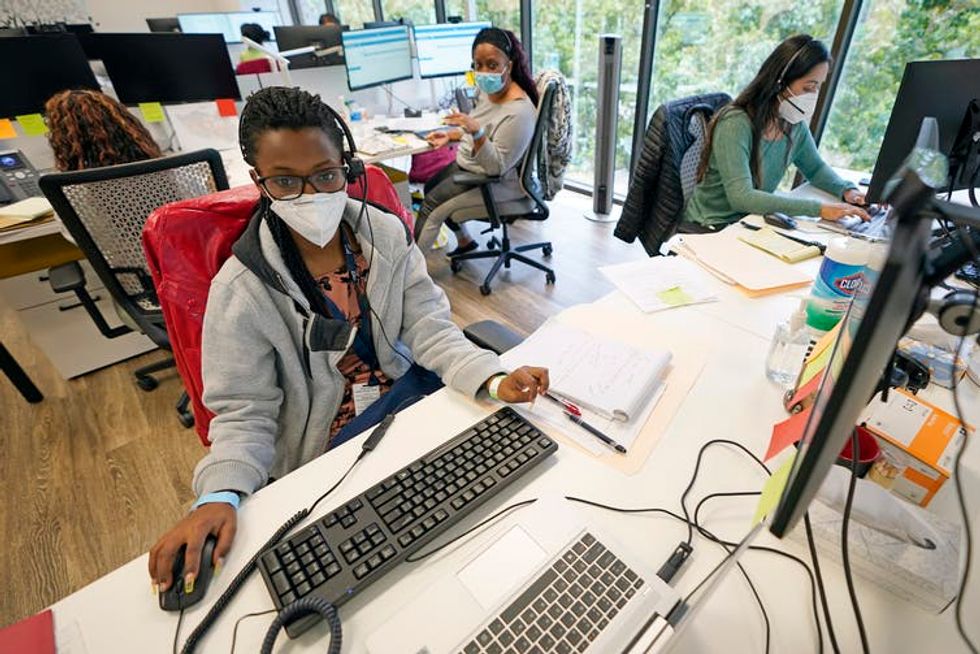
Contact tracers work at Harris County Public Health contact tracing facility in Houston, Texas.
Enter digital innovations that offer a tantalizing promise: to automate the laborious task of alerting people who have been exposed to the virus. Numerous governments have championed such apps as a means of augmenting manual contact tracing. As an economist who tracks digital technology’s use worldwide, I’ve found that the experiences of these countries reveal challenges to getting enough people to use the apps. Unfortunately, these challenges appear to me to be all but insurmountable in the U.S.
Privacy and trust
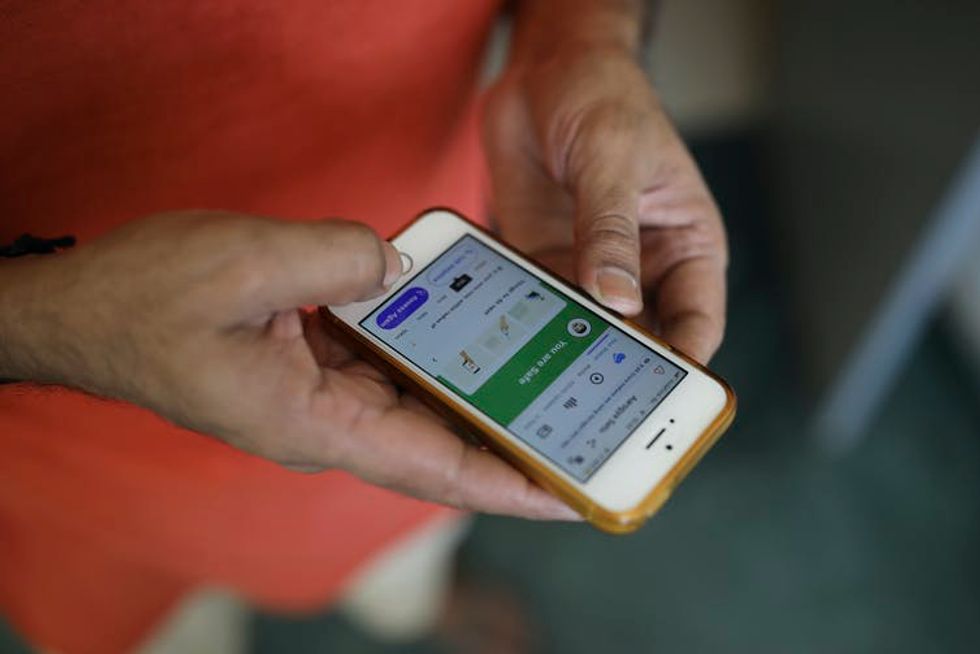
Contact tracing apps detect when a smartphone is in the presence of another app-enabled smartphone whose owner has tested positive for SARS-CoV-2.
These apps come in two types. One mimics traditional contact tracing by uploading to a central public health server the ID numbers of smart phones that have been close to an infected person’s smart phone. Depending on the app, public health authorities can be notified of the smart phone owners’ identities.
The alternative is an “exposure notification” app that prioritizes privacy by using random numbers to ensure that no one can learn anyone else’s identity. All data are stored on the users’ phones. The Apple-Google collaboration supports these types of apps.
[The Conversation’s newsletter explains what’s going on with the coronavirus pandemic. Subscribe now.]
South Korea’s, India’s and Germany’s experiences suggest a three-question test for gauging the potential of such apps: Does the government have its citizens’ trust, leading citizens to believe that the government is not collecting data or, if it is, will not misuse it? Are citizens willing to “pay” for improved health outcomes by accepting some loss of privacy? Are there events in the nation’s history that help shift the balance in favor of citizens’ willingness to share data?
Arguably, it has one of the most intrusive digitally aided tracking systems anywhere. The system shares locations of infected people, even with the media, and issues emergency text alerts.
All of this was widely accepted, except when intrusion crossed a line. When a COVID-19 cluster was linked to gay clubs and bars and led to calls to out people who visited such establishments, it raised concerns about discrimination against the LGBTQ community. The government stopped singling out particular clubs or bars in its alerts.
Why were Koreans willing to tolerate this level of official intrusion? The explanation can be traced to the country’s history. The previous administration had botched its response to the 2015 MERS outbreak, when it shared no information about hospitals visited by infected citizens. This led to public support for legislation giving health authorities access to CCTV and smartphone location data on infected citizens and the right to issue alerts.
India: partially mandated adoption
In preparation for reopening post-lockdown, the Indian government declared its Aarogya Setu contact tracing app to be mandatory for office workers, with police enforcement in some cases. But then, concerns mounted. The app had few privacy safeguards. It collected data using both GPS and Bluetooth technologies, stored it in centralized servers with no data protection law in place.
A man uses India’s Aarogya Setu contact tracing app on his mobile phone in New Delhi.
In response, the government switched the app from mandatory to “advisable,” with enough loopholes for organizations to set individual mandates. In addition, the app was uploaded to a public GitHub repository, which, in principle, opens the app – though not the data it collects – to public scrutiny.
Ironically, Prime Minister Narendra Modi enjoyed overwhelming public support even as the country endured the most stringent of lockdowns anywhere, with unspeakable hardships for many. However, the app stored citizens’ data on centralized servers, which compounded fears of digitally enabled state surveillance. Also, the app had been co-created by a ministry headed by Modi’s lieutenant, Amit Shah, who has a troubling history of abuse of power. All this made voluntary adoption difficult.
This U-turn occurred despite widespread confidence in Chancellor Angela Merkel, especially with her administration’s handling of the coronavirus response. Again, history provides a guide. Germans have lived through two notorious surveillance regimes: the Gestapo during the Nazi era and the Stasi during the Cold War.
Even with a decentralized, privacy-protecting approach, Germany’s new app is unlikely to achieve the level of adoption of South Korea’s. However, the government’s investment in an effective traditional contact tracing approach using public health staff to investigate contacts makes a digital alternative less urgent.
Prospects for digital contact tracing in the US
What do these cases say about adoption of digital contact tracing in the U.S., which leads the world in COVID-19 cases and deaths?
There is also no cohesive nationwide plan to deploy such apps. The White House, federal agencies and state governments have failed to champion them, which means that adoption rates are likely to be low and people won’t see enough value in using them to risk their privacy. Apps may appear in pockets – companies, college campuses, local communities – creating a fragmented, unreliable system of digital contact tracing.
In short, the U.S. is left relying almost entirely on tried-and-true though time-consuming and expensive manual contact tracing. As it stands, only seven states and the District of Columbia have sufficient numbers of contact tracers. Compliance is another challenge. Officials in Rockland County, New York have issued subpoenas to force people to cooperate with contact tracing efforts.
Ironically, the U.S. may need digital contact tracing more than any other country but appears to me likely to turn its back on the very lifesaving innovations it has helped develop.
President Donald Trump's campaign is making a solemn vow to supporters that he will never allow the destruction of iconic statues located in foreign countries.
The Daily Beast reports that the Trump campaign over the weekend sent out a new ad featuring a photo of the Cristo Redentor in the Brazilian city of Rio de Janeiro and informed supporters that "WE WILL PROTECT THIS."
The Cristo Redentor is perhaps the most famous landmark in all of Brazil, but apparently no one on the Trump campaign realized that the statue was not located in the United States.
"There’s no indication that the 125-foot sculpture, which sits at the peak of Corcovado mountain overlooking Rio, is at risk of vandalism or removal," The Daily Beast notes. "It’s also not clear how Trump or Pence might go about protecting it if it were threatened, which, again, it does not appear to be."
In addition to his promises to protect statues of Jesus, Trump has also vowed to defend monuments dedicated to Confederate generals, and on Monday the president criticized NASCAR for banning its drivers from displaying the Confederate flag on their vehicles.